Loading...
Done
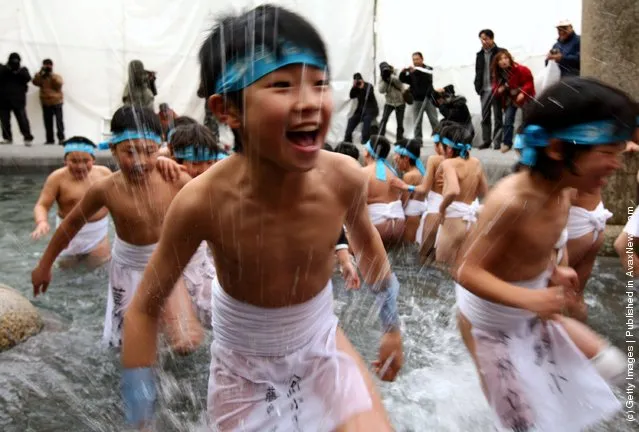
Japanese children wear loincloths as they splash about in freezing cold water during Saidaiji Naked Festival, at Saidaiji Temple

“A Hadaka Matsuri (“Naked Festival”) is a type of Japanese festival, or matsuri, in which participants wear a minimum amount of clothing; usually just a Japanese loincloth (called fundoshi), sometimes with a short happi coat, and rarely completely naked. Whatever the clothing, it is considered to be above vulgar, or everyday, undergarments, and on the level of holy Japanese shrine attire. Naked festivals are held in dozens of places throughout Japan every year, usually in the summer or winter. The most famous festival is held in Okayama, where the festival originated. Every year, over 9,000 men participate in this festival”. – Wikipedia

Photo: Japanese men wear loincloths as they splash about in freezing cold water during Saidaiji Naked Festival, at Saidaiji Temple on February 18, 2012 in Okayama, Japan. (Photo by Buddhika Weerasinghe/Getty Images)
Details
19 Feb 2012 12:18:00
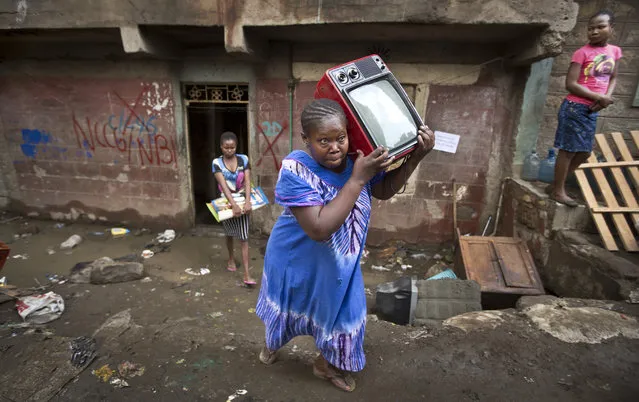
A woman leaves with her television set, as she and others are evicted from their apartment blocks close to the site of last week's building collapse, after their homes were deemed unfit for habitation and marked for demolition, in the Huruma neighborhood of Nairobi, Kenya Friday, May 6, 2016. (Photo by Ben Curtis/AP Photo)

A woman leaves with her television set, as she and others are evicted from their apartment blocks close to the site of last week's building collapse, after their homes were deemed unfit for habitation and marked for demolition, in the Huruma neighborhood of Nairobi, Kenya Friday, May 6, 2016. Following a building collapse which claimed at least 40 lives with more 80 people still unaccounted for, after severe flooding, the government has ordered the demolition of similar unsafe buildings in the area. (Photo by Ben Curtis/AP Photo)
Details
07 May 2016 13:22:00
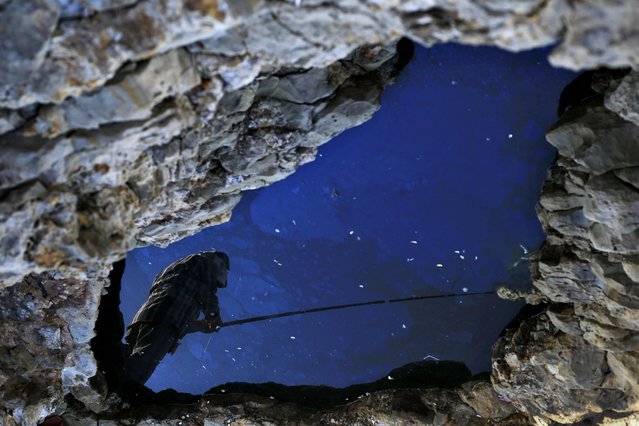
A Lebanese man is reflected in a pool of dirty water as he casts his fishing pole from a rocky coastal area along the Beirut coastline, Lebanon, Monday, October 3, 2016. (Photo by Hassan Ammar/AP Photo)

A Lebanese man is reflected in a pool of dirty water as he casts his fishing pole from a rocky coastal area along the Beirut coastline, Lebanon, Monday, October 3, 2016. (Photo by Hassan Ammar/AP Photo)
Details
28 Oct 2016 10:42:00
Stunning images have revealed ice-cool British tourists chilling out inside Europe’s largest glacier – despite being at risk of flooding. The spectacular collection of images show the explorers braving the freezing temperatures to climb, photograph and even abseil down the inside of the icy cliff sides. Another image shows one visitor on his knees appearing to pray next to a water fall of melted ice. Other glistening shots show an adventurer trying to keep warm by a fire whose flames dance beautifully against the glossy roof. More shots show the caves sparkling like crystal with one ice formation appearing to resemble bubble wrap. In one picture, a brave tourist stands at the edge of a river flowing through the centre of the frosty caves. (Photo by Einar Runar Sigurdsson/Mediadrumworld.com)

Stunning images have revealed ice-cool British tourists chilling out inside Europe’s largest glacier – despite being at risk of flooding. The spectacular collection of images show the explorers braving the freezing temperatures to climb, photograph and even abseil down the inside of the icy cliff sides. Another image shows one visitor on his knees appearing to pray next to a water fall of melted ice. Other glistening shots show an adventurer trying to keep warm by a fire whose flames dance beautifully against the glossy roof. (Photo by Einar Runar Sigurdsson/Mediadrumworld.com)
Details
03 Dec 2016 11:36:00
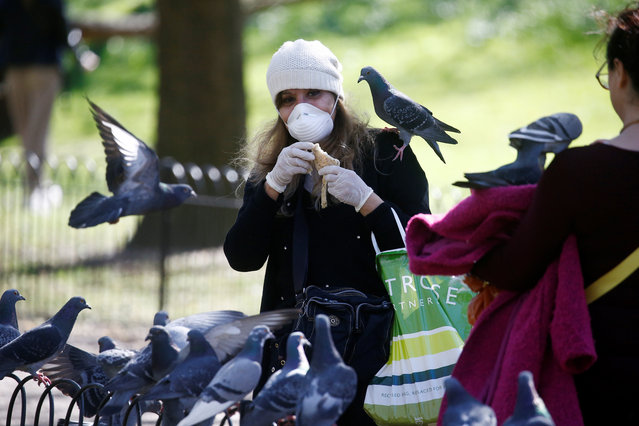
A lady wearing a mask feeds pigeons in St James' Park, as the spread of the coronavirus disease (COVID-19) continues, London, Britain, April 5, 2020. (Photo by Henry Nicholls/Reuters)

A lady wearing a mask feeds pigeons in St James' Park, as the spread of the coronavirus disease (COVID-19) continues, London, Britain, April 5, 2020. (Photo by Henry Nicholls/Reuters)
Details
07 Apr 2020 00:07:00
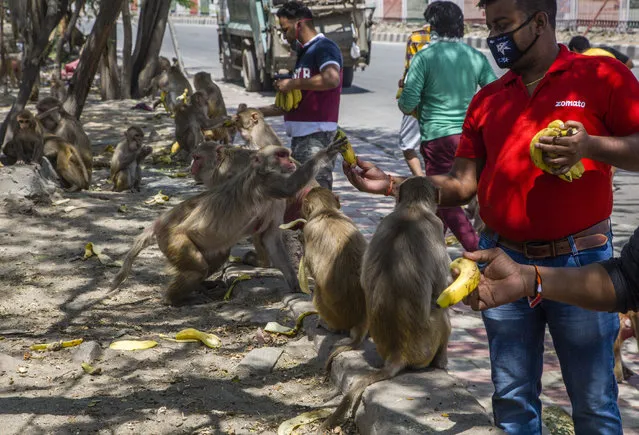
Men give bananas to monkeys gathered on the side of the road as India remains under an unprecedented lockdown over the highly contagious coronavirus (COVID-19) on April 08, 2020 in New Delhi, India. Wild animals, including monkeys, are roaming human settlements in India as people are staying indoors due to the 21-day lockdown. With India's 1.3 billion population and tens of millions of cars off the roads, wildlife is moving towards areas inhabited by humans. Wild animals in many countries have been seen roaming streets. A study says some 60 percent of the new diseases found around the globe every year are zoonotic, meaning they originate in animals and are passed on to humans. COVID-19 is a zoonotic disease that is suspected to have come from the wet markets of Wuhan, China. (Photo by Yawar Nazir/Getty Images)

Men give bananas to monkeys gathered on the side of the road as India remains under an unprecedented lockdown over the highly contagious coronavirus (COVID-19) on April 08, 2020 in New Delhi, India. Wild animals, including monkeys, are roaming human settlements in India as people are staying indoors due to the 21-day lockdown. (Photo by Yawar Nazir/Getty Images)
Details
12 Apr 2020 00:05:00
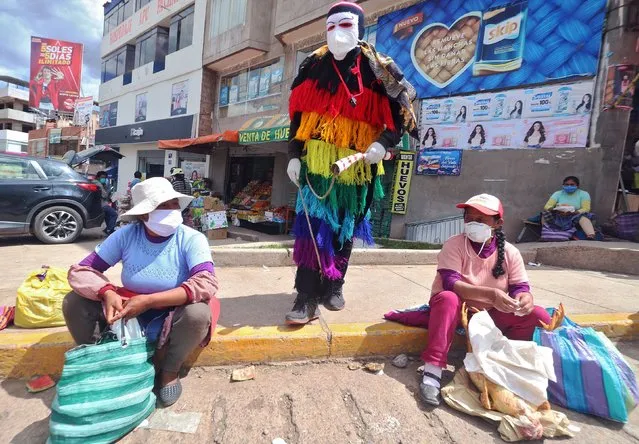
A man dressed in Andean attire as “Ukukus” or “Pabluchas”, a traditional character that acts as a vigilante imposing social order, uses a whip as a threat to force people to maintain their distance and remind them to wear face masks and gloves as a preventive measure against the novel coronavirus COVID-19, in the Vinocanchon market area in San Jeronimo district, close to the Peruvian Andean city of Cusco, on May 2, 2020. The government has identified public markets as major hotspots of the new coronavirus in Peru, where 40,459 confirmed cases and 1,124 deaths were reported on May 1. (Photo by Jose Carlos Angulo/AFP Photo)

A man dressed in Andean attire as “Ukukus” or “Pabluchas”, a traditional character that acts as a vigilante imposing social order, uses a whip as a threat to force people to maintain their distance and remind them to wear face masks and gloves as a preventive measure against the novel coronavirus COVID-19, in the Vinocanchon market area in San Jeronimo district, close to the Peruvian Andean city of Cusco, on May 2, 2020. The government has identified public markets as major hotspots of the new coronavirus in Peru, where 40,459 confirmed cases and 1,124 deaths were reported on May 1. (Photo by Jose Carlos Angulo/AFP Photo)
Details
04 May 2020 00:07:00
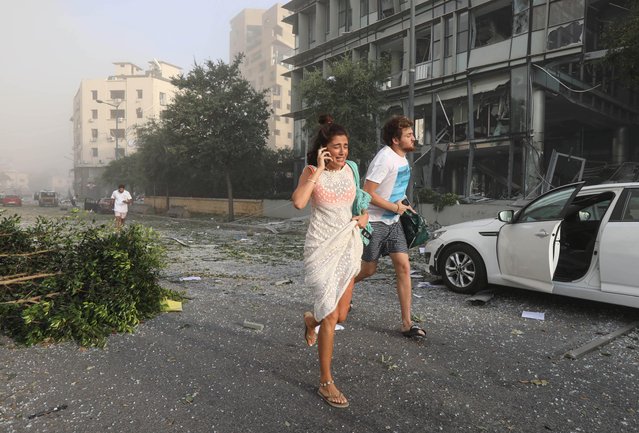
People run for cover following an explosion in Beirut's port area, Lebanon on August 4, 2020. (Photo by Mohamed Azakir/Reuters)

People run for cover following an explosion in Beirut's port area, Lebanon on August 4, 2020. A mega-blast tore through the harbour in the heart of the Lebanese capital with the force of an earthquake, killing more than 100 people and injuring over 4,000. (Photo by Mohamed Azakir/Reuters)
Details
07 Aug 2020 00:01:00