Loading...
Done
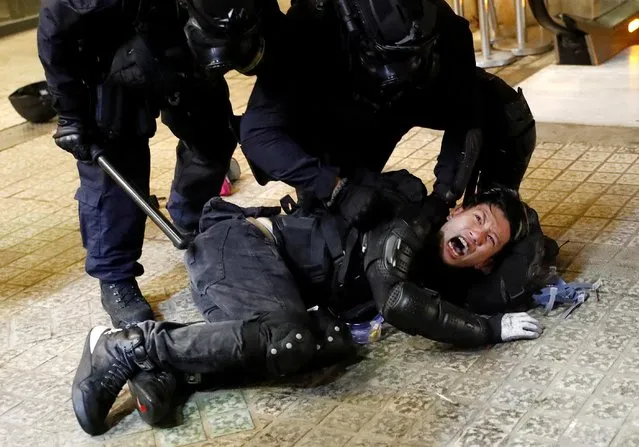
A demonstrator is detained by police officers during a protest in Hong Kong, China on August 31, 2019. Hong Kong police fired tear gas and water cannons and pro-democracy protesters threw petrol bombs in the latest in a series of chaotic clashes that have plunged the Chinese-ruled city into its worst political crisis in decades. (Photo by Kai Pfaffenbach/Reuters)

A demonstrator is detained by police officers during a protest in Hong Kong, China on August 31, 2019. Hong Kong police fired tear gas and water cannons and pro-democracy protesters threw petrol bombs in the latest in a series of chaotic clashes that have plunged the Chinese-ruled city into its worst political crisis in decades. (Photo by Kai Pfaffenbach/Reuters)
Details
02 Sep 2019 00:05:00
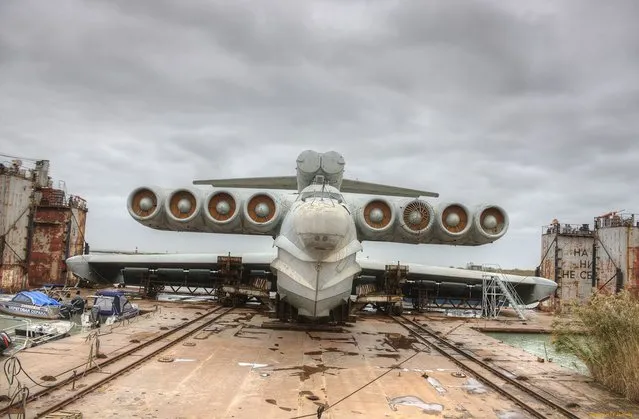
The Lun-class Ekranoplane was used by the Soviet Navy starting in 1987, and wasn't retired until the late 1990s, after the Soviet Union's fall. (Igor113)

“The Lun-class ekranoplan (NATO reporting name Duck) was a ground effect vehicle (GEV) designed by Rostislav Evgenievich Alexeev and used by the Soviet and Russian navies from 1987 until sometime in the late 1990s. It “flew” using the lift generated by the ground effect of its large wings when close to the surface of the water – about four metres or less. Although they might look similar and/or have related technical characteristics, ekranoplans like the Lun are not aircraft, seaplanes, hovercraft, or hydrofoils – ground effect is a separate technology altogether. The International Maritime Organization classifies these vehicles as maritime ships. The name Lun comes from the Russian for harrier”. – Wikipedia (Photo by Igor113)
Details
08 Aug 2014 10:51:00
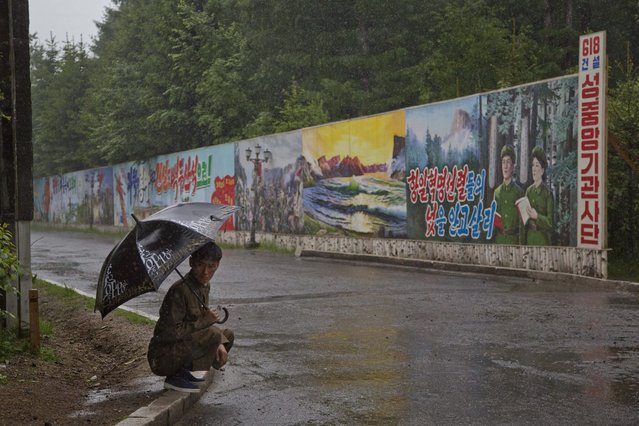
In this June 17, 2014 photo, a North Korean man takes shelter in the rain next to long propaganda billboards in the town of Samjiyon in North Korea's Ryanggang province. (Photo by David Guttenfelder/AP Photo)

In this June 17, 2014 photo, a North Korean man takes shelter in the rain next to long propaganda billboards in the town of Samjiyon in North Korea's Ryanggang province. The Associated Press was granted to embark on a weeklong road trip across North Korea to the country’s spiritual summit Mount Paektu. The trip was on North Korea's terms. An AP reporter and photographer couldn't interview ordinary people or wander off course, and government “minders” accompanied them the entire way. (Photo by David Guttenfelder/AP Photo)
Details
23 Oct 2014 11:51:00
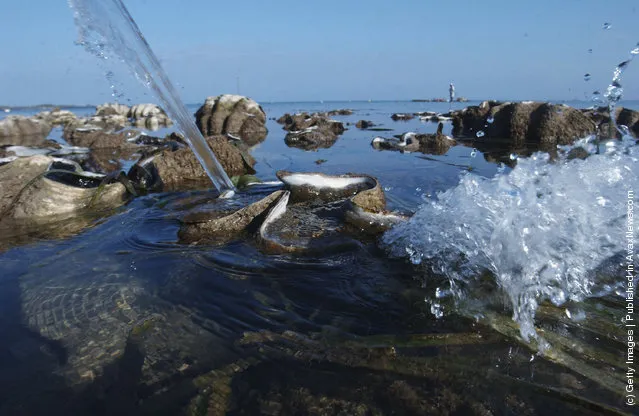
Tridacna Gigas, or Giant Clams

“The giant clam, Tridacna gigas (known as pā’ua in Cook Islands Māori), is the largest living bivalve mollusc. T. gigas is one of the most endangered clam species. It was mentioned as early as 1825 in scientific reports. One of a number of large clam species native to the shallow coral reefs of the South Pacific and Indian oceans, they can weigh more than 200 kilograms (440 lb) measure as much as 120 cm (47 in) across, and have an average lifespan in the wild of 100 years or more”. – Wikipedia

Photo: Tridacna Gigas, or Giant Clams spew water as a traditional fisherman passes by a small sanctuary on January 23, 2004 near Bolinao in the Northern Philippines. The clams, prime builders for coral reefs and providing shelter for spawning fish and other marine life, are exposed by low tides in the sanctuary. Overfishing and pollution throughout the country are not only threatening food security, but are also starting to choke one of the few working clam sanctuaries in the world. (Photo by David Greedy/Getty Images)
Details
01 Oct 2011 13:10:00


“Chameleons (family Chamaeleonidae) are a distinctive and highly specialized clade of lizards. They are distinguished by their parrot-like zygodactylous feet, their separately mobile and stereoscopic eyes, their very long, highly modified, and rapidly extrudable tongues, their swaying gait, the possession by many of a prehensile tail, crests or horns on their distinctively shaped heads, and the ability of some to change color. Uniquely adapted for climbing and visual hunting, the approximately 160 species of chameleon range from Africa, Madagascar, Spain and Portugal, across south Asia, to Sri Lanka, have been introduced to Hawaii, California and Florida, and are found in warm habitats that vary from rain forest to desert conditions”. – Wikipedia

Photo: A woman with the latest fashion accessory, a chameleon. (Photo by Fox Photos/Getty Images). Circa 1926

Details
20 Mar 2011 15:45:00
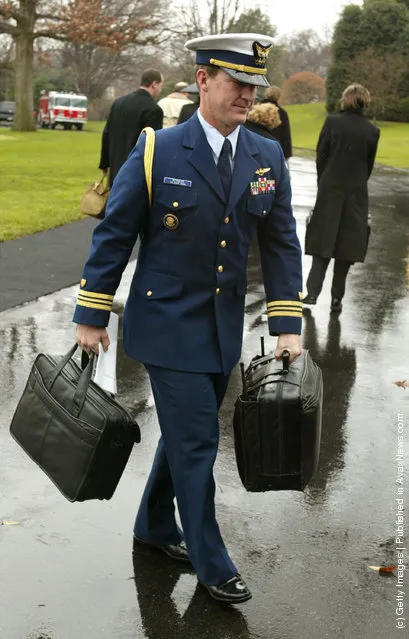
Nuclear Football

“The nuclear football (also known as the atomic football, the president's emergency satchel, the button, the black box, or just the football) is a briefcase, the contents of which are to be used by the President of the United States of America to authorize a nuclear attack while away from fixed command centers, such as the White House Situation Room. It functions as a mobile hub in the strategic defense system of the United States. It is a metallic Zero Halliburton briefcase carried in a black leather “jacket”. The package weighs around 45 pounds (20 kilograms). A small antenna protrudes from the bag near the handle”. – Wikipedia

Photo: A U.S. Military officer carries the “football”, which carries nuclear launch codes, on South Lawn after returning with U.S. President George W. Bush to the White House January 7, 2002 in Washington, DC. (Photo by Mark Wilson/Getty Images)
Details
06 Aug 2011 12:53:00
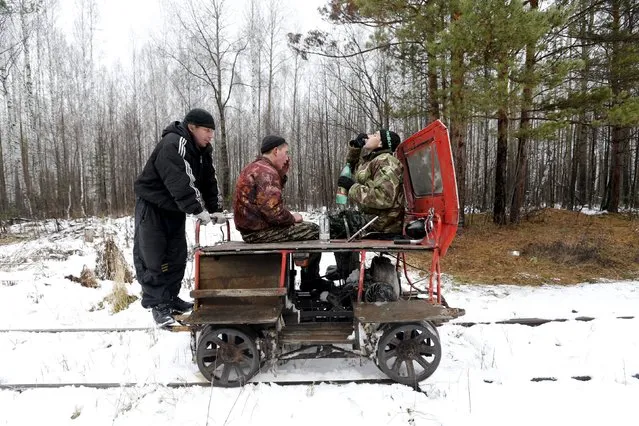
(L-R) A man nicknamed "Barcelona", Alexey Bolotov and Alexey Jakushin drink vodka as they travel by a pioneer motorised railcar on their way to Kalach, Sverdlovsk region, Russia October 18, 2015. The "pioneer," a light auxiliary rail vehicle, is a popular form of transport among people who live along the Alapayevsk railway. (Photo by Maxim Zmeyev/Reuters)

(L-R) A man nicknamed "Barcelona", Alexey Bolotov and Alexey Jakushin drink vodka as they travel by a pioneer motorised railcar on their way to Kalach, Sverdlovsk region, Russia October 18, 2015. The "pioneer," a light auxiliary rail vehicle, is a popular form of transport among people who live along the Alapayevsk railway. In a remote corner of the Urals region at the end of a narrow-gauge railway is Kalach, population about a dozen. Three decades ago 600 people called the village home, but the local forestry industry suffered as the former Soviet Union imploded and people moved away in search of work. In Kalach today there are no telephones, no mobile reception and only a few hours of electricity a day. (Photo by Maxim Zmeyev/Reuters)
Details
15 Nov 2015 08:06:00
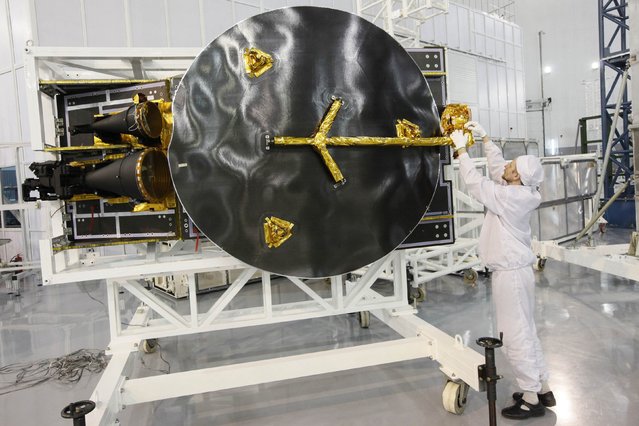
Engineer Mikhail Venin works on an antenna for the Express AM8 new generation geostationary telecommunications heavy satellite at the large-sized transformed mechanical systems centre of the Reshetnev Information Satellite Systems company in the Siberian town of Zheleznogorsk April 2, 2014. (Photo by Ilya Naymushin/Reuters)

Engineer Mikhail Venin works on an antenna for the Express AM8 new generation geostationary telecommunications heavy satellite at the large-sized transformed mechanical systems centre of the Reshetnev Information Satellite Systems company in the Siberian town of Zheleznogorsk April 2, 2014. The Express AM6 is a new generation satellite providing services including Russian governmental and presidential mobile communication, digital television and broadcasting, according to the Reshetnev company representatives. (Photo by Ilya Naymushin/Reuters)
Details
05 May 2014 09:18:00