Loading...
Done
A man stands at a passenger train damaged in a collision with a freight train in Moscow region May 20, 2014. The passenger train on its way to Moldova collided with a freight train near Moscow on Tuesday, killing at least four people and injuring 15, a spokeswoman for Russia's Emergencies Ministry said. The reason for the collision, near the town of Naro-Fominsk 55 km (34 miles) southwest of Moscow, was not immediately clear. (Photo by Grigory Dukor/Reuters)

A man stands at a passenger train damaged in a collision with a freight train in Moscow region May 20, 2014. The passenger train on its way to Moldova collided with a freight train near Moscow on Tuesday, killing at least four people and injuring 15, a spokeswoman for Russia's Emergencies Ministry said. The reason for the collision, near the town of Naro-Fominsk 55 km (34 miles) southwest of Moscow, was not immediately clear. (Photo by Grigory Dukor/Reuters)
Details
21 May 2014 11:27:00
An Indian man stands dressed like Hindu god Shiva to attract alms from devotees during the Ambubasi festival at the Kamakhya Hindu temple in Gauhati, India, Sunday, June 22, 2014. The annual festival where hundreds of holy men from an esoteric form of Hinduism, gather to perform rituals at the temple begins on June 22. (Photo by Anupam Nath/AP Photo)

An Indian man stands dressed like Hindu god Shiva to attract alms from devotees during the Ambubasi festival at the Kamakhya Hindu temple in Gauhati, India, Sunday, June 22, 2014. The annual festival where hundreds of holy men from an esoteric form of Hinduism, gather to perform rituals at the temple begins on June 22. (Photo by Anupam Nath/AP Photo)
Details
23 Jun 2014 11:43:00
Uranjargal, a leader of the Mongolian neo-Nazi group Tsagaan Khass, stands next to a statue of Chingunjav, a Mongolian national hero, in Ulan Bator June 22, 2013. (Photo by Carlos Barria/Reuters)

Uranjargal, a leader of the Mongolian neo-Nazi group Tsagaan Khass, stands next to a statue of Chingunjav, a Mongolian national hero, in Ulan Bator June 22, 2013. The group has rebranded itself as an environmentalist organisation fighting pollution by foreign-owned mines, seeking legitimacy as it sends Swastika-wearing members to check mining permits. Over the past years, ultra-nationalist groups have expanded in the country and among those garnering attention is Tsagaan Khass, which has recently shifted its focus from activities such as attacks on women it accuses of consorting with foreign men to environmental issues, with the stated goal of protecting Mongolia from foreign mining interests. This ultra-nationalist group was founded in the 1990s and currently has 100-plus members. (Photo by Carlos Barria/Reuters)
Details
09 Jul 2013 07:23:00
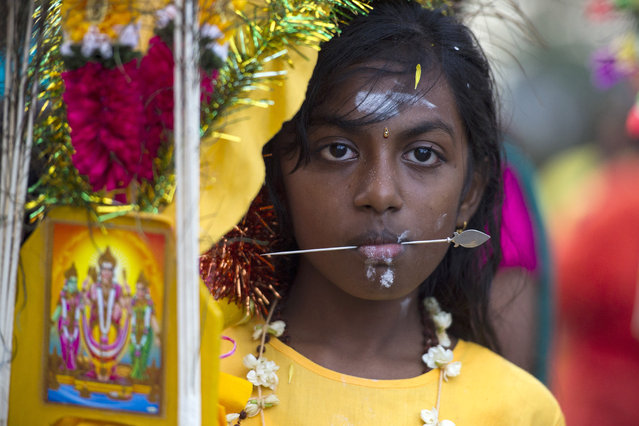
A Hindu devotee girl stands after getting her tongue pierced with a metal rod during the Thaipusam festival in Kuala Lumpur, Malaysia, Tuesday, February 3, 2015. Thaipusam, which is celebrated in honor of Hindu god Lord Murugan, is an annual procession by Hindu devotees seeking blessings, fulfilling vows and offering thanks. (Photo by Joshua Paul/AP Photo)

A Hindu devotee girl stands after getting her tongue pierced with a metal rod during the Thaipusam festival in Kuala Lumpur, Malaysia, Tuesday, February 3, 2015. Thaipusam, which is celebrated in honor of Hindu god Lord Murugan, is an annual procession by Hindu devotees seeking blessings, fulfilling vows and offering thanks. (Photo by Joshua Paul/AP Photo)
Details
04 Feb 2015 12:48:00
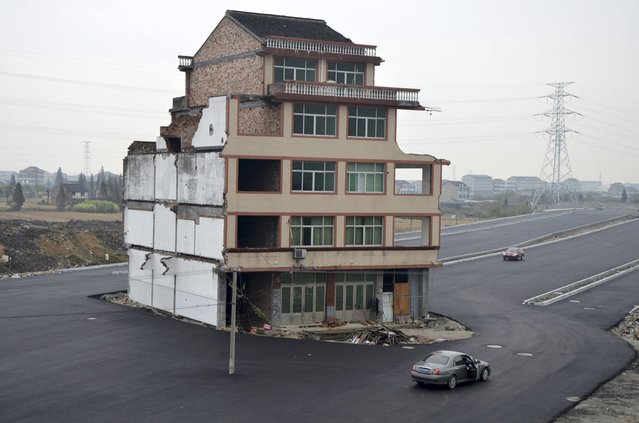
An isolated five-floor building stands in the middle of a new road on November 22, 2012 in Wenling, Zhejiang Province of China. Zhejiang Province of China. 67-year-old Luo Baogen and his 65-year-old wife from Xiazhangyang village still live in the half-demolished residential building, because they are dissatisfied with the relocation compensation. The road, which leads to the Wenling Railway Station, has not been put into use. (Photo by ChinaFotoPress)

An isolated five-floor building stands in the middle of a new road on November 22, 2012 in Wenling, Zhejiang Province of China. Zhejiang Province of China. 67-year-old Luo Baogen and his 65-year-old wife from Xiazhangyang village still live in the half-demolished residential building, because they are dissatisfied with the relocation compensation. The road, which leads to the Wenling Railway Station, has not been put into use. (Photo by China Foto Press)
Details
25 Nov 2012 09:49:00


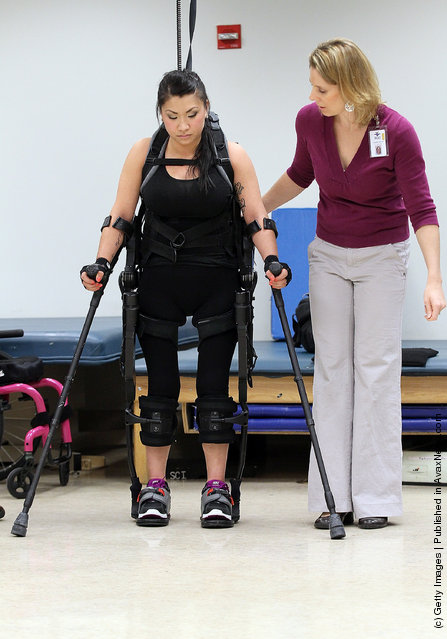
“eLEGS is a wearable, artificially intelligent, bionic device that enables people with paralysis to stand up and walk again. The exoskeleton is battery-powered and rechargeable, fitting comfortably and securely over clothing. Initially, eLEGS will be used under medical supervision for rehabilitation and training”. – BerkeleyBionics.com

Photo: Paralysis victim Stephanie Sablan (L) is helped by physical therapist Shonna Moran as she walks using eLEGS robotic legs at Santa Clara Valley Medical Center on May 25, 2011 in San Jose, California. Sablan, 24, was paralyzed from the waist down earlier this year when she was in a car accident and has begun using the newly developed eLEGS made by Berkeley Bionics. The robot-like battery powered eLEGS fit over clothing and enables people with paralysis to stand up and walk again. (Photo by Justin Sullivan/Getty Images)
Details
26 May 2011 09:56:00
A flight crew from China Airlines, wearing protective masks, stand in the international terminal after arriving on a flight from Taipei at Los Angeles International Airport (LAX) on February 28, 2020 in Los Angeles, California. The World Health Organization (WHO) has raised the global coronavirus risk level to “very high”. (Photo by Mario Tama/Getty Images)

A flight crew from China Airlines, wearing protective masks, stand in the international terminal after arriving on a flight from Taipei at Los Angeles International Airport (LAX) on February 28, 2020 in Los Angeles, California. The World Health Organization (WHO) has raised the global coronavirus risk level to “very high”. (Photo by Mario Tama/Getty Images)
Details
01 Jan 2021 00:05:00
Omar Gamal, a 28-year-old pigeon keeper, stands next to his pigeon coop on his rooftop in the Egyptian capital's twin city of Giza on February 21, 2021, with the Pyramids of (R to L) Khufu (Cheops), Khafre (Chephren), and Menkaure (Menkheres) in the background. An ancient tradition handed down through the generations, the practice of domesticating pigeons stretches across borders from the banks of the Nile to north Africa and beyond, with people not only training birds for competitions, but also serving them up as a dining delicacy. (Photo by Khaled Desouki/AFP Photo)

Omar Gamal, a 28-year-old pigeon keeper, stands next to his pigeon coop on his rooftop in the Egyptian capital's twin city of Giza on February 21, 2021, with the Pyramids of (R to L) Khufu (Cheops), Khafre (Chephren), and Menkaure (Menkheres) in the background. An ancient tradition handed down through the generations, the practice of domesticating pigeons stretches across borders from the banks of the Nile to north Africa and beyond, with people not only training birds for competitions, but also serving them up as a dining delicacy. (Photo by Khaled Desouki/AFP Photo)
Details
27 Mar 2021 09:11:00