The 33-year-old Norwegian rightwing extremist Anders Behring Breivik, who killed 77 people in twin attacks in Norway last year, arrives at a courtroom. (Photo by Heiko Junge/AP File Photo)
Photographed leaping, bounding, but most notably gurning with dopey pleasure, this two-year-old boxer's hilarious enthusiasm to catch his slippery chew toy is remarkably captured in his larger-than-life face.
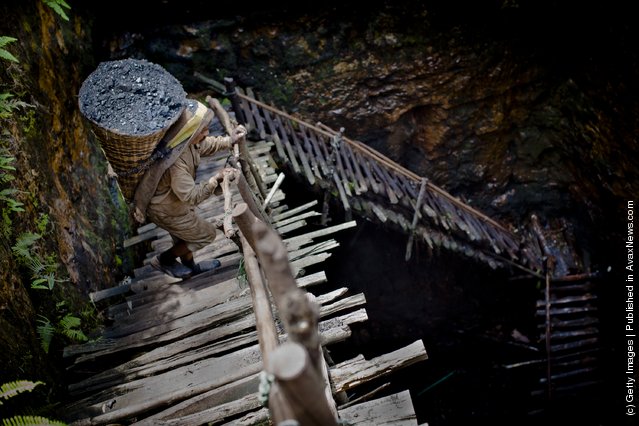
38 year old Prabhat Sinha, from Assam, carries a load of coal weighing 60kg's, supported by a head-strap, as he ascends the staircase of a coal mine on April 16, 2011 near the village of Khliehriat, in the district of Jaintia Hills, India. (Photo by Daniel Berehulak/Getty Images)
Six year old Gillian Smith preparing for the All England Stage Dancing Competition where she has previously won five certificates and a silver medal in the under sevens category. (Photo by Terry Fincher/Keystone/Getty Images). 5th July 1957
A zoo keeper feeds Diego, a three month old howler monkey, which is reared at Edinburgh Zoo, July 29, 2008 in Scotland. (Photo by Jeff J. Mitchell/Getty Images)
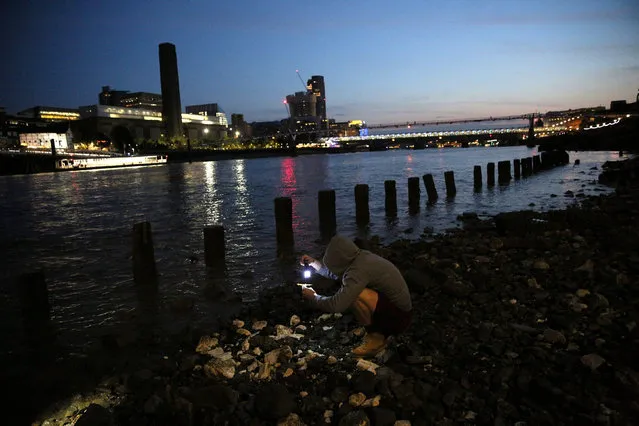
A mudlark uses a torch to look for items on the bank of the River Thames in London, Britain June 06, 2016. Mudlarking is believed to trace its origins to the 18th and 19th century, when scavengers searched the Thames' shores for items to sell. These days, history and archaeology fans are the ones hoping to find old relics such as coins, ceramics, artifacts or everyday items from across centuries. their finds with the Portable Antiquities Scheme. Any item over 300 years old must be recorded. (Photo by Neil Hall/Reuters)
A serene turquoise glow glimmers from underneath these powerful icebergs. Stood in the middle of Antarctica, the giant icebergs appear to be from an unearthly world. These stunning photographs were captured by American photographer Michael Leggero. “My images show pure nature, as that is how I describe Antarctica, simply pure nature”, says the 43 year old, of Carthage, New York. “It is the only place on our planet that humans have not left a presence behind”. (Photo by Michael Leggero/Hotspotmedia/Visual Press Agency)
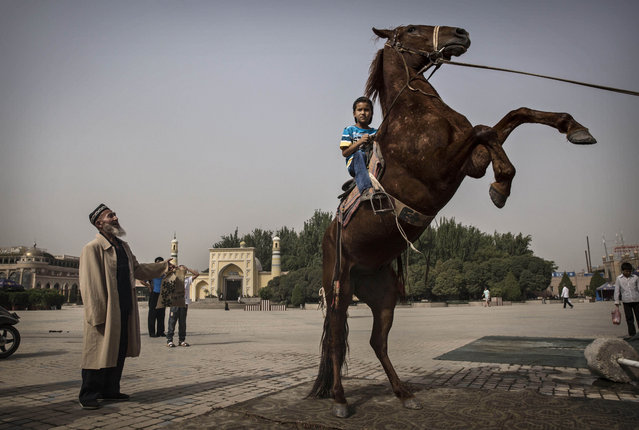
A Uyghur boy sits atop a horse as he has his picture taken outside the Id Kah Mosque before the Eid holiday on July 28, 2014 in old Kashgar, Xinjiang Province, China. Nearly 100 people have been killed in unrest in the restive Xinjiang Province in the last week in what authorities say is terrorism but advocacy groups claim is a result of a government crackdown to silence opposition to its policies. China's Muslim Uyghur ethnic group faces cultural and religious restrictions by the Chinese government. Beijing says it is investing heavily in the Xinjiang region but Uyghurs are increasingly dissatisfied with the influx of Han Chinese and uneven economic development. (Photo by Kevin Frayer/Getty Images)