Loading...
Done


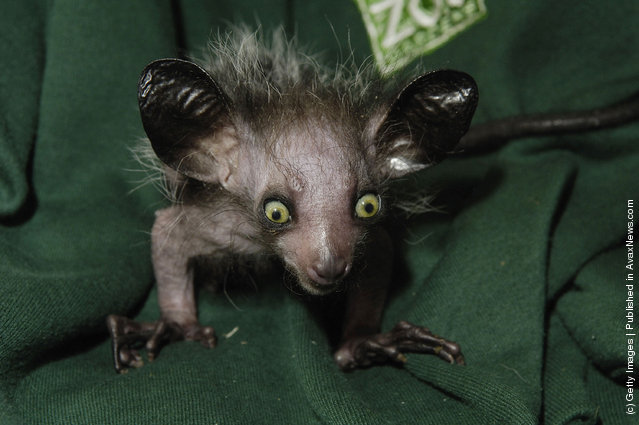
“The aye-aye (Daubentonia madagascariensis) is a lemur, a strepsirrhine primate native to Madagascar that combines rodent-like teeth and a special thin middle finger to fill the same ecological niche as a woodpecker. It is the world's largest nocturnal primate, and is characterized by its unusual method of finding food; it taps on trees to find grubs, then gnaws holes in the wood and inserts its narrow middle finger to pull the grubs out. The only other animal species known to find food in this way is the striped possum. From an ecological point of view the aye-aye fills the niche of a woodpecker as it is capable of penetrating wood to extract the invertebrates within”. – Wikipedia

Photo: In this handout image from Bristol Zoo is seen the first captive bred aye-aye in the UK named “Kintana” (meaning star in Malagasy) April 15, 2005 at Bristol Zoo Gardens, England. The zoo announced today only the second baby aye-aye to be hand-reared in the world (the first was in Jersey Zoo) and has now made his first public appearance since his birth on 11 February 2005. (Photo by Rob Cousins/Bristol Zoo via Getty Images)
Details
13 Apr 2011 13:33:00
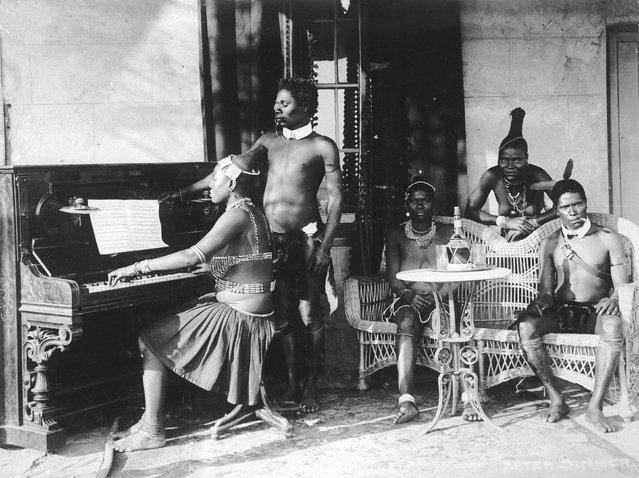
circa 1925:  A Zulu woman playing the piano while a group of others sit and listen.  (Photo by General Photographic Agency/Getty Images)

“The Zulu are the largest South African ethnic group, with an estimated 10–11 million people living mainly in the province of KwaZulu-Natal. Small numbers also live in Zimbabwe, Zambia, and Mozambique. Their language, Zulu, is a Bantu language; more specifically, part of the Nguni subgroup. The Zulu Kingdom played a major role in South African history during the 19th and 20th centuries. Under apartheid, Zulu people were classed as third-class citizens and suffered from state-sanctioned discrimination. They remain today the most numerous ethnic group in South Africa, and now have equal rights along with all other citizens”. – Wikipedia.

Photo: A Zulu woman playing the piano while a group of others sit and listen (to put it briefly, Englishmen scoff over Zulu). South Africa, circa 1925. (Photo by General Photographic Agency)

Details
03 Feb 2014 09:40:00


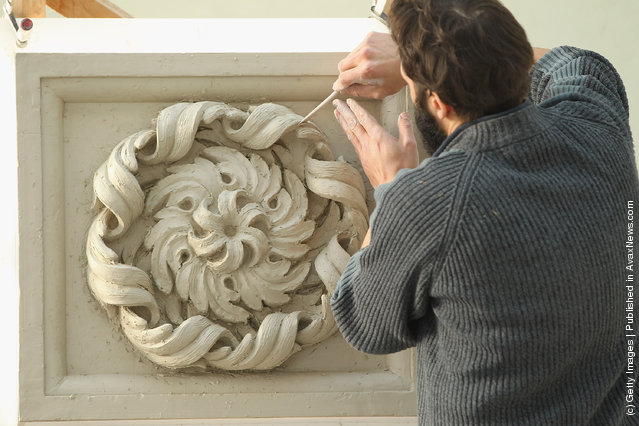
BERLIN, GERMANY - NOVEMBER 11: Sculptor Oleg Bessonov creates a rosette from clay at the Schlossbauhuette studio where a team of sculptors is creating decorative elements for the facade of the Berliner Schloss city palace on November 11, 2011 in Berlin, Germany. The Berliner Schloss was the residence of the Prussian Kaiser and was among the major architectural landmarks of Berlin until it was heavily damaged by Allied bombing in 1945. The communist authorities of East Berlin demolished the building in the 1950s, and today's Berlin government is pursuing an ambitious project to rebuild the palace according to a design by Italian architect Franco Stella, which will recreate the facade of the building but with a modern interior at a cost of approximately EUR 590 million. The Humboldt Forum, the foundation leading the project, has given the Schlossbauhuette sculptors the formidable task of recreating the hundreds of architectural elements that decorated the facade, and though some original pieces were saved, more often the sculptors have only old black and white photos as reference. (Photo by Sean Gallup/Getty Images)
Details
21 Nov 2011 11:22:00
Youths tussle for the leather ball during the annual 'Fastern Eve Handba' event in Jedburgh's High Street in the Scottish Borders in Jedburgh

“Ba game is a version of medieval football played in Scotland, perhaps most notably in Orkney and the Scottish Borders, around Christmas and New Year”. – Wikipedia

Photo: Men tussle for the leather ball during the annual “Fastern Eve Handba” event in Jedburgh's High Street in the Scottish Borders on March 1, 2012 in Jedburgh, Scotland. The annual event, which started in the 1700's, takes place today and involves two teams, the Uppies (residents from the higher part of Jedburgh) and the Doonies (residents from the lower part of Jedburgh) getting the ball to either the top or bottom of the town. The ball, which is made of leather, stuffed with straw and decorated with ribbons is thrown into the crowd to begin the game. (Photo by Jeff J. Mitchell/Getty Images)
Details
02 Mar 2012 10:07:00
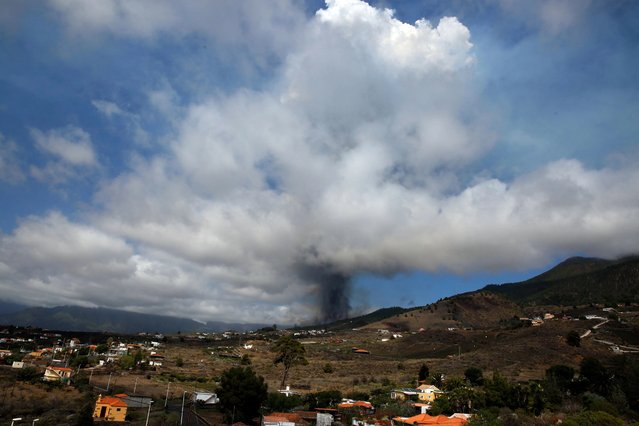
Mount Cumbre Vieja erupts spewing a column of smoke and ash as seen from Los Llanos de Aridane on the Canary island of La Palma on September 19, 2021. (Photo by Desiree Martin/AFP Photo)

Mount Cumbre Vieja erupts spewing a column of smoke and ash as seen from Los Llanos de Aridane on the Canary island of La Palma on September 19, 2021. The Cumbre Vieja volcano erupted on Spain's Canary Islands today spewing out lava, ash and a huge column of smoke after days of increased seismic activity, sparking evacuations of people living nearby, authorities said. Cumbre Vieja straddles a ridge in the south of La Palma island and has erupted twice in the 20th century, first in 1949 then again in 1971. (Photo by Desiree Martin/AFP Photo)
Details
20 Sep 2021 08:27:00
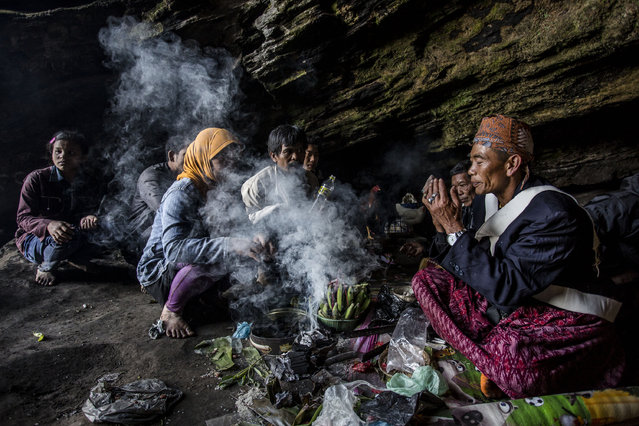
A Tenggerese shaman praying for worshippers at Widodaren cave during the Tenggerese Hindu Yadnya Kasada festival on July 31, 2015 in Probolinggo, East Java, Indonesia. The festival is the main festival of the Tenggerese people and lasts about a month. On the fourteenth day, the Tenggerese make the journey to Mount Bromo to make offerings of rice, fruits, vegetables, flowers and livestock to the mountain gods by throwing them into the volcano's caldera. (Photo by Ulet Ifansasti/Getty Images)

A Tenggerese shaman praying for worshippers at Widodaren cave during the Tenggerese Hindu Yadnya Kasada festival on July 31, 2015 in Probolinggo, East Java, Indonesia. The festival is the main festival of the Tenggerese people and lasts about a month. On the fourteenth day, the Tenggerese make the journey to Mount Bromo to make offerings of rice, fruits, vegetables, flowers and livestock to the mountain gods by throwing them into the volcano's caldera. The origin of the festival lies in the 15th century when a princess named Roro Anteng started the principality of Tengger with her husband Joko Seger, and the childless couple asked the mountain Gods for help in bearing children. The legend says the Gods granted them 24 children but on the provision that the 25th must be tossed into the volcano in sacrifice. The 25th child, Kesuma, was finally sacrificed in this way after initial refusal, and the tradition of throwing sacrifices into the caldera to appease the mountain Gods continues today. (Photo by Ulet Ifansasti/Getty Images)
Details
01 Aug 2015 12:07:00
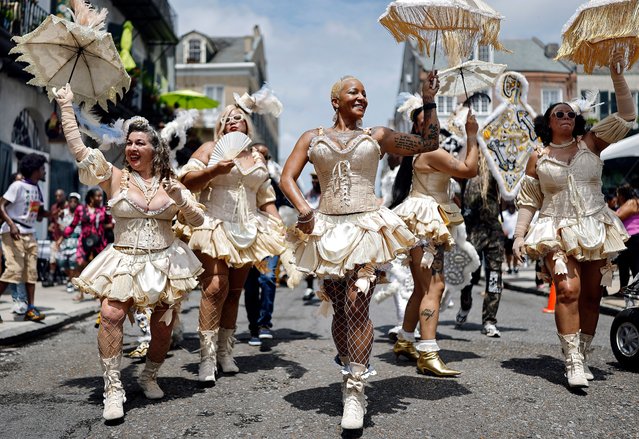
Members of the Mahogany Blue Baby Dolls including Victoria “Lady Lotus” Spotts (C) march in the 25th Anniversary Satchmo Salute second line parade, honoring New Orleans jazz legend Louis Armstrong, on August 3, 2025 in New Orleans, Louisiana. Revelers marched from historic St. Augustine Catholic Church in the Tremé neighborhood to the New Orleans Jazz Museum where Satchmo Summerfest is being held. New Orleans and the Gulf Coast region are preparing to mark the 20 year anniversary of Hurricane Katrina, which occurred on August 29, 2005. The failure of levees during the catastrophic storm in New Orleans flooded about 80 percent of the city including historic communities such as the Lower Ninth Ward. Katrina resulted in nearly 1,400 deaths, according to revised statistics from the National Hurricane Center, and remains the costliest storm in U.S. history at around $200 billion in today’s dollars. (Photo by Mario Tama/Getty Images)

Members of the Mahogany Blue Baby Dolls including Victoria “Lady Lotus” Spotts (C) march in the 25th Anniversary Satchmo Salute second line parade, honoring New Orleans jazz legend Louis Armstrong, on August 3, 2025 in New Orleans, Louisiana. Revelers marched from historic St. Augustine Catholic Church in the Tremé neighborhood to the New Orleans Jazz Museum where Satchmo Summerfest is being held. (Photo by Mario Tama/Getty Images)
Details
12 Aug 2025 03:19:00
Astronaut Edward H. White II, pilot for the Gemini-Titan 4 (GT-4) spaceflight, floats in the zero-gravity of space during the third revolution of the GT-4 spacecraft on June 3, 1965. White wears a specially designed spacesuit. His face is shaded by a gold-plated visor to protect him from unfiltered rays of the sun. (Photo by NASA)

Astronaut Edward H. White II, pilot for the Gemini-Titan 4 (GT-4) spaceflight, floats in the zero-gravity of space during the third revolution of the GT-4 spacecraft on June 3, 1965. White wears a specially designed spacesuit. His face is shaded by a gold-plated visor to protect him from unfiltered rays of the sun. In his right hand he carries a Hand-Held Self-Maneuvering Unit (HHSMU) that gives him control over his movements in space. White also wears an emergency oxygen chest pack; and he carries a camera mounted on the HHSMU for taking pictures of the sky, Earth and the GT-4 spacecraft. He is secured to the spacecraft by a 25-feet umbilical line and a 23-feet tether line. Both lines are wrapped together in gold tape to form one cord. Astronaut James A. McDivitt, command pilot, remained inside the spacecraft during the extravehicular activity (EVA). Astronaut White died in the Apollo/Saturn 204 fire at Cape Kennedy on January 27, 1967. (Photo by NASA)
Details
22 Jul 2014 12:05:00