Loading...
Done
Italian police officers carry away a FEMEN activist during a protest in St. Peter's Square at the Vatican, Friday, November 14, 2014. Members of the Ukrainian feminist group Femen staged a protest against the upcoming visit of Pope Francis at the European Parliament and Council. (Photo by AP Photo)

Italian police officers carry away a FEMEN activist during a protest in St. Peter's Square at the Vatican, Friday, November 14, 2014. Members of the Ukrainian feminist group Femen staged a protest against the upcoming visit of Pope Francis at the European Parliament and Council. (Photo by AP Photo)
Details
15 Nov 2014 13:04:00
Natan Dvir, an Israeli photographer, focuses on the human aspects of political, social and cultural issues. For his “Coming Soon” series, Dvir says that in recent years, a kaleidoscopic net of huge billboards has enveloped the commercial hubs of New York. Seen here, a man looks at a Juicy Couture billboard while passing it on 52nd street close to 5th Avenue in New York, June 5, 2012. (Photo by Natan Dvir/Polaris)

Natan Dvir, an Israeli photographer, focuses on the human aspects of political, social and cultural issues. For his “Coming Soon” series, Dvir says that in recent years, a kaleidoscopic net of huge billboards has enveloped the commercial hubs of New York. Seen here, a man looks at a Juicy Couture billboard while passing it on 52nd street close to 5th Avenue in New York, June 5, 2012. (Photo by Natan Dvir/Polaris)
Details
05 Jun 2015 10:39:00
A family of children share a bath in Japan, 1965

A family of children share a bath in Japan, circa 1965. (Photo by Three Lions/Hulton Archive/Getty Images)
Details
09 Aug 2011 11:27:00


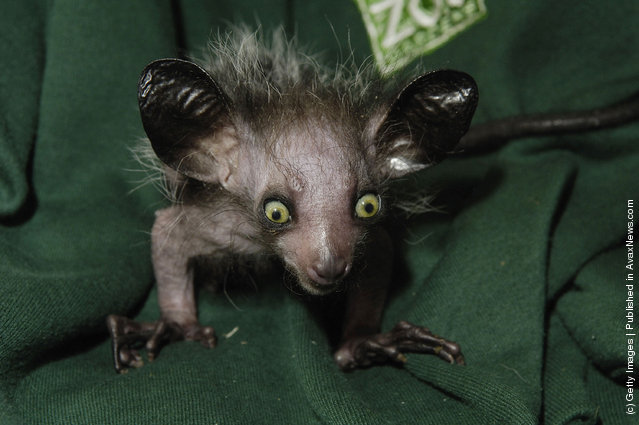
“The aye-aye (Daubentonia madagascariensis) is a lemur, a strepsirrhine primate native to Madagascar that combines rodent-like teeth and a special thin middle finger to fill the same ecological niche as a woodpecker. It is the world's largest nocturnal primate, and is characterized by its unusual method of finding food; it taps on trees to find grubs, then gnaws holes in the wood and inserts its narrow middle finger to pull the grubs out. The only other animal species known to find food in this way is the striped possum. From an ecological point of view the aye-aye fills the niche of a woodpecker as it is capable of penetrating wood to extract the invertebrates within”. – Wikipedia

Photo: In this handout image from Bristol Zoo is seen the first captive bred aye-aye in the UK named “Kintana” (meaning star in Malagasy) April 15, 2005 at Bristol Zoo Gardens, England. The zoo announced today only the second baby aye-aye to be hand-reared in the world (the first was in Jersey Zoo) and has now made his first public appearance since his birth on 11 February 2005. (Photo by Rob Cousins/Bristol Zoo via Getty Images)
Details
13 Apr 2011 13:33:00


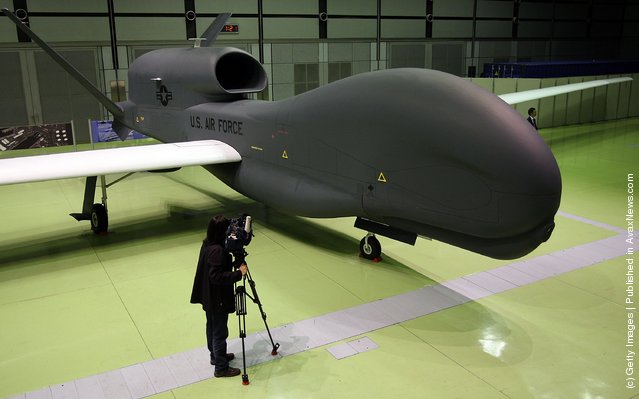
“The Northrop Grumman (formerly Ryan Aeronautical) RQ-4 Global Hawk (known as Tier II+ during development) is an unmanned aerial vehicle (UAV) used by the United States Air Force and Navy as a surveillance aircraft”. – Wikipedia

Photo: A full-scale model of The RQ-4 Global Hawk unmanned plane is displayed during a presentation at PiO Exhibition Center on March 24, 2010 in Tokyo, Japan. (Photo by Koichi Kamoshida/Getty Images)
Details
23 Jul 2011 12:31:00
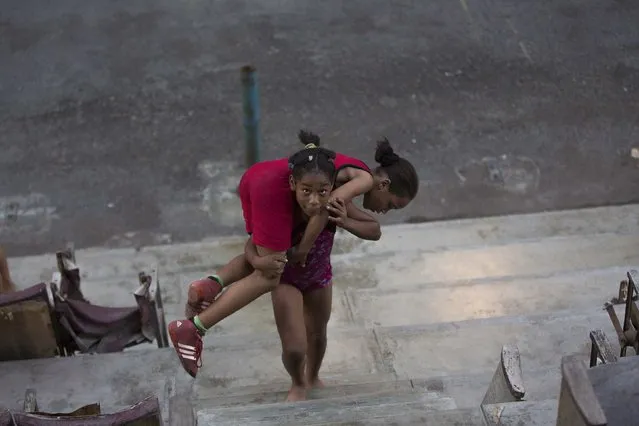
Children exercise before a wrestling practice session at an old Basque ball game gymnasium in downtown Havana, October 30, 2014. (Photo by Alexandre Meneghini/Reuters)

Children exercise before a wrestling practice session at an old Basque ball game gymnasium in downtown Havana, October 30, 2014. (Photo by Alexandre Meneghini/Reuters)
Details
20 Nov 2014 12:51:00
These incredible images capture the immense detail of waves beautifully crashing into the serene waters of Hawaii. (Photo by Bryce Groark/Caters)

These incredible images capture the immense detail of waves beautifully crashing into the serene waters of Hawaii. (Photo by Bryce Groark/Caters)
Details
26 Jun 2013 04:45:00
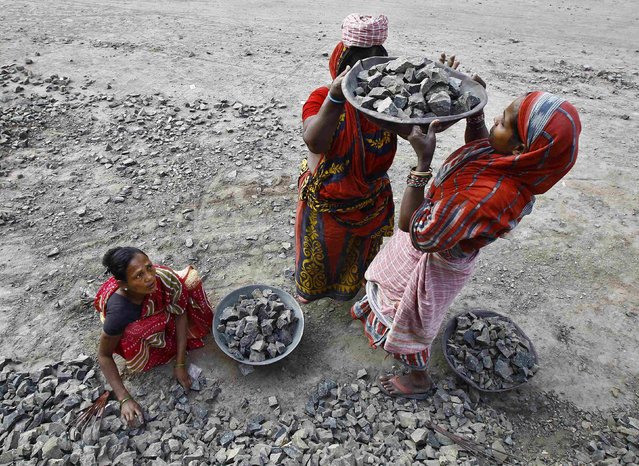
Women labourers work at the construction site of a road in Kolkata January 8, 2015. Across towns and cities in India, it is not uncommon to see women cleaning building sites, carrying bricks and or shoveling gravel - helping construct the infrastructure necessary for the country's economic and social development. (Photo by Rupak De Chowdhuri/Reuters)

Women labourers work at the construction site of a road in Kolkata January 8, 2015. Across towns and cities in India, it is not uncommon to see women cleaning building sites, carrying bricks and or shoveling gravel – helping construct the infrastructure necessary for the country's economic and social development. They help build roads, railway tracks, airports, and offices. They lay pipes for clean water supplies, cables for telecommunications, and dig the drains for sewage systems. But although women make up at least 20 percent of India's 40 million construction workers, they are less recognized than male workers with lower pay and often prone to safety hazards and sexual harassment. They are often unaware of their rights or scared to complain, say activists now trying to campaign for better treatment of women in the construction industry. (Photo by Rupak De Chowdhuri/Reuters)

Details
15 Jan 2015 13:47:00