Loading...
Done
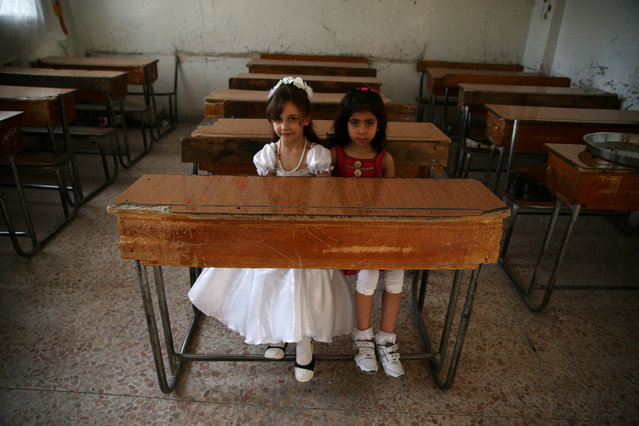
Girls sit inside an empty classroom as they pose for a photograph during a celebration marking the end of the school year in the town of Douma, eastern Ghouta in Damascus, Syria May 21, 2016. (Photo by Bassam Khabieh/Reuters)

Girls sit inside an empty classroom as they pose for a photograph during a celebration marking the end of the school year in the town of Douma, eastern Ghouta in Damascus, Syria May 21, 2016. (Photo by Bassam Khabieh/Reuters)
Details
28 Jun 2016 12:35:00
Rahma, 19, pictured with her 10-year old brother Fahad on June 21, 2016 in Kano, Nigeria. A teenage girl born without limbs lives her life in a plastic bowl. Rahma Haruna is a bright, happy girl, despite suffering from a mystery condition that stopped her arms and legs developing properly – leaving her practically limbless and in constant pain. The 19-year- old, from Kano, Nigeria, was born a healthy baby but when she turned six months old her growth came to a sudden halt and she stopped hitting key development milestones. Rahma’s family do their best to provide her with a fulfilling life and transport her around the village in a plastic bowl. Rahma said: “They help me a lot. How do they? They give me anything I need”. Rahma died on 25 December 2016. (Photo by Sani Maikatanga/Barcroft Images)

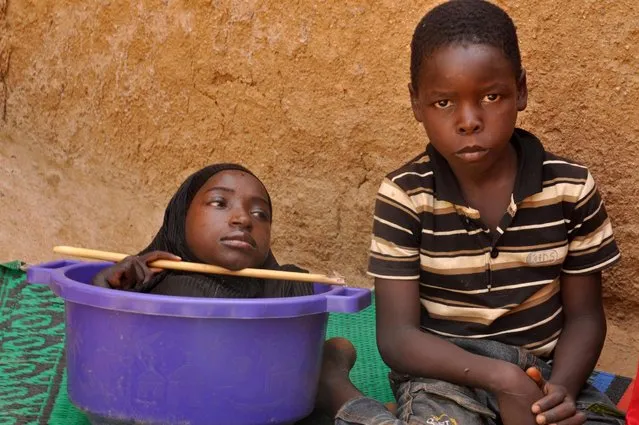
Rahma, 19 (L), pictured with her 10-year old brother Fahad on June 21, 2016 in Kano, Nigeria. A teenage girl born without limbs lives her life in a plastic bowl. Rahma Haruna is a bright, happy girl, despite suffering from a mystery condition that stopped her arms and legs developing properly – leaving her practically limbless and in constant pain. The 19-year- old, from Kano, Nigeria, was born a healthy baby but when she turned six months old her growth came to a sudden halt and she stopped hitting key development milestones. Rahma’s family do their best to provide her with a fulfilling life and transport her around the village in a plastic bowl. Rahma said: “They help me a lot. How do they? They give me anything I need”. Rahma died on 25 December 2016. (Photo by Sani Maikatanga/Barcroft Images)
Details
30 Dec 2016 10:52:00
Sikh devotee take part in Nagar Keertan procession on the occasion of Guru Gobind Singh birth anniversary in Allahabad, India on December 29, 2016. (Photo by Prabhat Kumar Verma/Pacific Press via ZUMA Wire/Rex Features/Shutterstock)

Sikh devotee take part in Nagar Keertan procession on the occasion of Guru Gobind Singh birth anniversary in Allahabad, India on December 29, 2016. Guru Gobind Singh, born Gobind Rai (1666 – 1708), was the 10th Sikh Guru, a spiritual master, warrior, poet and philosopher. When his father, Guru Tegh Bahadur, was beheaded for refusing to convert to Islam, Guru Gobind Singh was formally installed as the leader of the Sikhs at age nine, becoming the last of the living Sikh Gurus. (Photo by Prabhat Kumar Verma/Pacific Press via ZUMA Wire/Rex Features/Shutterstock)

Details
31 Dec 2016 10:27:00
Women take a selfie next to a police officer as they take part in New Year's Eve celebrations in the Bund, in Shanghai, China December 31, 2016. (Photo by Aly Song/Reuters)

Women take a selfie next to a police officer as they take part in New Year's Eve celebrations in the Bund, in Shanghai, China December 31, 2016. (Photo by Aly Song/Reuters)
Details
01 Jan 2017 09:22:00
German police officers take pictures as fireworks explode next to the Quadriga sculpture atop the Brandenburg gate during New Year celebrations in Berlin, Germany, January 1, 2017. (Photo by Fabrizio Bensch/Reuters)

German police officers take pictures as fireworks explode next to the Quadriga sculpture atop the Brandenburg gate during New Year celebrations in Berlin, Germany, January 1, 2017. (Photo by Fabrizio Bensch/Reuters)
Details
02 Jan 2017 12:25:00
A toddler sits on the winner of the giant pumpkin category during the RHS (Royal Horticultural Society) London Harvest Festival Show at RHS Lindley Halls on October 6, 2015 in London, England. The traditional harvest themed show runs October 6-7 and showcases a wide range of late summer grown fruit and vegetables. (Photo by Ben Pruchnie/Getty Images)

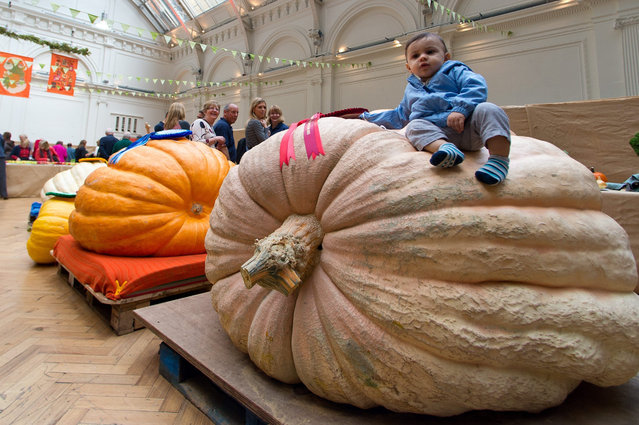
A toddler sits on the winner of the giant pumpkin category during the RHS (Royal Horticultural Society) London Harvest Festival Show at RHS Lindley Halls on October 6, 2015 in London, England. The traditional harvest themed show runs October 6-7 and showcases a wide range of late summer grown fruit and vegetables. (Photo by Ben Pruchnie/Getty Images)
Details
09 Oct 2015 08:07:00
“The Sunsetter”. An EF-4 tornado rips through the open space of farmland near Rozel, Kansas. This tornado moves slowly but powerful towards the setting sun an gets its beautiful color right before sunset. Storm Chasers are spotting on the left side. Photo location: Rozel, Kansas. (Photo and caption by Dennis Oswald/National Geographic Photo Contest)

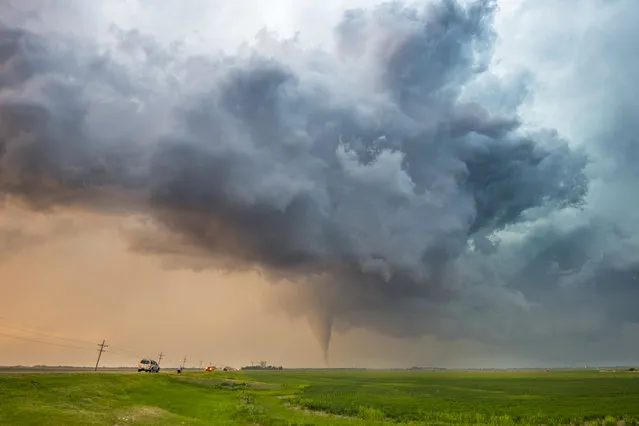
“The Sunsetter”. An EF-4 tornado rips through the open space of farmland near Rozel, Kansas. This tornado moves slowly but powerful towards the setting sun an gets its beautiful color right before sunset. Storm Chasers are spotting on the left side. Photo location: Rozel, Kansas. (Photo and caption by Dennis Oswald/National Geographic Photo Contest)

ATTENTION! All pictures are presented in high resolution. To see Hi-Res images – just TWICE click on any picture. In other words, click small picture – opens the BIG picture. Click BIG picture – opens VERY BIG picture.
Details
01 Dec 2013 11:03:00
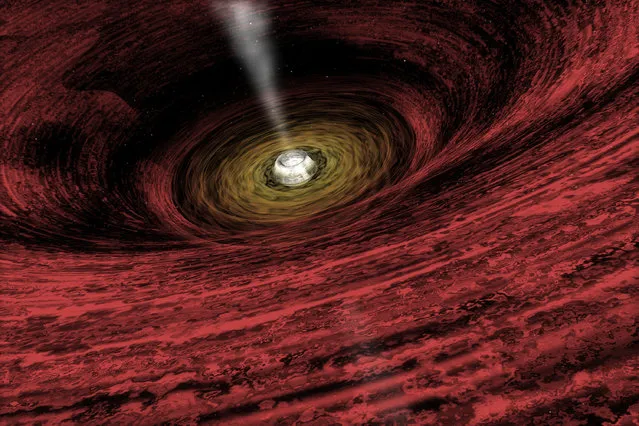
An artist's impression of a growing supermassive black hole located in the early Universe is seen in this NASA handout illustration released on June 15, 2011. Using the deepest X-ray image ever taken, astronomers found the first direct evidence that massive black holes were common in the early universe. This discovery from NASA's Chandra X-Ray Observatory shows that very young black holes grew more aggressively than previously thought, in tandem with the growth of their host galaxies. (Photo by Reuters/NASA/Chandra X-Ray Observatory/A.Hobart)

An artist's impression of a growing supermassive black hole located in the early Universe is seen in this NASA handout illustration released on June 15, 2011. Using the deepest X-ray image ever taken, astronomers found the first direct evidence that massive black holes were common in the early universe. This discovery from NASA's Chandra X-Ray Observatory shows that very young black holes grew more aggressively than previously thought, in tandem with the growth of their host galaxies. (Photo by Reuters/NASA/Chandra X-Ray Observatory/A.Hobart)
Details
11 Feb 2016 12:57:00