Loading...
Done
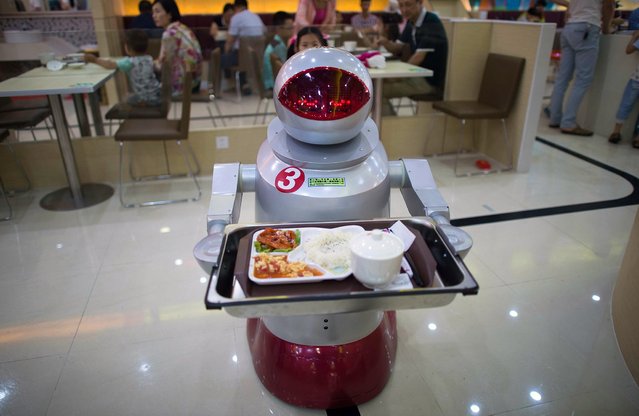
This photo taken on August 13, 2014, shows a robot carrying food to customers in a restaurant in Kunshan. It's more teatime than Terminator – a restaurant in China is electrifying customers by using more than a dozen robots to cook and deliver food. (Photo by Johannes Eisele/AFP Photo)

Located in Kunshan, eastern China, the restaurant relies on over a dozen machines for tasks such as greeting customers, waiting on tables and cooking basic meals. The eatery becomes the third café in the world to rely on the use of robot employees, potentially giving a glimpse into how future businesses could operate. Photo: This photo taken on August 13, 2014, shows a robot carrying food to customers in a restaurant in Kunshan. It's more teatime than Terminator – a restaurant in China is electrifying customers by using more than a dozen robots to cook and deliver food. (Photo by Johannes Eisele/AFP Photo)
Details
24 Aug 2014 09:40:00
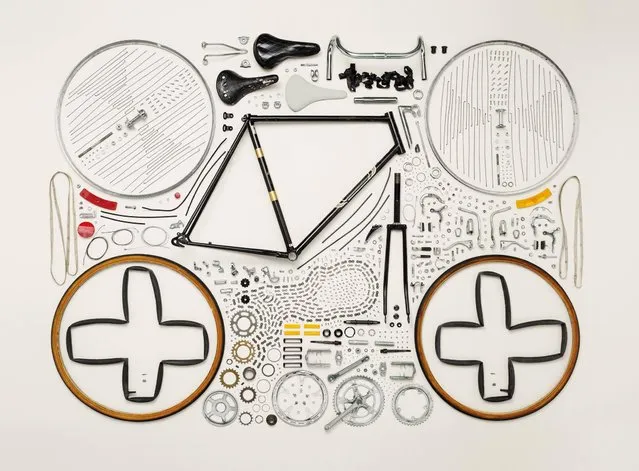
Deconstructed Objects By Todd McLellan

It is simply staggering how complicated some items really are. We never think about it, but some items that we use every day consist of hundreds of parts meticulously put together and working perfectly. Todd McLellan is a photographer who based his newest book “Things Come Apart” on the complexity of various old and new tech. By carefully taking apart various items and arranging all of the parts in perfect order, Todd has allowed us not only to look inside various appliances, but also to appreciate the astounding complexity of these items. Just like the human mind, we are so used to seeing and talking with people that we forget just how complicated their minds really are. It would be great if we could “take apart” the human mind in order to gain some insight into the person’s thoughts and desires. However, very few people are capable of doing it, while the rest will remain blind to the obvious. (Photo by Todd McLellan)
Details
15 Nov 2014 12:30:00
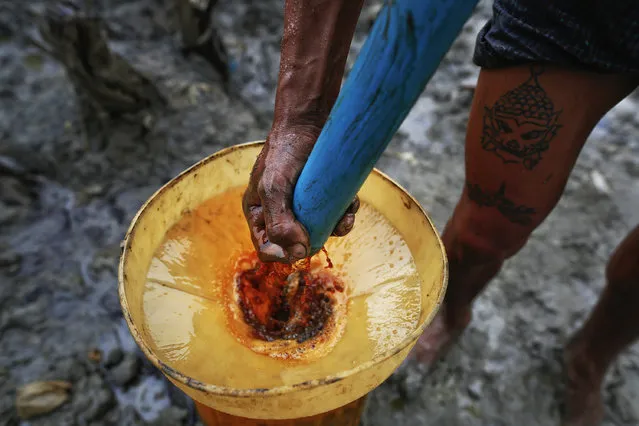
Ko Min, 26, manually extracts oil from one of three 300 feet deep wells he works on in the Minhla township of the Magwe district October 27, 2013. Everyday, Ko Min makes around $30 extracting crude oil from three small wells after he bought rights to use them for close to $1000 from a farmer who owns the land. (Photo by Damir Sagolj/Reuters)

Ko Min, 26, manually extracts oil from one of three 300 feet deep wells he works on in the Minhla township of the Magwe district October 27, 2013. Everyday, Ko Min makes around $30 extracting crude oil from three small wells after he bought rights to use them for close to $1000 from a farmer who owns the land. In Myanmar, an impoverished country rich with natural resources, people from poor communities find ways to supplement their income by exploiting such resources, such as the Minhla township, traditionally rich with oil, often using primitive and dangerous methods. (Photo by Damir Sagolj/Reuters)
Details
21 Apr 2014 10:06:00
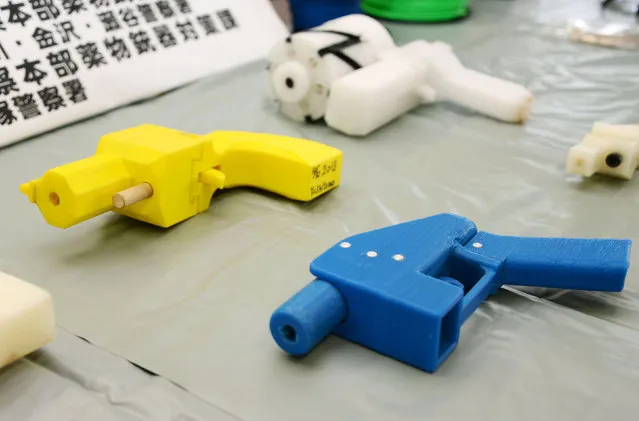
Seized plastic handguns which were created using 3D printing technology are displayed at Kanagawa police station in Yokohama, south of Tokyo, in this photo taken by Kyodo May 8, 2014. (Photo by Reuters/Kyodo)

Seized plastic handguns which were created using 3D printing technology are displayed at Kanagawa police station in Yokohama, south of Tokyo, in this photo taken by Kyodo May 8, 2014. Yoshimoto Imura became the first man to be arrested in Japan for illegal possession of two guns he created himself using 3D printing technology, Japanese media said on Thursday. The 27-year-old, a college employee in the city of Kawasaki, was arrested after police found video online posted by Imura claiming to have produced his own guns. Gun possession is strictly regulated in Japan. Police raided Imura's home and found five guns, two of which could fire real bullets, Japanese media said. (Photo by Reuters/Kyodo)
Details
12 May 2014 10:46:00
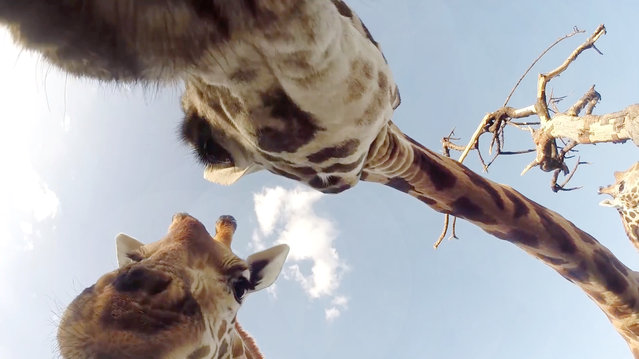
An innovative photographer attached a camera to a remote-controlled car, allowing him to capture angles of wild lions, rhinos and other animals. Over the last 11 years, Chris Bray has been taking pictures of animals using his toy car contraption while he takes guests on photography tours in Kenya. Bray purchased an ordinary remote-controlled car, stripped it of anything that could chewed or ripped off, leaving the chassis, then strapped a GoPro to the top of it. When a herd of animals has been sighted, Bray uses the toy car to approach the subjects’ general area without intruding. (Photo by Chris Bray/Caters News Agency)

An innovative photographer attached a camera to a remote-controlled car, allowing him to capture angles of wild lions, rhinos and other animals. Over the last 11 years, Chris Bray has been taking pictures of animals using his toy car contraption while he takes guests on photography tours in Kenya. (Photo by Chris Bray/Caters News Agency)
Details
25 Oct 2019 00:01:00
Anne Lamb – Art

Allyson Anne Lamb is a Brooklyn based fine artist primarily working in photography. Her work uses the body to explore the complexity of human emotions and the continuous invisible transformations we experience, revealing them as monstrosities or fantastical beings. Through the assembling of body parts, bright colors and fictional spaces that exist in Lamb's magical realm where sexual anxiety, female identity and altered sensorial perceptions are explored, Lamb invites us to participate in an altered state of consciousness. We step in to quaint fragmented realities where we are welcomed to engage in lucid dreaming populated by colorful mutations.
Details
14 Jun 2012 12:51:00
Philip Levine

London born Philip started using his head as a canvas for creativity back in 2006 when he began to go bald. He did not want to conform to shaving his head like everyone else so started using it as an art form to express. Philip's head designs have now become iconic around the world. As a tastemaker, he has gained recognition with sites including Trend Hunter and NotCot with such terms as 'Baldazzling'. His designs are inspiring men and women alike who might be bald.
Details
11 Apr 2015 09:55:00
Book Art by Thomas Allen

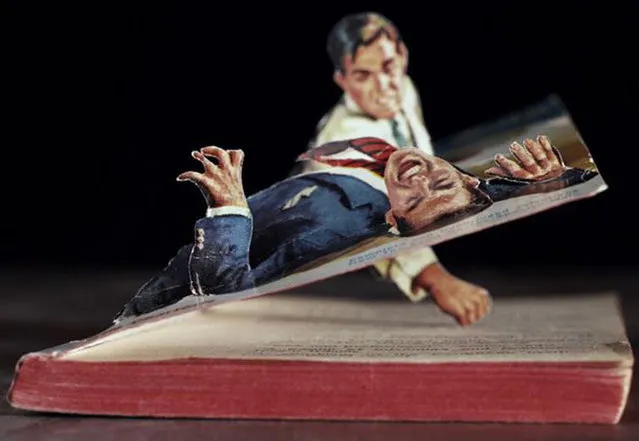
American photographer Thomas Allen constructs witty and clever dioramas using figures cut from the covers of old pulp paperbacks. Using salacious pulp art drawing’s of the ’40s and ’50s that covered books such as ” I Married a Dead Man” and ” Marihuana Girl’, Allen constructs one set of pictures up close while obscuring another, and in the process creates a different context. Each piece is given a brand new storyline, though never quite strays from their cheeky origins.
Details
05 Dec 2012 13:01:00