Loading...
Done
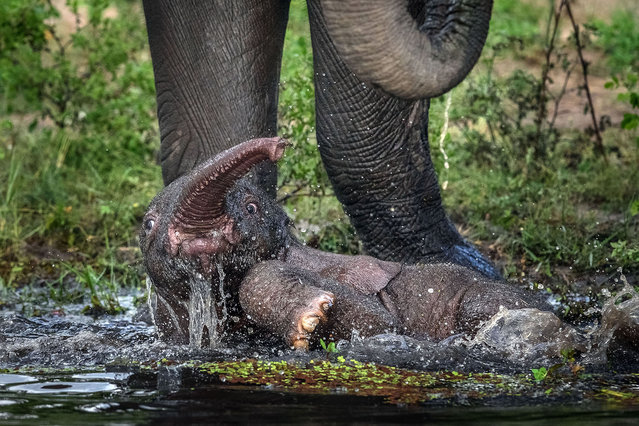
This cute elephant calf was spotted after it got stuck in a pool of water and required a helping trunk from its mum to get out. The young calf looked like it was having an incredible time however, as it frolicked about in the water and could have done with some waterproofs to boot. But mum clearly knew best with her tot, when she wrapped her trunk around the youngsters body and hoisted it out of the pool. The incident which took place on the Chobe River, Botswana, was captured by Neal Cooper, 50, a professional photographer from South Africa. (Photo by Neal Cooper/Caters News)

This cute elephant calf was spotted after it got stuck in a pool of water and required a helping trunk from its mum to get out. The young calf looked like it was having an incredible time however, as it frolicked about in the water and could have done with some waterproofs to boot. But mum clearly knew best with her tot, when she wrapped her trunk around the youngsters body and hoisted it out of the pool. The incident which took place on the Chobe River, Botswana, was captured by Neal Cooper, 50, a professional photographer from South Africa. (Photo by Neal Cooper/Caters News)
Details
15 Apr 2016 10:54:00
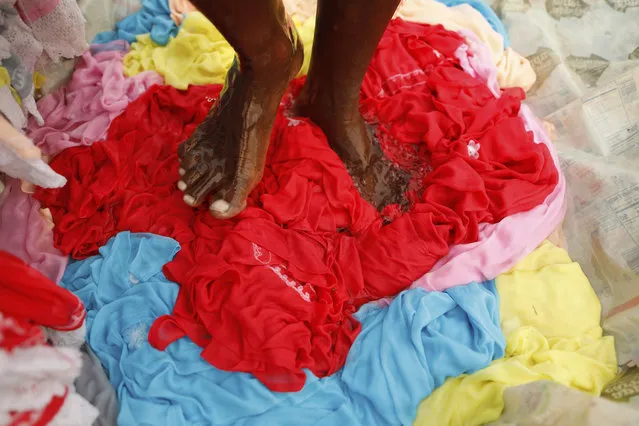
A dhobi, or a washerman washes cloths on the banks of the River Gomti in Lucknow, India, Saturday, September 12, 2020. Dhobis are traditional laundry workers who wash clothes by hand and dry them in the sun, an occupation which has been in existence for generations. Most cities in India have a Dhobi Ghat, or washermen's area, where the city's pile of clothes is laundered. This practice is still popular in India, despite of modern technology. Around 1,000 families work in Lucknow's Dhobi Ghat. However, in light of the novel coronavirus, their wages have decreased drastically. With each family earning around US$100-200 per month. (Photo by Rajesh Kumar Singh/AP Photo)

A dhobi, or a washerman washes cloths on the banks of the River Gomti in Lucknow, India, Saturday, September 12, 2020. Dhobis are traditional laundry workers who wash clothes by hand and dry them in the sun, an occupation which has been in existence for generations. Most cities in India have a Dhobi Ghat, or washermen's area, where the city's pile of clothes is laundered. This practice is still popular in India, despite of modern technology. Around 1,000 families work in Lucknow's Dhobi Ghat. However, in light of the novel coronavirus, their wages have decreased drastically. With each family earning around US$100-200 per month. (Photo by Rajesh Kumar Singh/AP Photo)
Details
25 Sep 2020 00:03:00


“Kumbh Mela is a mass Hindu pilgrimage in which Hindus gather at the Ganges river. The normal Kumbh Mela is celebrated every 3 years, the Ardh (half) Kumbh Mela is celebrated every six years at Haridwar and Prayag, the Purna (complete) Kumbh takes place every twelve years, at four places (Prayag (Allahabad), Haridwar, Ujjain, and Nashik). The Maha (great) Kumbh Mela which comes after 12 “Purna Kumbh Melas”, or 144 years, is held at Allahabad.

The last Ardh Kumbh Mela was held over a period of 45 days beginning in January 2007, more than 70 million Hindu pilgrims took part in the Ardh Kumbh Mela at Prayag, and on January 15, the most auspicious day of the festival of Makar Sankranti, more than 5 million participated. The previous Maha Kumbh Mela, held in 2001, was attended by around 60 million people, making it at the time the largest gathering anywhere in the world in recorded history”. – Wikipedia

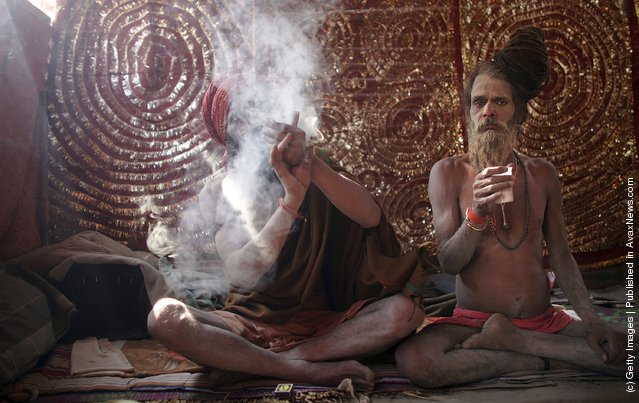
Photo: Sadhus (holy men) smoke at their camp near the ritual site at Sangam, the confluence of the Ganges, Yamuna and mythical Saraswati rivers during the Ardh Kumbh Mela festival (Half Pitcher festival) January 18, 2007 in Allahabad, India. Millions of Hindu pilgrims have flocked to the largest religious gathering in the world which lasts for 45 days in northern India. The festival commemorates the mythical conflict between gods and demons over a pitcher filled with the “nectar of immortality”. Devotees believe that taking a holy dip in the Ganges at this time washes away their sins and paves the path to salvation. (Photo by Mario Tama/Getty Images)

Details
30 Jun 2011 10:27:00
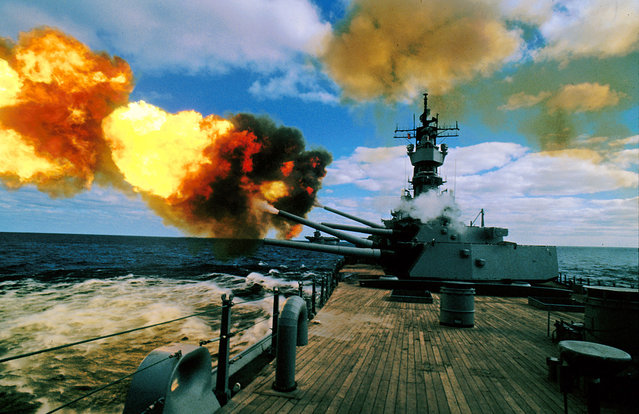
The battleship USS Iowa fires its 16-inch guns during duty in the Persian Gulf on December 16, 1987. In 1943, the Iowa ferried President Franklin Roosevelt home from the Teheran Conference, where post-WW II leaders divided up the world. The ship fought battles from the South Pacific to Korea and escorted convoys through the Persian Gulf. Forty-seven sailors died atop its deck when an explosion ripped through a gun turret. Now, the new port for the retired USS Iowa just might be the home of California's annual asparagus festival, the gritty agriculture port town of Stockton on the San Joaquin River, about 80 miles inland from San Francisco. (Photo by Eric Risberg/AP Photo)

The battleship USS Iowa fires its 16-inch guns during duty in the Persian Gulf on December 16, 1987. In 1943, the Iowa ferried President Franklin Roosevelt home from the Teheran Conference, where post-WW II leaders divided up the world. The ship fought battles from the South Pacific to Korea and escorted convoys through the Persian Gulf. Forty-seven sailors died atop its deck when an explosion ripped through a gun turret. Now, the new port for the retired USS Iowa just might be the home of California's annual asparagus festival, the gritty agriculture port town of Stockton on the San Joaquin River, about 80 miles inland from San Francisco. (Photo by Eric Risberg/AP Photo)
Details
12 Apr 2018 00:05:00
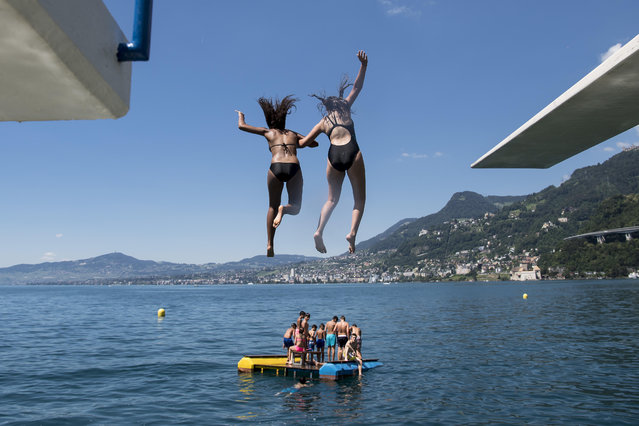
In this July 9, 2016 file photo, girls jump from a diving platform into the Geneva Lake and enjoy sunny and warm weather, in Villeneuve, Switzerland. After nearly 90 years, women can legally swim topless in Geneva’s lake and Rhone River without running the risk of a fine. Geneva’s regional council has voted to modify a 1929 ordinance that banned women from swimming topless in the city’s main natural waterways, though the change doesn’t apply to public swimming pools or swimming totally naked. Nicolas Bolle, an official with Geneva’s security department, on Thursday, April 6, 2017 confirmed the council’s action a day earlier. (Photo by Jean-Christophe Bott/Keystone via AP Photo)

In this July 9, 2016 file photo, girls jump from a diving platform into the Geneva Lake and enjoy sunny and warm weather, in Villeneuve, Switzerland. After nearly 90 years, women can legally swim topless in Geneva’s lake and Rhone River without running the risk of a fine. Geneva’s regional council has voted to modify a 1929 ordinance that banned women from swimming topless in the city’s main natural waterways, though the change doesn’t apply to public swimming pools or swimming totally naked. Nicolas Bolle, an official with Geneva’s security department, on Thursday, April 6, 2017 confirmed the council’s action a day earlier. (Photo by Jean-Christophe Bott/Keystone via AP Photo)
Details
08 Apr 2017 09:39:00
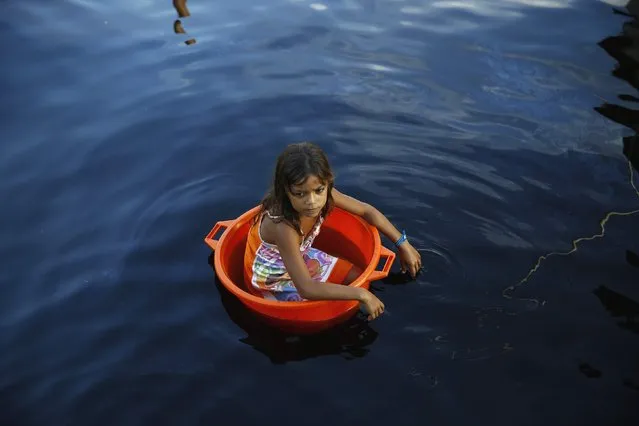
A girl floats in a bucket in the village of Ologa in the western state of Zulia October 23, 2014. (Photo by Jorge Silva/Reuters)

A girl floats in a bucket in the village of Ologa in the western state of Zulia October 23, 2014. This year the Catatumbo Lightning was approved for inclusion in the 2015 edition of Guinness World Records, dethroning the Congolese town of Kifuka as the place with the world's most lightning bolts per square kilometer each year at 250. Scientists think the Catatumbo, named for a river that runs into the lake, is normal lightning that just happens to occur far more than anywhere else, due to local topography and wind patterns. (Photo by Jorge Silva/Reuters)
Details
09 Nov 2014 09:08:00
Lost City Shicheng found Underwater in China

Qiandao Lake (Chinese: 千島湖, lit. Thousand Island Lake), a man-made lake located in Chun'an County, Zhejiang, China, formed after the completion of the Xin'an River hydroelectric station in 1959. 1,078 large islands dot the lake and a few thousand smaller ones are scattered across it. The lake covers an area of 573 km² and has a storage capacity of 17.8 km³. The islands in the lake cover about 86 km²
Details
07 Feb 2014 13:25:00


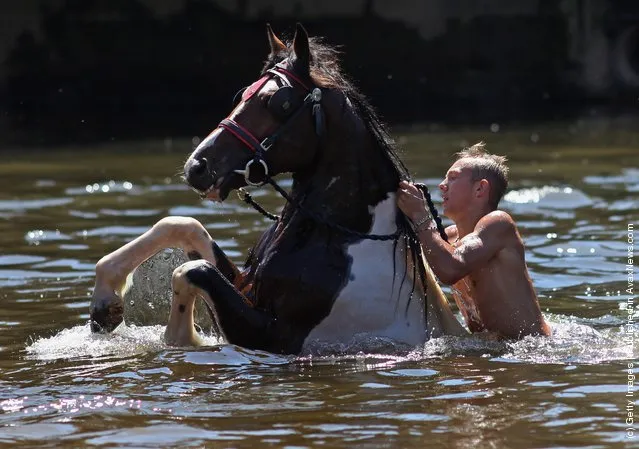
A traveller washes his horse in the River Eden in preparation for selling at the Appleby Horse Fair on June 3, 2011 in Appleby, England. Appleby Horse Fair has existed under the protection of a charter granted by James II since 1685. It is one of the key gathering points for the Romany, gypsy and traveling community. Appleby Horse Fair is attended by about 5,000 travelers who come to buy and sell horses. The animals are washed and groomed before being ridden at high speed along the “mad mile” for the viewing of potential buyers. (Photo by Christopher Furlong/Getty Images)
Details
04 Jun 2011 06:35:00