Loading...
Done
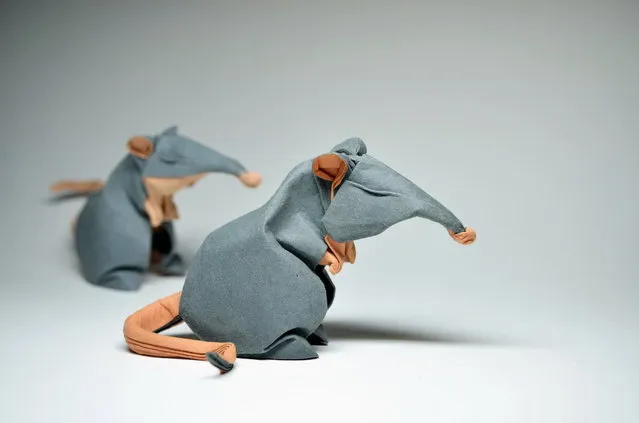
Undercats By Sebastian Magnani

Vietnamese artist Hoang Tien Quyet produces curved paper forms using a difficult technique known as wet-folding. This adds an element of sculpture to the work, making Hoàng’s origami animals truly remarkable. Too little water and the paper dries before the folding is done; too much water, and the paper will rip.
Details
28 May 2015 08:07:00
Mayu adjusts Koiku’s kimono, as Koiku wears a protective face mask while posing for a photograph, before they work at a party where they will entertain with other geisha at Japanese luxury restaurant Asada in Tokyo, Japan, June 23, 2020. The coronavirus pandemic has made Tokyo's geisha fear for their centuries-old profession as never before. Though the number of geisha - famed for their witty conversation, beauty and skill at traditional arts - has been falling for years, they were without work for months due to Japan's state of emergency and now operate under awkward social distancing rules. Engagements are down 95 percent, and come with new rules: no pouring drinks for customers or touching them even to shake hands, and sitting 2 meters apart. Masks are hard to wear with their elaborate wigs, so they mostly don't. “I was just full of anxiety”, said Mayu, 47. “I went through my photos, sorted my kimonos ... The thought of a second wave is terrifying”. (Photo by Kim Kyung-Hoon/Reuters)

Mayu adjusts Koiku’s kimono, as Koiku wears a protective face mask while posing for a photograph, before they work at a party where they will entertain with other geisha at Japanese luxury restaurant Asada in Tokyo, Japan, June 23, 2020. (Photo by Kim Kyung-Hoon/Reuters)
Details
23 Jul 2020 00:03:00
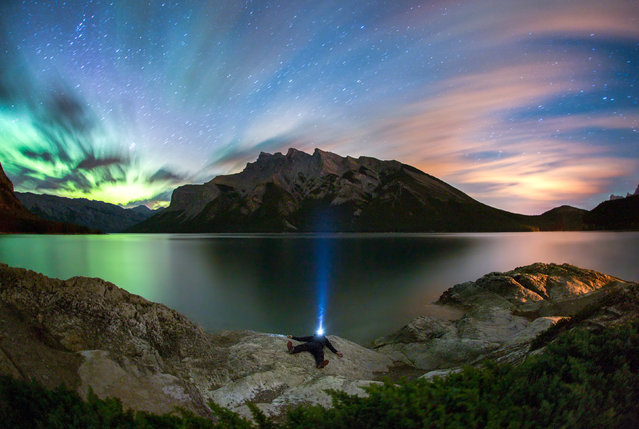
A photographer has shot this series of scenic selfies – scaling freezing mountain tops to snap himself in front of stunning scenery. Paul Zizkas breath-taking work features himself in front of beautiful backdrops such as shimmering lakes, snowy mountains and vibrant auroras. He has travelled to a number of different locations worldwide including Canada, New Zealand, Niue the South Pacific and French Polynesia. (Photo by Paul Zizkas/Caters News)

A photographer has shot this series of scenic selfies – scaling freezing mountain tops to snap himself in front of stunning scenery. Paul Zizkas breath-taking work features himself in front of beautiful backdrops such as shimmering lakes, snowy mountains and vibrant auroras. He has travelled to a number of different locations worldwide including Canada, New Zealand, Niue the South Pacific and French Polynesia. Explorer Paul, from Banff, Alberta, Canada, saw his selfies go viral early in 2014 – and has now unveiled his latest work. He said: I find that sometimes including a person in a landscape scene adds to the photograph – that it conveys a different story. Here: lake Minnewanka, Banff National Park, Alberta, Canada. (Photo by Paul Zizkas/Caters News)

Details
14 Dec 2014 12:18:00
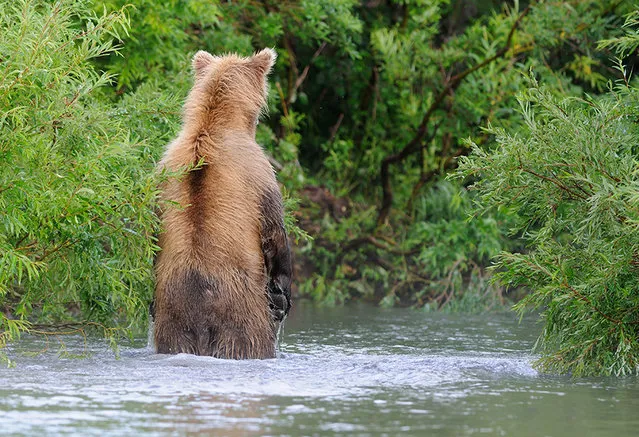
Where's the fish?/n. South Kamchatka Sanctuary<><>South Kamchatka Sanctuary; Kuril Lake; Kamchatka; bear; salmon; spawning

Igor Shpilenok works in the reserve at Kamchatka, Russia. Igor is a fellow of the International League of Conservation Photographers and a winner of the 2006 BBC Wildlife Photographer Competition. Igor’s work has been published in numerous international and Russian magazines, including Smithsonian, National Wildlife, Geo, and BBC Wildlife.

“How does a bear behave when encounter a human? In most cases he runs away. But before running he almost always would rise to stand on his rear feet. And this behavior does not indicate the attack, as many people think...” – Igor Shpilenok. (Photo by Igor Shpilenok via Wildlife Photo Russia)
Details
16 Sep 2012 12:54:00
The Berenson robot strolls among visitors during the exhibition “Persona : Oddly Human” at the Quai Branly museum in Paris, France, February 23, 2016. The Berenson robot, developed in France in 2011, is the brainchild of anthropologist Denis Vidal and robotics engineer Philippe Gaussier. Its programming allows it to record reactions of museum visitors to certain pieces of art and then use the data to develop its own unique taste, which allows “Berenson” to judge whether or not it likes a certain work of art within an exhibition. (Photo by Philippe Wojazer/Reuters)

The Berenson robot strolls among visitors during the exhibition “Persona : Oddly Human” at the Quai Branly museum in Paris, France, February 23, 2016. The Berenson robot, developed in France in 2011, is the brainchild of anthropologist Denis Vidal and robotics engineer Philippe Gaussier. Its programming allows it to record reactions of museum visitors to certain pieces of art and then use the data to develop its own unique taste, which allows “Berenson” to judge whether or not it likes a certain work of art within an exhibition. (Photo by Philippe Wojazer/Reuters)
Details
25 Feb 2016 12:26:00
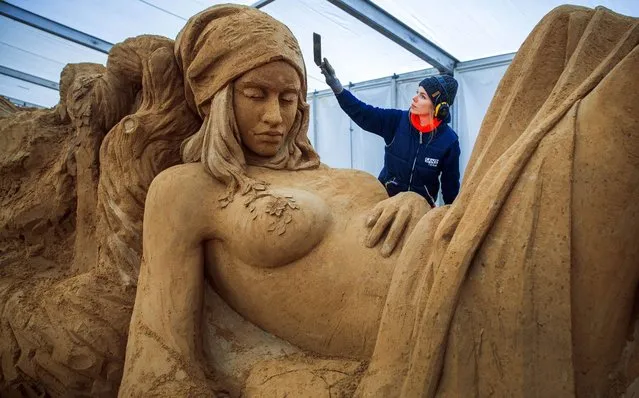
Marieke van der Meer from the Netherlands works on her sculpture “Flora” at the sand sculpture show in Binz on Ruegen island, Germany, 09 March 2016. With the motto “Fascination Nature”, 50 sand artists have created oversized sculptures. The sculptors use 16,000 tons of special sand that is pressed into big blocks first and then formed. The 7th sand sculpture show on 5,600 square meters of exhibition ground opens on 12 March 2016. (Photo by Ens Buettner/EPA)

Marieke van der Meer from the Netherlands works on her sculpture “Flora” at the sand sculpture show in Binz on Ruegen island, Germany, 09 March 2016. With the motto “Fascination Nature”, 50 sand artists have created oversized sculptures. The sculptors use 16,000 tons of special sand that is pressed into big blocks first and then formed. The 7th sand sculpture show on 5,600 square meters of exhibition ground opens on 12 March 2016. (Photo by Ens Buettner/EPA)
Details
10 Mar 2016 13:03:00
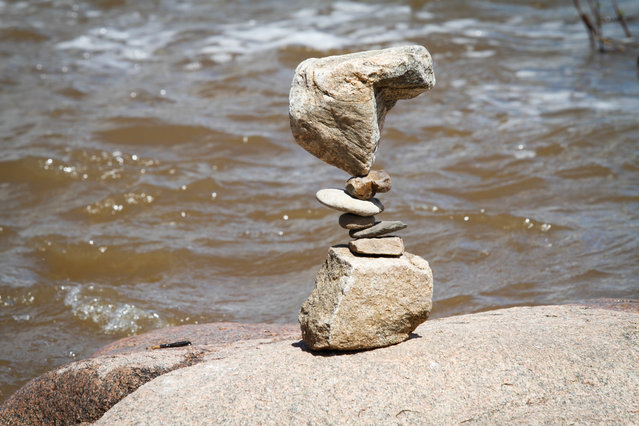
Tim Anderson final balanced rock stack in the Llano River. Tim Anderson, rock balancing “pro” from Pennsylvania, carefully worked to balance his stack on a dry spot in the Llano river Saturday March 12, 2016. He was an honored guest of the festival and enjoyed visiting Texas so he came for another year. The river was higher this year because of the rains so the balancers could not get to the better rock that were available last year. (Photo by Nell Carroll/American-Statesman)

Tim Anderson final balanced rock stack in the Llano River. Tim Anderson, rock balancing “pro” from Pennsylvania, carefully worked to balance his stack on a dry spot in the Llano river Saturday March 12, 2016. He was an honored guest of the festival and enjoyed visiting Texas so he came for another year. The river was higher this year because of the rains so the balancers could not get to the better rock that were available last year. (Photo by Nell Carroll/American-Statesman)
Details
19 Mar 2016 12:47:00
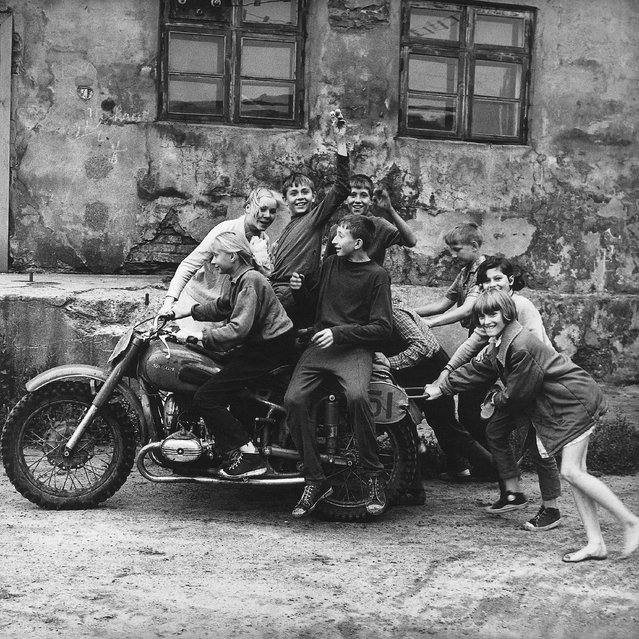
When he started using a camera there were very few documentary photographers working outside the government. Sutkus instead looked to writers and film-makers, and says he drew inspiration from the works of Franz Kafka, Jean-Paul Sartre, Ernest Hemingway and Vladimir Nabokov. Here: The first Lithuanian bikers, 1974. (Photo by Antanas Sutkus)

Rebelling against political propaganda, acclaimed photographer Antanas Sutkus embarked on a life-long journey to capture the everyday scenes around him. Antanas Sutkus, born in 1939, studied journalism at Vilnius University in the late 1950s before becoming disillusioned by the confines of the Soviet-controlled press. He began taking photographs instead, and soon co-founded the Lithuanian Association of Art Photographers. Here: The first Lithuanian bikers, 1974. (Photo by Antanas Sutkus)
Details
11 Apr 2016 10:54:00