Loading...
Done
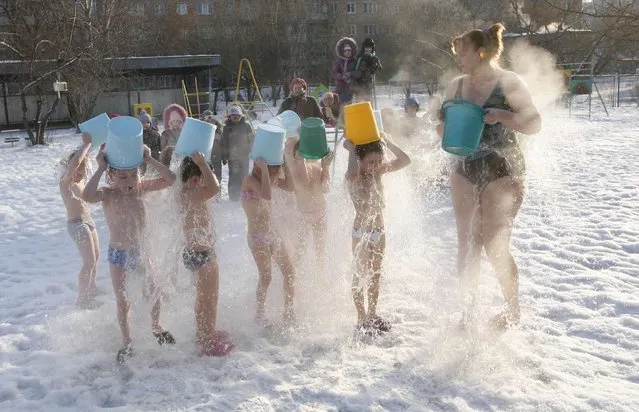
Children pour cold water on themselves under the control of fitness coach Margarita Filimonova (R) at local kindergarten number 317, with the air temperature at about minus 23 degrees Celsius (minus 9.4 degrees Fahrenheit), in Russia's Siberian city of Krasnoyarsk, February 5, 2013. (Photo by Ilya Naymushin/Reuters)

Children pour cold water on themselves under the control of fitness coach Margarita Filimonova (R) at local kindergarten number 317, with the air temperature at about minus 23 degrees Celsius (minus 9.4 degrees Fahrenheit), in Russia's Siberian city of Krasnoyarsk, February 5, 2013. (Photo by Ilya Naymushin/Reuters)

P.S. All pictures are presented in high resolution. To see Hi-Res images – just TWICE click on any picture. In other words, click small picture – opens the BIG picture. Click BIG picture – opens VERY BIG picture (if available; this principle works anywhere on the site AvaxNews).
Details
17 Feb 2013 15:40:00


“Sektor gaza” (Russian: Сектор газа) was a Russian rock band formed on 5 December 1987 in the city of Voronezh, Russia. Despite only semi-officially existing (due to obscene lyrics), the group remains popular in Russia today. The group name was taken from an eponymous industrial district of Voronezh (itself named for high levels of environmental contamination). Their music style could be defined as Russian punk, integrated with elements of different musical genres such as rock, rap, and Russian folk. On 4 July 2000, group leader Yuri “Hoy” Klinskih complained of strong pains in his stomach and the left side of his chest. He suffered heart failure shortly thereafter. Klinskikh died in Voronezh (Russia)at the age of 35. He is buried in the Levoberezhniy Cemetery. The group ceased to exist.

About the music video: The First Chechen War, also known as the War in Chechnya, was a conflict between the Russian Federation and the Chechen Republic of Ichkeria, fought from December 1994 to August 1996. After the initial campaign of 1994 – 1995, culminating in the devastating Battle of Grozny, Russian federal forces attempted to seize control of the mountainous area of Chechnya but were set back by Chechen guerrilla warfare and raids on the flatlands in spite of Russia's overwhelming manpower, weaponry, and air support...
Details
24 May 2012 14:38:00
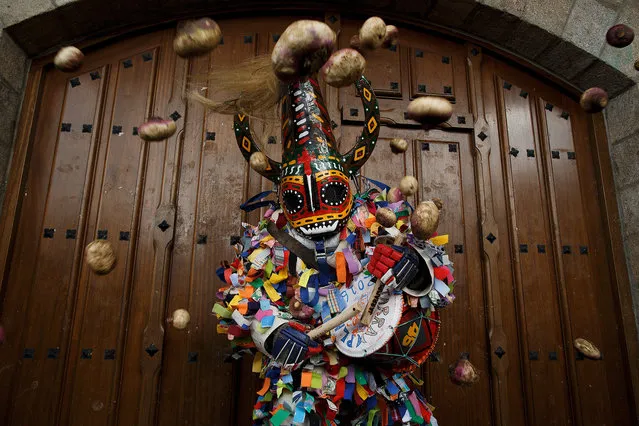
People throw turnips at the Jarramplas as he comes out from the church beating his drum during the Jarramplas Festival on January 20, 2016 in Piornal, Caceres province, Spain. The centuries old Jarramplas festival takes place annually every January 19-20 on Saint Sebastian Day and this year they expect to use more than 20 thousand kilogrames of turnips. Even though the exact origins of the festival are not known, various theories exist including the mythological punishment of Caco by Hercules. (Photo by Pablo Blazquez Dominguez/Getty Images)

People throw turnips at the Jarramplas as he comes out from the church beating his drum during the Jarramplas Festival on January 20, 2016 in Piornal, Caceres province, Spain. The centuries old Jarramplas festival takes place annually every January 19-20 on Saint Sebastian Day and this year they expect to use more than 20 thousand kilogrames of turnips. Even though the exact origins of the festival are not known, various theories exist including the mythological punishment of Caco by Hercules, a relation to ceremonies celebrated by the American Indians that were seen by the first conquerors, to a cattle thief ridiculed and expelled by his village neighbours. It is generally believed to symbolize the expulsion of everything bad. (Photo by Pablo Blazquez Dominguez/Getty Images)
Details
21 Jan 2016 13:21:00
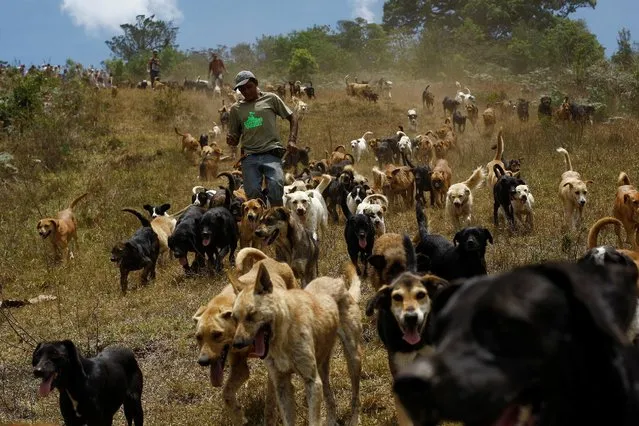
Stray dogs run at dog sanctuary Territorio de Zaguates or “Land of the Strays” in Carrizal de Alajuela, Costa Rica, April 20, 2016. In a lush, sprawling corner of Costa Rica, hundreds of dogs roam freely on a hillside – among the luckiest strays on earth. Fed, groomed and cared for by vets, more than 750 dogs rescued from the streets of Costa Rica inhabit Territorio de Zaguates or “Land of the Strays”, a pooch paradise. The 152-hectare sanctuary in the centre of the Central American country is funded by donations. Around 8,000 dogs have passed through the refuge. There are more than a million stray dogs in Costa Rica, where the government outlawed putting animals down in 2003. (Photo by Juan Carlos Ulate/Reuters)

Stray dogs run at dog sanctuary Territorio de Zaguates or “Land of the Strays” in Carrizal de Alajuela, Costa Rica, April 20, 2016. In a lush, sprawling corner of Costa Rica, hundreds of dogs roam freely on a hillside – among the luckiest strays on earth. Fed, groomed and cared for by vets, more than 750 dogs rescued from the streets of Costa Rica inhabit Territorio de Zaguates or “Land of the Strays”, a pooch paradise. (Photo by Juan Carlos Ulate/Reuters)
Details
30 Apr 2016 09:41:00
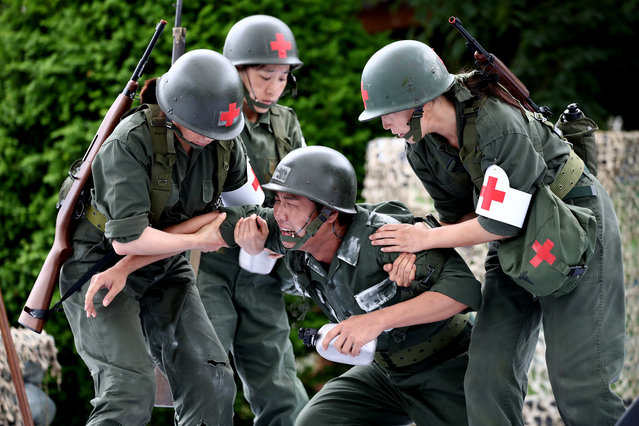
South Korean performers participate in a re-enactment of the battle of the Korean war during the ceremony to mark the 70th anniversary of the Korean War in Cheorwon, near the border with North Korea on June 25, 2020 in Cheorwon, South Korea. Over 66,000 South Koreans have been separated from their families during the Korean War which started on June 25, 1950, and effectively split the Korean Peninsula into two over the 3-year conflict. The fighting between North and South Korea ended on July 27, 1953, with the signing of the Korean Armistice Agreement and the heavily guarded Demilitarized Zone was created, however, both countries remain technically still at war since no peace agreement was signed and many Koreans died before they could reunite with their loved ones. (Photo by Chung Sung-Jun/Getty Images)

South Korean performers participate in a re-enactment of the battle of the Korean war during the ceremony to mark the 70th anniversary of the Korean War in Cheorwon, near the border with North Korea on June 25, 2020 in Cheorwon, South Korea. Over 66,000 South Koreans have been separated from their families during the Korean War which started on June 25, 1950, and effectively split the Korean Peninsula into two over the 3-year conflict. (Photo by Chung Sung-Jun/Getty Images)
Details
27 Jun 2020 00:03:00
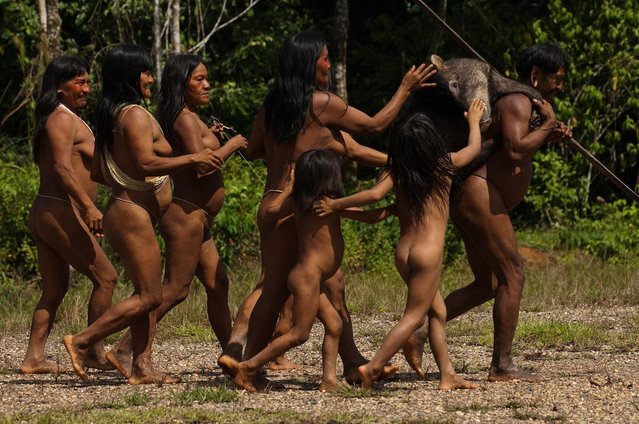
Spectacular images offering insight into the lives of the Huaorani people in the Ecuadorian Amazon have been revealed showing how they use traditional methods to hunt monkeys for food. The stunning pictures were taken by conservation photographer Pete Oxford from Torquay, Devon in the Ecuadorian Amazon. “The Huaorani Indians are a forest people highly in tune with their environment. Many are now totally acculturated since the 1950s by missionaries”, said Pete. “Today they face radical change to their culture to the proximity of oil exploration within their territory and the Yasuni National Park and Biosphere Reserve, they are vastly changed. Some still live very traditionally and for this shoot, through my Huaorani friend, a direct relative of those photographed he wanted to depict them as close to their original culture as possible. They still largely hunt with blow pipes and spears eating a lot of monkeys and peccaries”. The Huaorani are also known as the Waorani, Waodani or the Waos and are native Amerindians. Their lands are located between the Curaray and Napo rivers and speak the Huaorani language. Pete says that during his visit he was welcomed into the group and hopes that ancient cultures can be saved. Here: The tribe were seen celebrating after a hunter returned to camp with a wild pig. (Photo by Pete Oxford/Mediadrumworld.com)

Spectacular images offering insight into the lives of the Huaorani people in the Ecuadorian Amazon have been revealed showing how they use traditional methods to hunt monkeys for food. The stunning pictures were taken by conservation photographer Pete Oxford from Torquay, Devon in the Ecuadorian Amazon. Here: The tribe were seen celebrating after a hunter returned to camp with a wild pig. (Photo by Pete Oxford/Mediadrumworld.com)
Details
20 Jan 2017 07:58:00
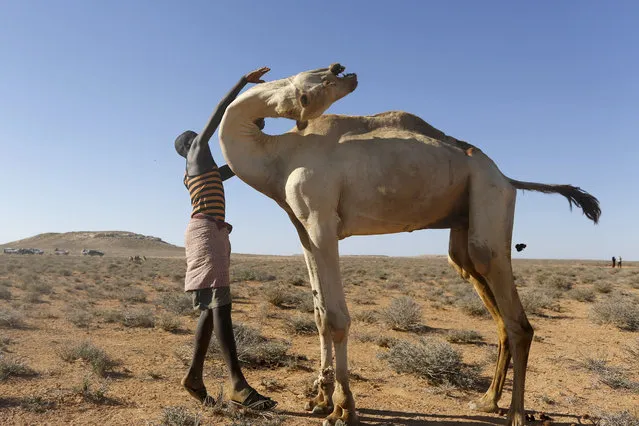
Ali Asair, who has left his family behind and traveled hundreds of kilometers in search for a pasture for his animals, attends to his camel in a pastoralists' settlement in the Bandarbeyla district in Somalia's semi-autonomous region of Puntland, Somalia, 24 March 2017. According to media reports, the United Nations says only 31 percent of 864 million US dollars appeal for a drought-hit Somalia is funded. The UN said the world is facing the largest humanitarian crisis since 1945, adding that more than 20 million people are facing the threat of famine in Somalia, Yemen, South Sudan and Nigeria and 1.4 million children could die from starvation this year. (Photo by Dai Kurokawa/EPA)

Ali Asair, who has left his family behind and traveled hundreds of kilometers in search for a pasture for his animals, attends to his camel in a pastoralists' settlement in the Bandarbeyla district in Somalia's semi-autonomous region of Puntland, Somalia, 24 March 2017. According to media reports, the United Nations says only 31 percent of 864 million US dollars appeal for a drought-hit Somalia is funded. The UN said the world is facing the largest humanitarian crisis since 1945, adding that more than 20 million people are facing the threat of famine in Somalia, Yemen, South Sudan and Nigeria and 1.4 million children could die from starvation this year. (Photo by Dai Kurokawa/EPA)
Details
28 Mar 2017 09:01:00
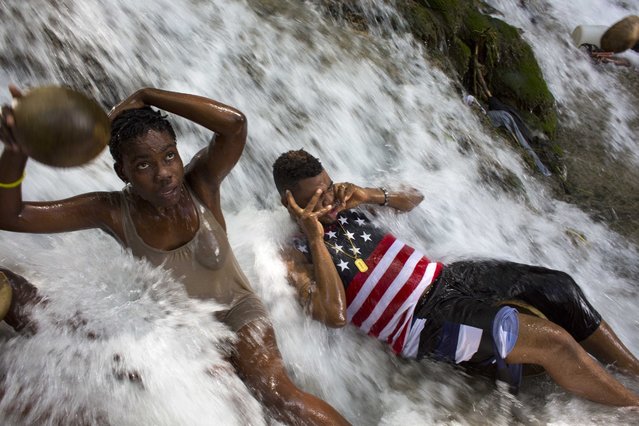
Voodoo pilgrims bathe in a waterfall believed to have purifying powers during the annual celebration in Saut d' Eau, Haiti, Saturday, July 16, 2016. Annually, the falls are the site of a large, important religious pilgrimage, during the festival of Our Lady of Carmel, from July 14–16. A Eucharistic rite is held during the festival, as well as various vodou rituals, but the penultimate devotional activity is bathing in the waters of the falls, and asking favors of the Virgin or Erzulie. After bathing, voodoo pilgrims throw away the dresses they wore to the site, and don new clothes for good luck. (Photo by Dieu Nalio Chery/AP Photo)

Voodoo pilgrims bathe in a waterfall believed to have purifying powers during the annual celebration in Saut d' Eau, Haiti, Saturday, July 16, 2016. Annually, the falls are the site of a large, important religious pilgrimage, during the festival of Our Lady of Carmel, from July 14–16. A Eucharistic rite is held during the festival, as well as various vodou rituals, but the penultimate devotional activity is bathing in the waters of the falls, and asking favors of the Virgin or Erzulie. After bathing, voodoo pilgrims throw away the dresses they wore to the site, and don new clothes for good luck. (Photo by Dieu Nalio Chery/AP Photo)
Details
18 Jul 2016 13:02:00