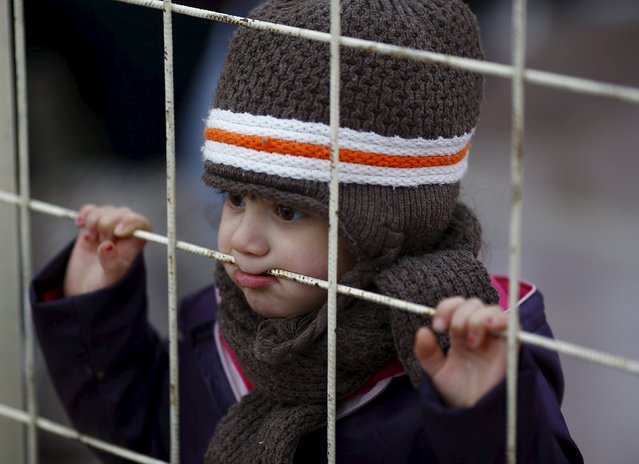
A Syrian boy looks through a gate as others wait to cross into Syria at Oncupinar border crossing in the southeastern city of Kilis, Turkey February 11, 2016.. (Photo by Osman Orsal/Reuters)
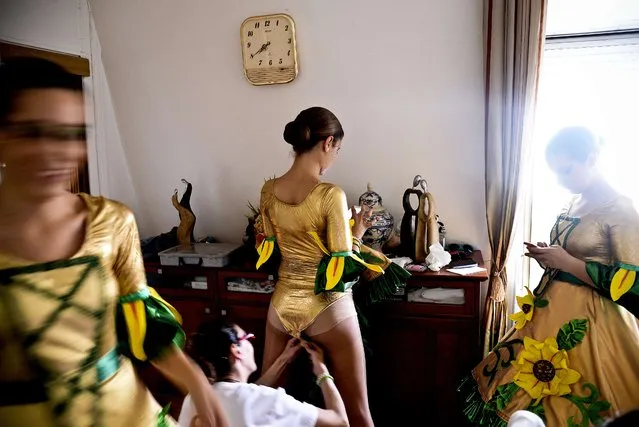
Inês Carvalho (C), accompanied by her sister and cousin, is helped by her aunt to dress up at Alfama neighborhood in Lisbon on June 12, 2014. Carvalho, 18, is one of the revelers from the Alfama march and every Saint Anthony's day, Lisbon's protector, she parades with several other typical neighborhoods of the city. (Photo by Patricia De Melo Moreira/AFP Photo)
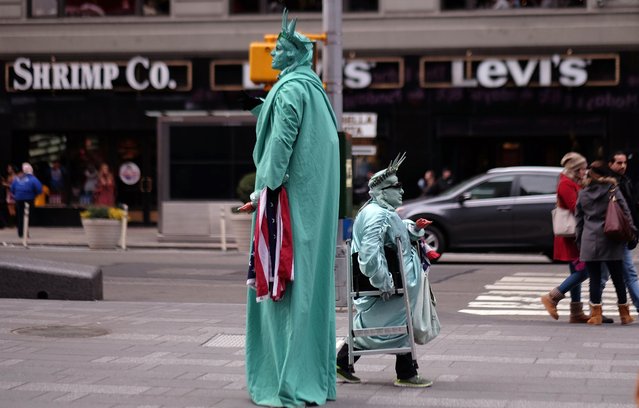
Two men dressed as the Statue of Liberty look for tourists to pose with them for pictures in exchange for donations in New York's Times Square on January 20, 2015. (Photo by Jewel Samad/AFP Photo)
This Thursday, January 22, 2015 photo made with a long exposure shows the glow from a Noctiluca scintillans algal bloom along the seashore in Hong Kong. The luminescence, also called Sea Sparkle, is triggered by farm pollution that can be devastating to marine life and local fisheries, according to University of Georgia oceanographer Samantha Joye. Noctiluca itself does not produce neurotoxins like other similar organisms do. But its role as both prey and predator tends can eventually magnify the accumulation of toxins in the food chain, according to R. Eugene Turner at Louisiana State University. (Photo by Kin Cheung/AP Photo)
Jill Olsen (R) has her picture taken inside a giant cocoon, from the “Falling Skies” TV series, during the 2014 Comic-Con International Convention in San Diego, California July 24, 2014. (Photo by Sandy Huffaker/Reuters)
Festival goers in Finsbury Park ahead of the Wireless Festival at Finsbury Park in London, United Kingdom on Friday, July 8, 2022. (Photo by James Manning/PA Wire Press Association)
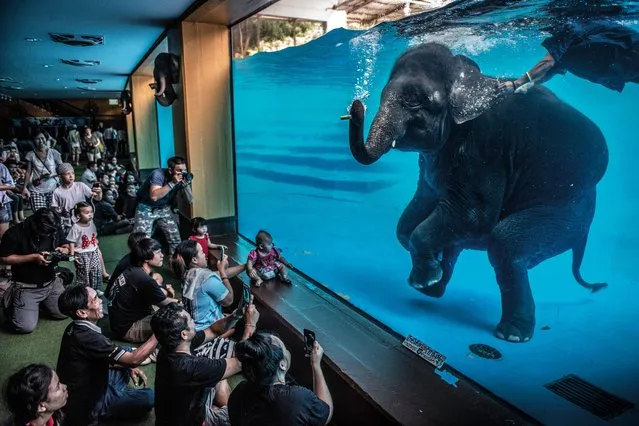
Winner, photojournalism. Elephant in the room, by Adam Oswell, Australia Zoo. Visitors watch a young elephant performing underwater. Oswell was disturbed by this scene, and organisations concerned with the welfare of captive elephants say performances like this encourage unnatural behaviour. In Thailand, there are now more elephants in captivity than in the wild. With the Covid pandemic causing tourism to collapse, elephant sanctuaries are becoming overwhelmed with animals that can no longer be looked after by their owners. (Photo by Adam Oswell/Wildlife Photographer of the Year 2021)