Loading...
Done
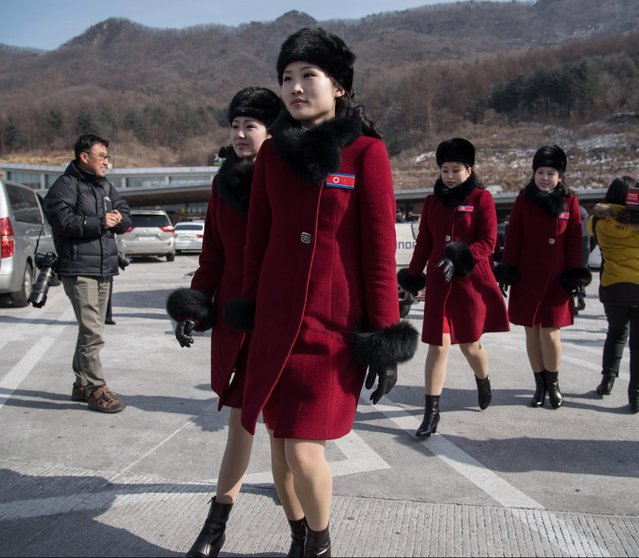
North Korean cheerleaders arrive at a rest stop, or service station, as their bus convoy carrying a 280- member delegation on its way to the 2018 Pyeongchang winter Olympic games, makes its way past Gapyeong on February 7, 2018 More than 200 young North Korean women arrived in South Korea to root for athletes from both sides of the peninsula at the Winter Olympics. (Photo by Ed Jones/AFP Photo)

North Korean cheerleaders arrive at a rest stop, or service station, as their bus convoy carrying a 280- member delegation on its way to the 2018 Pyeongchang winter Olympic games, makes its way past Gapyeong on February 7, 2018 More than 200 young North Korean women arrived in South Korea to root for athletes from both sides of the peninsula at the Winter Olympics. (Photo by Ed Jones/AFP Photo)
Details
08 Feb 2018 09:41:00
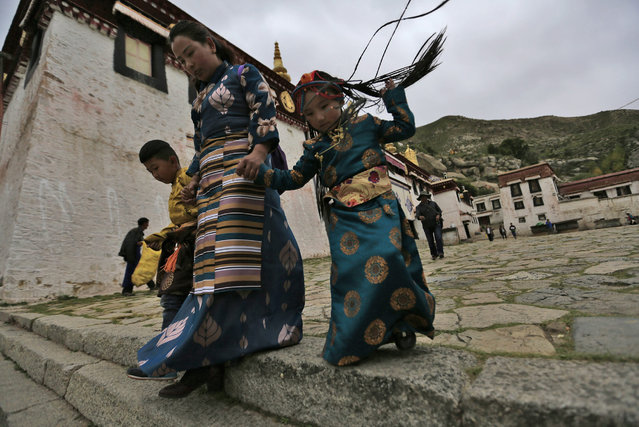
Tibetan pilgrims walk outside the Sera Monastery in Lhasa, Tibet Autonomous Region, China, 11 September 2016. Sera Monastery is known as one of the “great three” Gelug university monasteries of Tibet founded in 1419. (Photo by How Hwee Young/EPA)

Tibetan pilgrims walk outside the Sera Monastery in Lhasa, Tibet Autonomous Region, China, 11 September 2016. Sera Monastery is known as one of the “great three” Gelug university monasteries of Tibet founded in 1419. (Photo by How Hwee Young/EPA)
Details
22 Sep 2016 09:59:00
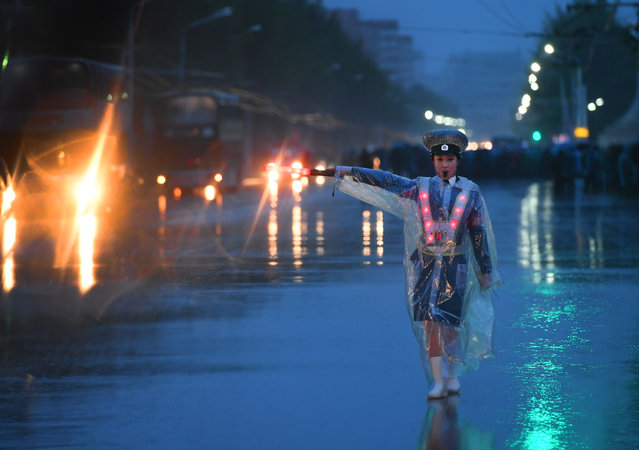
A woman directs traffic in the pouring rain in Pyongyang, North Korea on May 3, 2016. The city is preparing for the Workers' Party Congress starting on May 6th.  It will be the first time since 1980 that the ruling party has convened. (Photo by Linda Davidson/The Washington Post)

A woman directs traffic in the pouring rain in Pyongyang, North Korea on May 3, 2016. The city is preparing for the Workers' Party Congress starting on May 6th. It will be the first time since 1980 that the ruling party has convened. (Photo by Linda Davidson/The Washington Post)
Details
09 May 2016 09:27:00
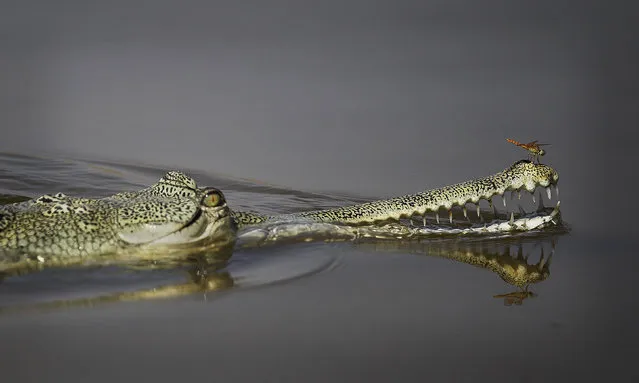
In this photo taken Wednesday, April 30, 2014, a dragonfly sits on the nose of a Gharial, rare crocodile-like creatures, in the River Chambal near Bhopepura village in the northern Indian state of Uttar Pradesh. The narrow 250-mile stretch of the Chambal is a place of crocodiles and jackals, of river dolphins and the occasional wolf. Hundreds of species of birds, storks, geese, babblers, larks, falcons and so many more, nest along the river. (Photo by Altaf Qadri/AP Photo)

In this photo taken Wednesday, April 30, 2014, a dragonfly sits on the nose of a Gharial, rare crocodile-like creatures, in the River Chambal near Bhopepura village in the northern Indian state of Uttar Pradesh. The narrow 250-mile stretch of the Chambal is a place of crocodiles and jackals, of river dolphins and the occasional wolf. Hundreds of species of birds, storks, geese, babblers, larks, falcons and so many more, nest along the river. Endangered birds lay small speckled eggs in tiny pits they dig in the sandbars. Gharials, rare crocodile-like creatures that look like they swaggered out of the Mesozoic Era, are commonplace here and nowhere else. (Photo by Altaf Qadri/AP Photo)
Details
23 Feb 2015 12:55:00
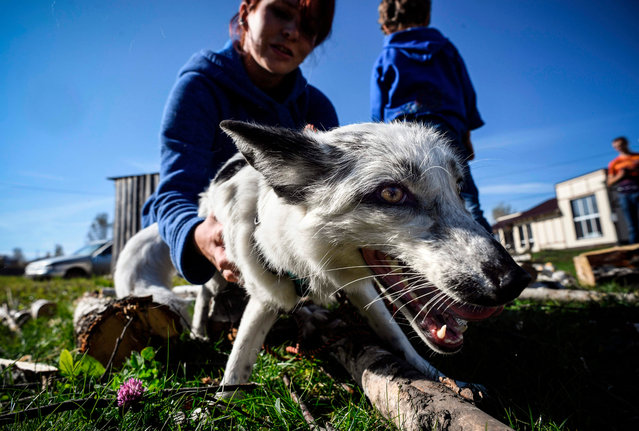
Tatyana Abramova, 33, plays with her home fox Plombir at her countryside house outside Siberian city of Novosibirsk on September 12, 2020. The official start of the Soviet experiment to better understand the domestication of animals by humans began in 1959, and was initiated by geneticists Dmitri Beliaiev and Lioudmila Trout on a farm in Akademgorodok, the scientific center of excellence in Siberia. Their primary objective was to domesticate foxes, to understand how the ancestor of wolves, another canine, evolved into a loyal and loving dog. And understand what this domestication tells us about the genetic evolution of species. (Photo by Alexander Nemenov/AFP Photo)

Tatyana Abramova, 33, plays with her home fox Plombir at her countryside house outside Siberian city of Novosibirsk on September 12, 2020. The official start of the Soviet experiment to better understand the domestication of animals by humans began in 1959, and was initiated by geneticists Dmitri Beliaiev and Lioudmila Trout on a farm in Akademgorodok, the scientific center of excellence in Siberia. Their primary objective was to domesticate foxes, to understand how the ancestor of wolves, another canine, evolved into a loyal and loving dog. And understand what this domestication tells us about the genetic evolution of species. (Photo by Alexander Nemenov/AFP Photo)
Details
25 Oct 2020 00:05:00
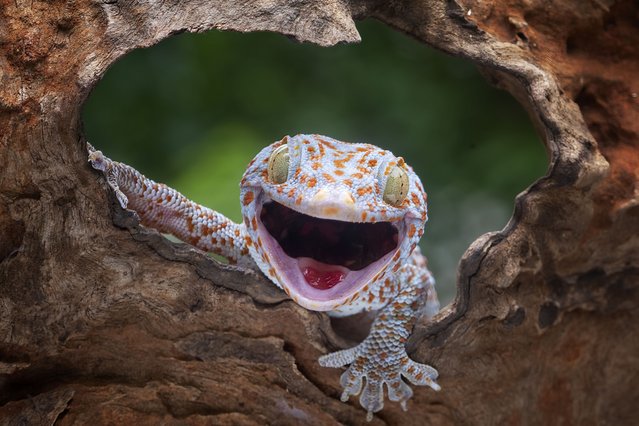
A smiling gecko bursts through a gap in the bark to surprise photographer in West Java, Indonesia in the last decade of March 2025. (Photo by Dzul Duzulfikri/Animal News Agency)

A smiling gecko bursts through a gap in the bark to surprise photographer in West Java, Indonesia in the last decade of March 2025. (Photo by Dzul Duzulfikri/Animal News Agency)
Details
06 Apr 2025 03:52:00
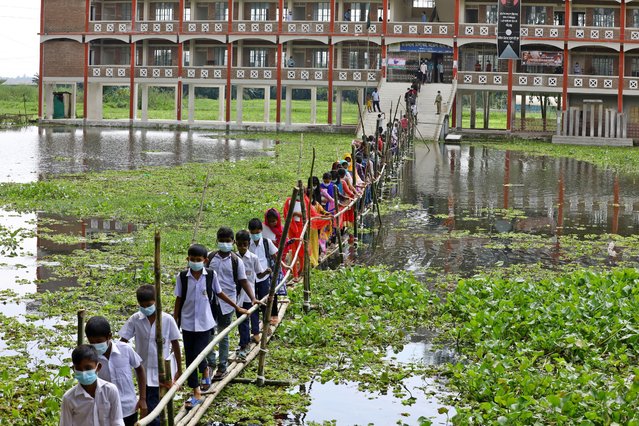
Students leave school via a bamboo bridge after the area was hit by floods in Gazipur, Bangladesh on September 12, 2021. (Photo by Harun-Or-Rashid/Eyepix Group/Rex Features/Shutterstock)

Students leave school via a bamboo bridge after the area was hit by floods in Gazipur, Bangladesh on September 12, 2021. (Photo by Harun-Or-Rashid/Eyepix Group/Rex Features/Shutterstock)
Details
23 Oct 2021 08:34:00
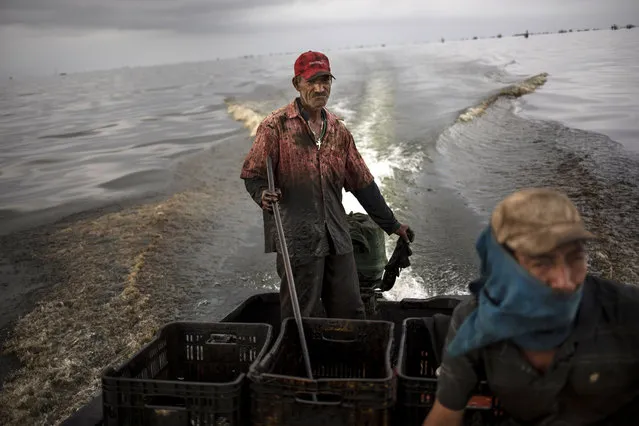
Fisherman Jose Miguel Perez, whose nickname is “Taliban”, navigates the oil infested waters of Lake Maracaibo, near Cabimas, Venezuela, May 21, 2019. Nobody lives as closely with the environmental fallout of Venezuela's collapsing oil industry as the fishermen who scratch out an existence on the blackened, sticky shores of Lake Maracaibo. (Photo by Rodrigo Abd/AP Photo)

Fisherman Jose Miguel Perez, whose nickname is “Taliban”, navigates the oil infested waters of Lake Maracaibo, near Cabimas, Venezuela, May 21, 2019. Nobody lives as closely with the environmental fallout of Venezuela's collapsing oil industry as the fishermen who scratch out an existence on the blackened, sticky shores of Lake Maracaibo. (Photo by Rodrigo Abd/AP Photo)
Details
26 Nov 2019 00:03:00