Loading...
Done
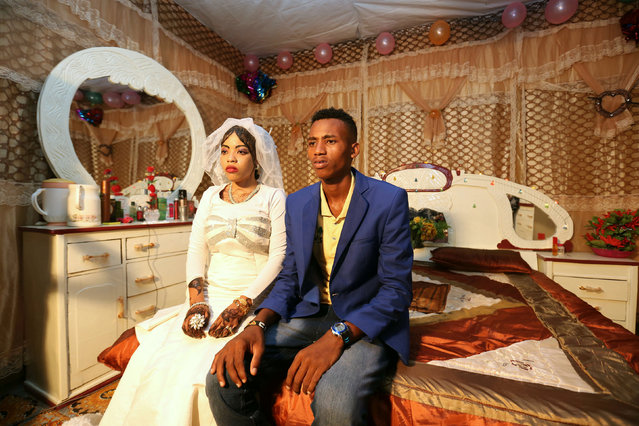
Somali couple Mohamed Noor (L) and Huda Omar pose for a photograph at their makeshift home during their wedding ceremony in Mogadishu's Rajo camp, Somalia August 17, 2016. Having met two years ago, the pair have just married at Rajo camp, where some 400 families live. Most, like Noor's parents, came here in the early 1990s to flee famine. They stayed on as years of conflict ravaged the Horn of Africa nation. As at any wedding, there is plenty of dancing and sweet treats for the young couple as they start married life in Noor's simple home, made of iron and plastic sheets. Noor works as a mason with his father. Others here are builders or sell sweets, nuts and stick toothbrushes to make money. Some beg around the seaside city, which like the rest of Somalia has been gripped by violence since the toppling of dictator Mohamed Siad Barre in 1991. (Photo by Feisal Omar/Reuters)

Somali couple Mohamed Noor (L) and Huda Omar pose for a photograph at their makeshift home during their wedding ceremony in Mogadishu's Rajo camp, Somalia August 17, 2016. Having met two years ago, the pair have just married at Rajo camp, where some 400 families live. Most, like Noor's parents, came here in the early 1990s to flee famine. (Photo by Feisal Omar/Reuters)
Details
14 Sep 2016 10:35:00
A park worker holds a monitor lizard at Lumpini park in Bangkok, Thailand, September 20, 2016. (Photo by Athit Perawongmetha/Reuters)

A park worker holds a monitor lizard at Lumpini park in Bangkok, Thailand, September 20, 2016. More than 400 of the Monitor lizards in the park will be caught by Thai authorities to relocate the reptile to a wildlife breeding center in the effort to control the creature population in the public park after the monitor lizard disturbing and causing several minor accident of people who jogging and cycling at the Lumpini Park. (Photo by Athit Perawongmetha/Reuters)
Details
21 Sep 2016 09:49:00
China has recently relaxed its one child policy that was used to control a burgeoning population. A couple has their wedding photo taken in an old quarter of Beijing on May 24, 2016. (Photo by Michael Robinson Chavez/The Washington Post)

China has recently relaxed its one child policy that was used to control a burgeoning population. A couple has their wedding photo taken in an old quarter of Beijing on May 24, 2016. (Photo by Michael Robinson Chavez/The Washington Post)
Details
27 Sep 2016 09:14:00
A group of fashionable nonagenarians pose for a photo in Pengzhou, Sichuan, China on October 12, 2016. (Photo by Rex Features/Shutterstock)

A group of fashionable nonagenarians pose for a photo in Pengzhou, Sichuan, China on October 12, 2016. (Photo by Rex Features/Shutterstock)
Details
16 Oct 2016 10:57:00
A man holds up for a picture a one hundred trillion Zimbabwean dollars note inside a shop in Harare, Zimbawe, June 12, 2015. (Photo by Philimon Bulawayo/Reuters)

A man holds up for a picture a one hundred trillion Zimbabwean dollars note inside a shop in Harare, Zimbawe, June 12, 2015. Hyperinflation in Zimbabwe was a period of currency instability that began in the late 1990s shortly after the confiscation of private farms from landowners, towards the end of Zimbabwean involvement in the Second Congo War. During the height of inflation from 2008 to 2009, it was difficult to measure Zimbabwe's hyperinflation because the government of Zimbabwe stopped filing official inflation statistics. However, Zimbabwe's peak month of inflation is estimated at 79.6 billion percent in mid-November 2008. (Photo by Philimon Bulawayo/Reuters)
Details
25 Oct 2016 10:08:00
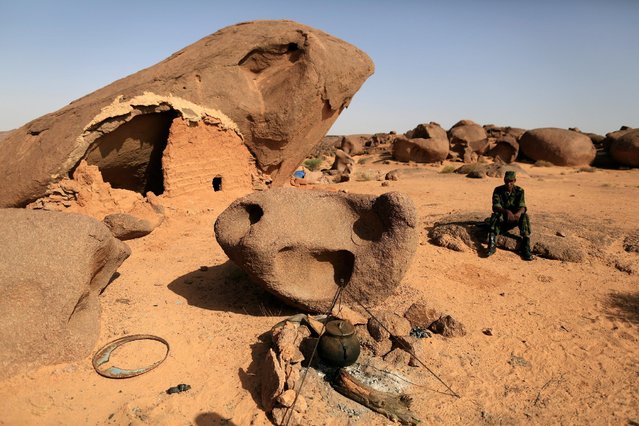
A Polisario fighter sits on a rock at a forward base on the outskirts of Tifariti, Western Sahara, September 9, 2016. At a rocky outpost in Western Sahara, a new generation of soldiers who have never known war are mobilising as tensions resurface in one of Africa's oldest disputes after a quarter century of uneasy peace. Young Sahrawi troops man new desert posts for the Polisario Front, which for more than 40 years has sought independence for the vast desert region - first in a guerrilla war against Morocco and then politically since a ceasefire deal in 1991. Now a standoff with Morocco, which controls the majority of Western Sahara, is renewing pressure for a diplomatic solution to ensure foot soldiers don't return to fighting as the last generation of commanders once did. The standoff since August has brought Moroccan and Polisario forces within 200 metres of each other in a narrow strip of land near the Mauritanian border. Rich in phosphate, Western Sahara has been contested since 1975 when Spanish colonial powers left. Morocco claimed the territory and fought the 16-year war with Polisario. (Photo by Zohra Bensemra/Reuters)

A Polisario fighter sits on a rock at a forward base on the outskirts of Tifariti, Western Sahara, September 9, 2016. At a rocky outpost in Western Sahara, a new generation of soldiers who have never known war are mobilising as tensions resurface in one of Africa's oldest disputes after a quarter century of uneasy peace. (Photo by Zohra Bensemra/Reuters)
Details
04 Nov 2016 12:09:00
Santa Jerry Julian of Colorado Springs, Colorado hides in the grass following a ride on the Polar Express during a field trip from the Charles W. Howard Santa Claus School in Midland, Michigan, U.S. October 28, 2016. (Photo by Christinne Muschi/Reuters)

Santa Jerry Julian of Colorado Springs, Colorado hides in the grass following a ride on the Polar Express during a field trip from the Charles W. Howard Santa Claus School in Midland, Michigan, U.S. October 28, 2016. (Photo by Christinne Muschi/Reuters)
Details
19 Nov 2016 11:24:00
For her series “Japanese Whispers”, Belgian photographer Zaza Bertrand headed inside the intimate world of rabuhos – Japanese love hotels. Love hotels became popular in Japan from the 1960s onwards, due to a lack of privacy in many family homes. There are now around 37,000 of these hotels in Japan, allowing short daytime “rests” or overnight stays. (Photo by Zaza Bertrand/The Guardian)

For her series “Japanese Whispers”, Belgian photographer Zaza Bertrand headed inside the intimate world of rabuhos – Japanese love hotels. Love hotels became popular in Japan from the 1960s onwards, due to a lack of privacy in many family homes. There are now around 37,000 of these hotels in Japan, allowing short daytime “rests” or overnight stays. (Photo by Zaza Bertrand/The Guardian)
Details
02 Dec 2016 11:30:00