Loading...
Done
Aiden Haas, left, and Lilli Alcala pose after being crowned Mud King and Mud Queen at the 29th annual Mud Day, Tuesday, July 12, 2016 in Westland, Mich. The event, open to children 12 and younger, was at the Hines Park-Nankin Mills Area west of Detroit. Children 12 and younger were able to slosh around in the pit while participating in mud limbo, wheelbarrow races and other free activities. (Photo by Carlos Osorio/AP Photo)

Aiden Haas, left, and Lilli Alcala pose after being crowned Mud King and Mud Queen at the 29th annual Mud Day, Tuesday, July 12, 2016 in Westland, Mich. The event, open to children 12 and younger, was at the Hines Park-Nankin Mills Area west of Detroit. Children 12 and younger were able to slosh around in the pit while participating in mud limbo, wheelbarrow races and other free activities. (Photo by Carlos Osorio/AP Photo)
Details
14 Jul 2016 09:57:00
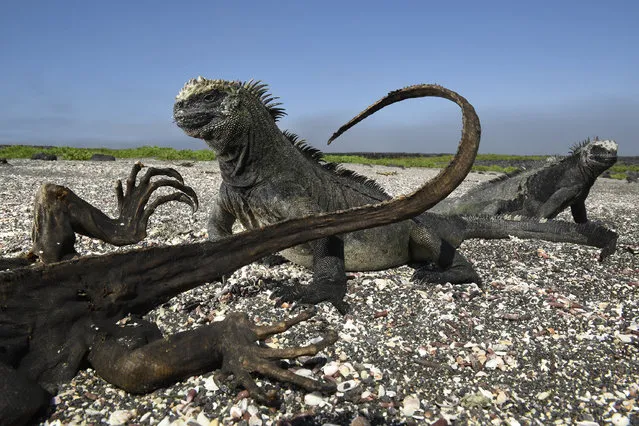
Galapagos – Rocking the Cradle: Four major ocean currents converge along the Galapagos archipelago, creating the conditions for an extraordinary diversity of animal life, April 25, 2016. The islands are home to at least 7,000 flora and fauna species, of which 97 percent of the reptiles, 80 percent of the land birds, 50 percent of the insects and 30 percent of the plants are endemic. The local ecosystem is highly sensitive to the changes in temperature, rainfall and ocean currents that characterize the climatic events known as El Niño and La Niña. These changes cause marked fluctuations in weather and food availability. Many scientists expect the frequency of El Niño and La Niña to increase as a result of climate change, making the Galapagos a possible early-warning location for its effects. (Photo by Thomas P. Peschak for National Geographic/World Press Photo)

Galapagos – Rocking the Cradle: Four major ocean currents converge along the Galapagos archipelago, creating the conditions for an extraordinary diversity of animal life, April 25, 2016. The islands are home to at least 7,000 flora and fauna species, of which 97 percent of the reptiles, 80 percent of the land birds, 50 percent of the insects and 30 percent of the plants are endemic. (Photo by Thomas P. Peschak for National Geographic/World Press Photo)
Details
16 Apr 2018 00:01:00
Lilly Caron, 8, of Bridgeton, Maine, Jason Homchick, of San Diego, and Lilly's father Jason Caron, (obscured), ride the Sky Swing at Seacoast Adventure, Thursday, July 14, 2016, in Wyndham, Maine. The 100-foot-tall swing gives riders the combined thrills of sky diving and hang gliding. (Photo by Robert F. Bukaty/AP Photo)

Lilly Caron, 8, of Bridgeton, Maine, Jason Homchick, of San Diego, and Lilly's father Jason Caron, (obscured), ride the Sky Swing at Seacoast Adventure, Thursday, July 14, 2016, in Wyndham, Maine. The 100-foot-tall swing gives riders the combined thrills of sky diving and hang gliding. (Photo by Robert F. Bukaty/AP Photo)
Details
16 Jul 2016 09:05:00
Two models sit in an acrylic “ZF-Car” from the German manufacturer of the same name at the Automechanika automotive service industry trade fair in Frankfurt am Main, Germany, 12 September 2016. The Automechanika Fair runs from 13 to 17 September 2016. (Photo by Boris Rössler/EPA)

Two models sit in an acrylic “ZF-Car” from the German manufacturer of the same name at the Automechanika automotive service industry trade fair in Frankfurt am Main, Germany, 12 September 2016. The Automechanika Fair runs from 13 to 17 September 2016. (Photo by Boris Rössler/EPA)
Details
13 Sep 2016 10:17:00
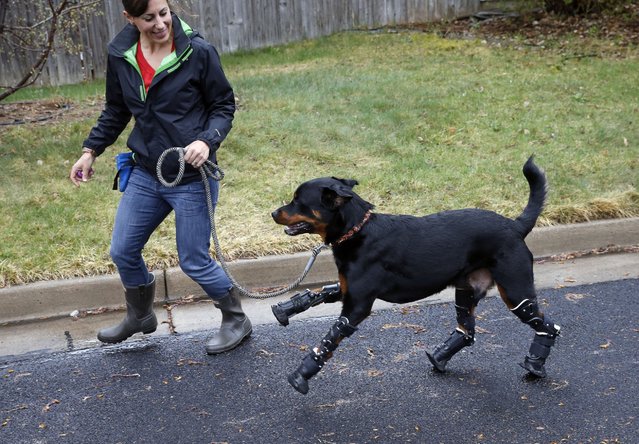
In this April 2, 2015 photo, dog owner Laura Aquilina strolls with her two year old Rottweiler Brutus, who was recently fitted with prosthetics on all four paws, and is currently learning to use them, near Aquilina's home in Loveland, Colo. Brutus lost all four paws to frostbite as a puppy while under care of a breeder, and Aquilina began caring for him about a year ago. (Photo by Brennan Linsley/AP Photo)

In this April 2, 2015 photo, dog owner Laura Aquilina strolls with her two year old Rottweiler Brutus, who was recently fitted with prosthetics on all four paws, and is currently learning to use them, near Aquilina's home in Loveland, Colo. Brutus lost all four paws to frostbite as a puppy while under care of a breeder, and Aquilina began caring for him about a year ago. (Photo by Brennan Linsley/AP Photo)
Details
11 Apr 2015 10:03:00
Valentin Arias Delgado and Diana Franco Durango, from Colombia, perform their routine at the Stage style Tango World Championship, in Buenos Aires, Argentina, August 31, 2016. (Photo by Enrique Marcarian/Reuters)

Valentin Arias Delgado and Diana Franco Durango, from Colombia, perform their routine at the Stage style Tango World Championship, in Buenos Aires, Argentina, August 31, 2016. (Photo by Enrique Marcarian/Reuters)
Details
02 Sep 2016 13:26:00
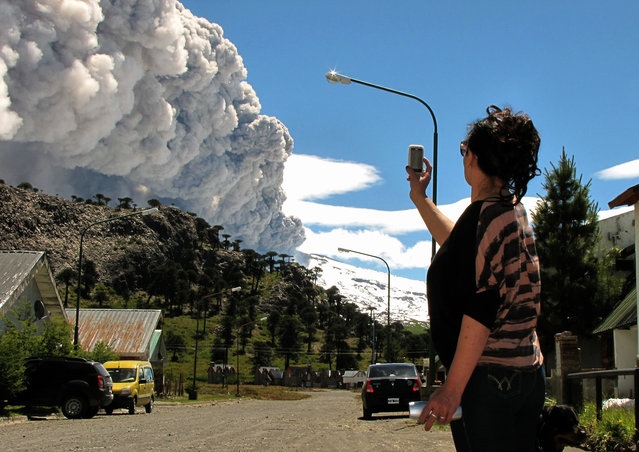
A woman takes a picture with her mobile phone from Caviahue, Neuquen province, Argentina, some 1500 km southwest of Buenos Aires, of the Copahue volcano spewing ashes on December 22, 2012. The authorities of Chile and Argentina issued yellow alerts due to the eruption of the Copahue volcano, placed in the border between both countries. (Photo by Antonio Huglich/AFP Photo)

A woman takes a picture with her mobile phone from Caviahue, Neuquen province, Argentina, some 1500 km southwest of Buenos Aires, of the Copahue volcano spewing ashes on December 22, 2012. The authorities of Chile and Argentina issued yellow alerts due to the eruption of the Copahue volcano, placed in the border between both countries. (Photo by Antonio Huglich/AFP Photo)
Details
23 Dec 2012 09:25:00
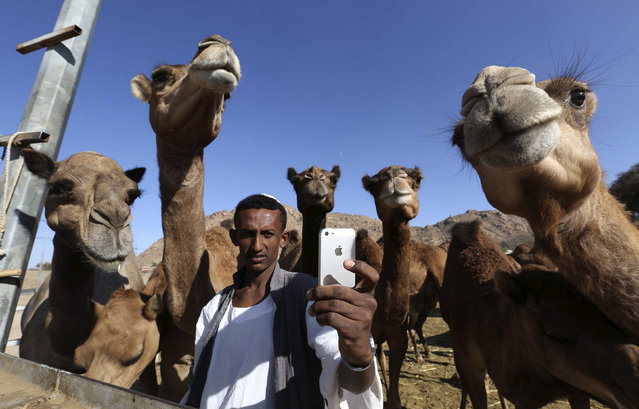
A man takes a “selfie” with camels at a farm in Taif November 1, 2014. Saudi Arabia said late on Wednesday it had detected six new cases of the deadly Middle East Respiratory Syndrome (MERS) in 24 hours, the biggest daily jump for months with officials blaming lax hospital procedures. (Photo by Mohamed Alhwaity/Reuters)

A man takes a “selfie” with camels at a farm in Taif November 1, 2014. Saudi Arabia said late on Wednesday it had detected six new cases of the deadly Middle East Respiratory Syndrome (MERS) in 24 hours, the biggest daily jump for months with officials blaming lax hospital procedures. Scientists are not sure of the origin of the virus, but several studies have linked it to camels and some experts think it is being passed to humans through close physical contact or through the consumption of camel meat or camel milk. (Photo by Mohamed Alhwaity/Reuters)
Details
08 Nov 2014 12:33:00