Aerial view of tourists in life vests and rubber rafts in the Grand Canyon of western Henan, Sanmenxia, China on August 5, 2017. (Photo by Imaginechina/Rex Features/Shutterstock)
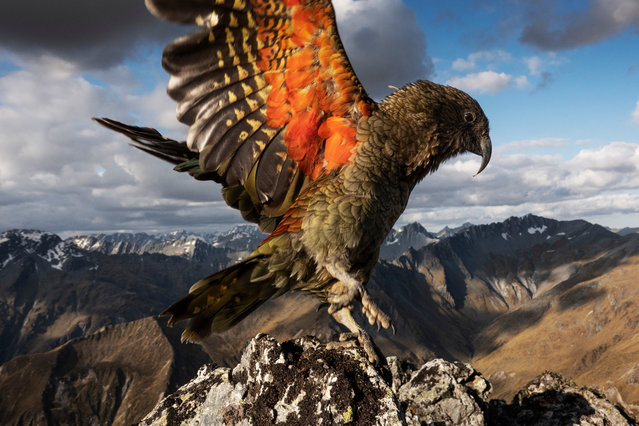
The endangered kea is the world’s only alpine parrot, and one of the most intelligent birds. They show no fear of humans and are thieves and pranksters. The parrot is seen in the Whakaari conservation area, near Glen Orchy in the Otago region of New Zealand, a place where historic huts and mining relics are surrounded by stunning mountains covered in tussock. (Photo by Murdo MacLeod/The Guardian)
An aerial view of the figure of a Catrina skull made with 18,000 Cempasuchil flowers (Mexican marigold) is on display at the Church of Santa Prisca as part of Day of the Dead celebrations, in Taxco, Mexico on October 27, 2021. (Photo by Daniel Cardenas/Anadolu Agency via Getty Images)
Boat party in Malta on July 17, 2023. Malta is the new party destination. Parties, sеx and bad behaviour mixed with cheap prices and wonderful weather have made malta the place to be. (Photo by Thea Jacobs/The Sun)
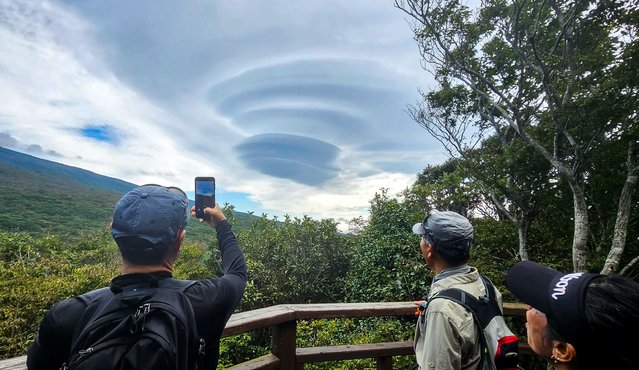
On the morning of the October 4, 2025, the second day of the Chuseok holiday, a lenticular cloud resembling an unidentified flying object (UFO) appeared in the northeastern sky as seen from the Healing Forest in Hogun-dong, Seogwipo-si, Jeju-do, creating a spectacular sight. (Photo by Newsis)
Motoring enthusiasts take part in the “Race The Wave” classic car meet on the beach at Bridlington, Britain on June 18, 2022. (Photo by Lee Smith/Reuters)
People take pictures of the Tribute in Light while it is illuminated next to the Statue of Liberty (C), One World Trade Center and the Empire State Building during events marking the 14th anniversary of the 9/11 attacks on the World Trade Center in New York September 11, 2015. (Photo by Eduardo Munoz/Reuters)
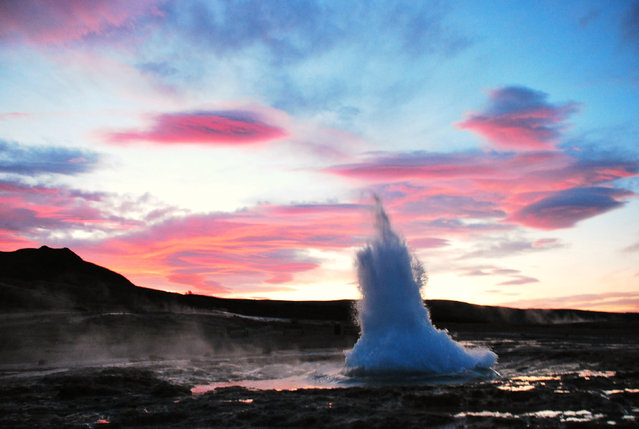
Strokkur geyser against cloudy sky at sunset. Strokkur is a fountain geyser located in a geothermal area beside the Hvítá River in Iceland in the southwest part of the country, east of Reykjavík. It is one of Iceland's most famous geysers, erupting once every 6–10 minutes. Its usual height is 15–20 m, although it can sometimes erupt up to 40 m high. (Photo by Teatsche Dijkhuis/Getty Images/EyeEm)