Loading...
Done


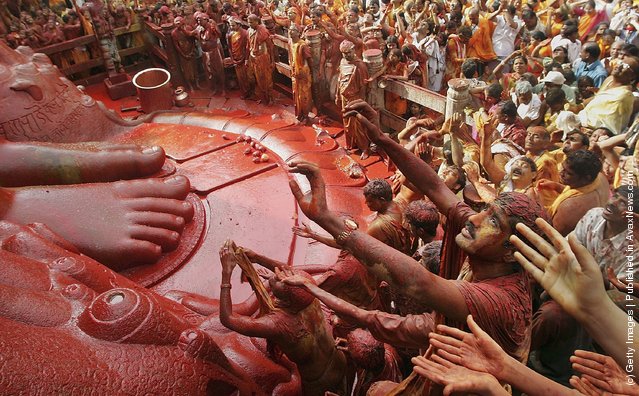
“The Mahamasthakabhisheka (or Mahamasthak Abhishek) is an important Jain festival held once every twelve years in the town of Shravanabelagola in Karnataka state, India. The festival is held in veneration of an immense 18 meter high statue of the Bhagwan (or Saint) Gomateshwara Bahubali. The anointing last took place in February 2006, and the next ceremony will occur in 2018”. – Wikipedia

Photo: A Jain Sadhu (2nd L) and devotees gather and pray at the feet of the monolithic statue of Jain sage Gomateswara during preparations for the Mahamastak Abhisheka ceremony February 7, 2006 in Shravanabelagola, India. The Mahamastak Abhisheka ceremony is held just once every twelve years where the statue will be bathed with milk, yogurt, saffron, gold coins and other religious items. The statue is said to be the world's largest monolith. The ceremony officially runs February 8-19. (Photo by Mario Tama/Getty Images)
Details
21 Jun 2011 12:27:00
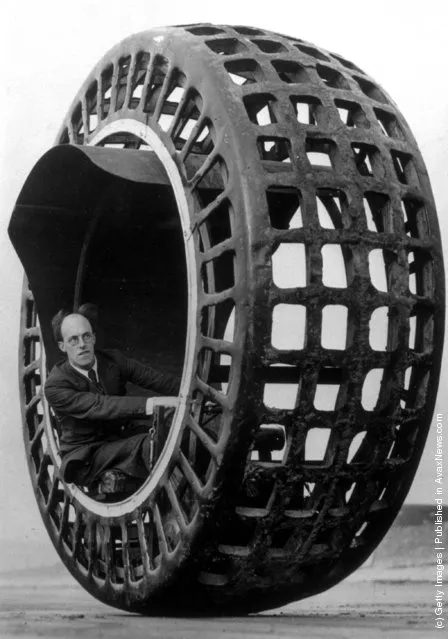
Dynasphere

The Dynasphere, an electrically-driven wheel, invented by Mr. J. A. Purves of Taunton and his son. It had 2.5 horse power and once attained a speed of 25 mph. (Photo by Fox Photos/Getty Images). 1932
Details
07 Sep 2011 12:54:00
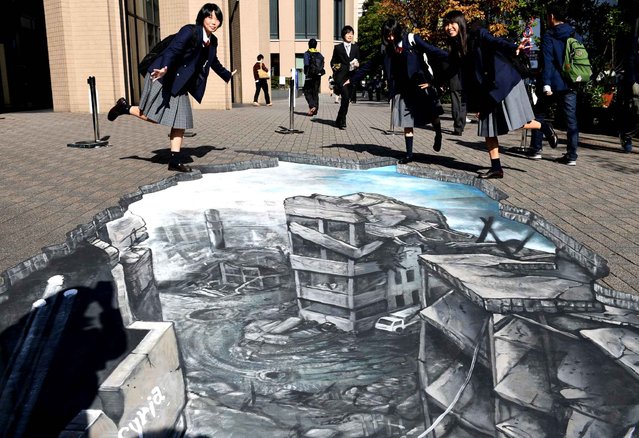
Students pose for a picture with a 3- D optical illusion artwork of a devastated cityscape in Aleppo, Syria at the campus of the Meiji University in Tokyo on November 18, 2016. The Japanese branch of the human rights organisation Amnesty International displayed the artwork to encourage people to think about the Syrian civil war. (Photo by Toshifumi Kitamura/AFP Photo)

Students pose for a picture with a 3- D optical illusion artwork of a devastated cityscape in Aleppo, Syria at the campus of the Meiji University in Tokyo on November 18, 2016. The Japanese branch of the human rights organisation Amnesty International displayed the artwork to encourage people to think about the Syrian civil war. (Photo by Toshifumi Kitamura/AFP Photo)
Details
19 Nov 2016 11:36:00
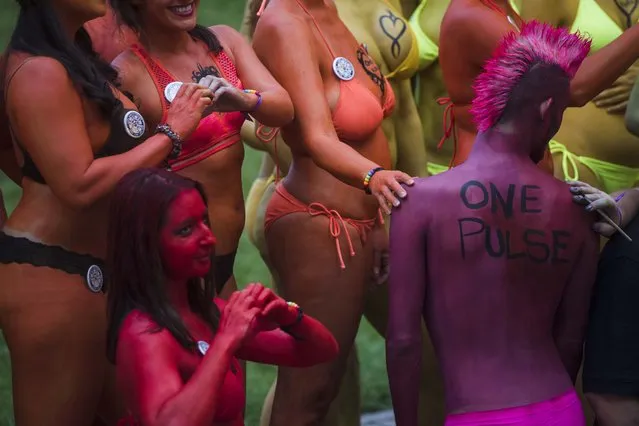
A human rainbow is created at a BASEOrlando coordinated event, “Orlando Strong Body Paint”, on Friday, June 17, 2016 in Orlando, Fl. The group created the rainbow, composed of volunteers numbering the same as that of the victims of the Pulse shooting, as a visual reminder of the amount of lives lost. (Photos by Amanda Voisard/The Washington Post)

A human rainbow is created at a BASEOrlando coordinated event, “Orlando Strong Body Paint”, on Friday, June 17, 2016 in Orlando, Fl. The group created the rainbow, composed of volunteers numbering the same as that of the victims of the Pulse shooting, as a visual reminder of the amount of lives lost. (Photos by Amanda Voisard/The Washington Post)
Details
20 Jun 2016 12:24:00
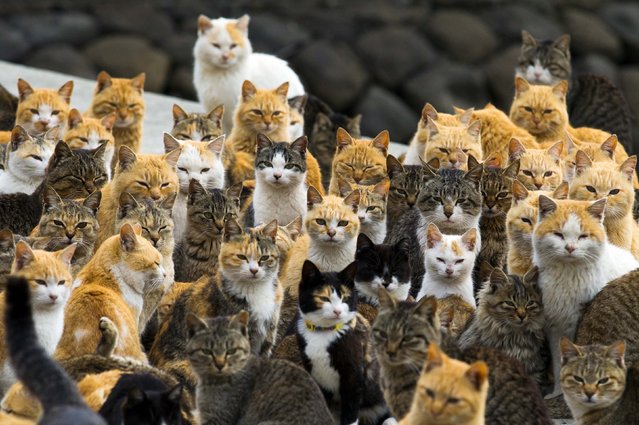
Cats crowd the harbour on Aoshima Island in the Ehime prefecture in southern Japan February 25, 2015. An army of cats rules the remote island in southern Japan, curling up in abandoned houses or strutting about in a fishing village that is overrun with felines outnumbering humans six to one. Picture taken February 25, 2015.  REUTERS/Thomas Peter

Cats crowd the harbour on Aoshima Island in the Ehime prefecture in southern Japan February 25, 2015. An army of cats rules the remote island in southern Japan, curling up in abandoned houses or strutting about in a fishing village that is overrun with felines outnumbering humans six to one. Picture taken February 25, 2015. REUTERS/Thomas Peter
Details
04 Mar 2015 14:16:00
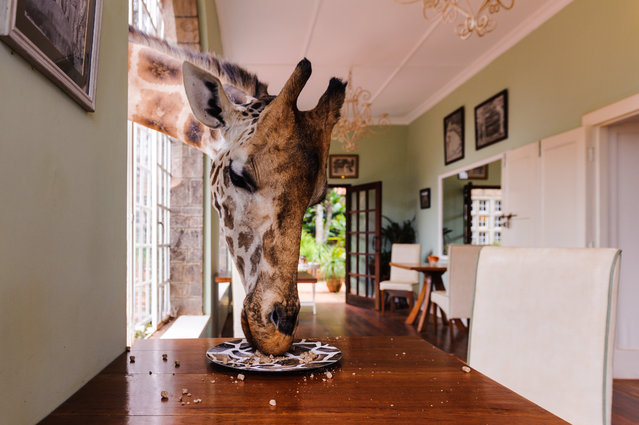
“Don't Leave Any Food On Your Plate”. The giraffes at Nairobi's Giraffe Manor are totally at home with humans. They will eat out of your hand, or even off your plate. Photo location: Giraffe Manor, Nairobi, Kenya. (Photo and caption by Gavin Werbeloff/National Geographic Photo Contest)

“Don't Leave Any Food On Your Plate”. The giraffes at Nairobi's Giraffe Manor are totally at home with humans. They will eat out of your hand, or even off your plate. Photo location: Giraffe Manor, Nairobi, Kenya. (Photo and caption by Gavin Werbeloff/National Geographic Photo Contest)
Details
20 Jun 2014 10:23:00


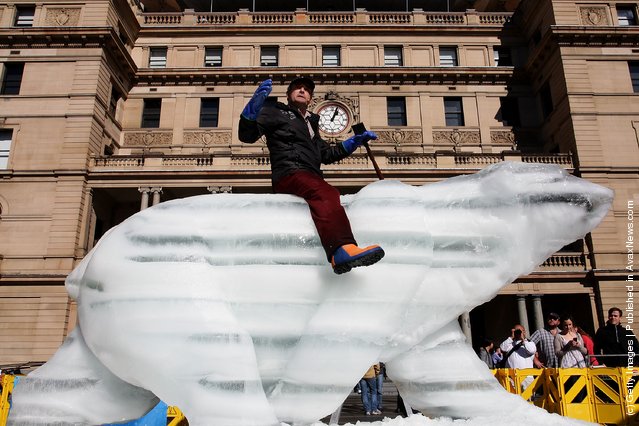
British artist, Mark Coreth sits on top of the “Sydney Ice Bear” carved from a 10 tonne block of ice to illustrate how humans affect climate change in the Arctic at Customs House on June 3, 2011 in Sydney, Australia. The public will be welcomed to touch the bear, and leave an imprint which will begin the melting process and act as a metaphor for how humans affect the environment. The ice bear's has visited six cities on it's global tour since 2009; the visit to Sydney coincides with World Environment Day on June 5. (Photo by Lisa Maree Williams/Getty Images)
Details
03 Jun 2011 08:21:00
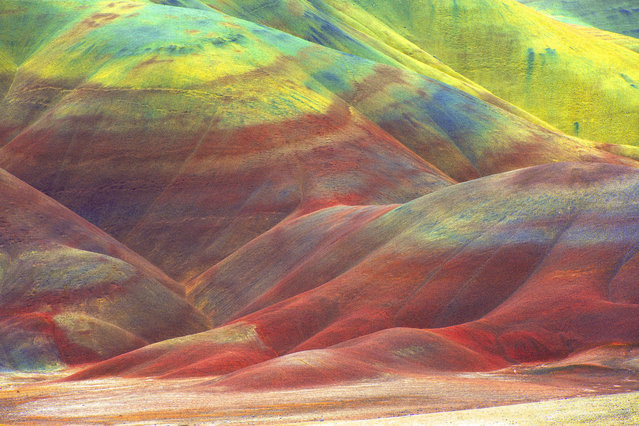
Layers of breathtaking colour streak the rolling hills of this vast desert, making the landscape appear as though it has been tie-dyed. The natural phenomenon, nicknamed the “Painted Desert”, was formed when the area was once a river floodplain. (Photo by Mark Brodkin/Solent News/SIPA Press)

Layers of breathtaking colour streak the rolling hills of this vast desert, making the landscape appear as though it has been tie-dyed. The natural phenomenon, nicknamed the “Painted Desert”, was formed when the area was once a river floodplain. Each colour corresponds to a different underground geological feature – rocks which have seemingly dyed the layers of earth above. Formed from volcanic activity, the hills at the John Day Fossil Beds National Monument in East Central Oregon, USA, are almost bursting with colour. Pictured: The colourful hills at the John Day Fossil Beds National Monument in East Central Oregon, USA. (Photo by Mark Brodkin/Solent News/SIPA Press)
Details
30 Jul 2014 11:00:00