Loading...
Done
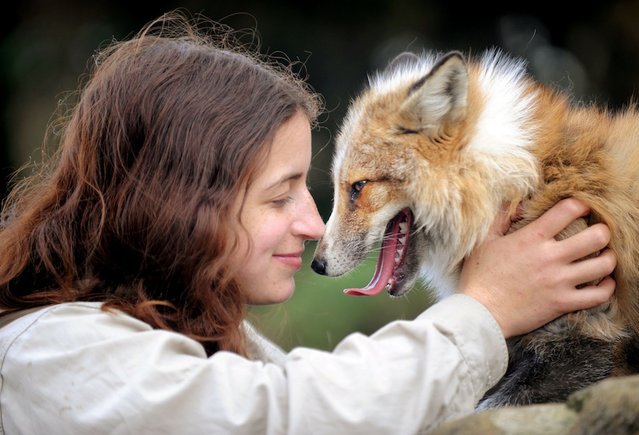
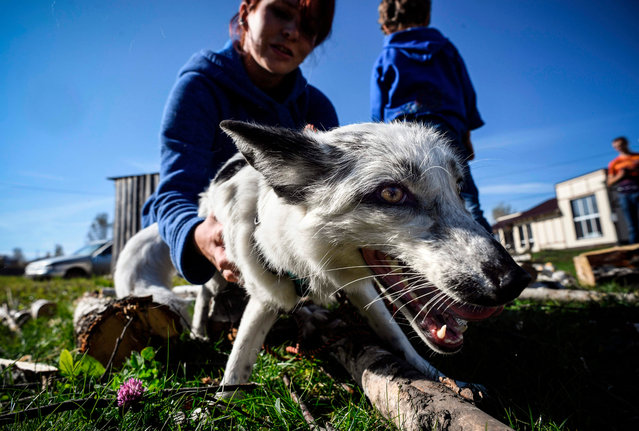
Tatyana Abramova, 33, plays with her home fox Plombir at her countryside house outside Siberian city of Novosibirsk on September 12, 2020. The official start of the Soviet experiment to better understand the domestication of animals by humans began in 1959, and was initiated by geneticists Dmitri Beliaiev and Lioudmila Trout on a farm in Akademgorodok, the scientific center of excellence in Siberia. Their primary objective was to domesticate foxes, to understand how the ancestor of wolves, another canine, evolved into a loyal and loving dog. And understand what this domestication tells us about the genetic evolution of species. (Photo by Alexander Nemenov/AFP Photo)

Tatyana Abramova, 33, plays with her home fox Plombir at her countryside house outside Siberian city of Novosibirsk on September 12, 2020. The official start of the Soviet experiment to better understand the domestication of animals by humans began in 1959, and was initiated by geneticists Dmitri Beliaiev and Lioudmila Trout on a farm in Akademgorodok, the scientific center of excellence in Siberia. Their primary objective was to domesticate foxes, to understand how the ancestor of wolves, another canine, evolved into a loyal and loving dog. And understand what this domestication tells us about the genetic evolution of species. (Photo by Alexander Nemenov/AFP Photo)
Details
25 Oct 2020 00:05:00
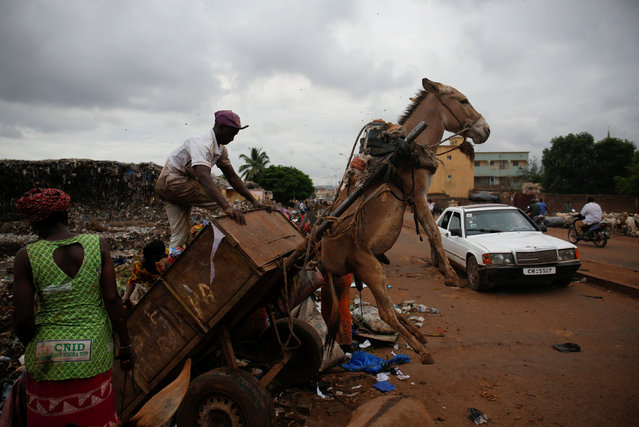
A waste picker unloads garbage at a waste transfer station in Bamako, Mali, August 19, 2018. In the Malian capital of Bamako, donkey carts driven by young men like 19-year-old Arouna Diabate play a vital role battling the fast-growing city's waste problem. Every morning before dawn, Diabate hitches his donkey to a cart and sets off on his rounds, going door-to-door to collect household garbage which he delivers to a local waste transfer station for a monthly salary of around $35. “I won't be picking up trash with a donkey cart for the rest of my life, but for now people appreciate us because we help clean up the homes of Bamako”, Diabate said. (Photo by Luc Gnago/Reuters)

A waste picker unloads garbage at a waste transfer station in Bamako, Mali, August 19, 2018. In the Malian capital of Bamako, donkey carts driven by young men like 19-year-old Arouna Diabate play a vital role battling the fast-growing city's waste problem. Every morning before dawn, Diabate hitches his donkey to a cart and sets off on his rounds, going door-to-door to collect household garbage which he delivers to a local waste transfer station for a monthly salary of around $35. “I won't be picking up trash with a donkey cart for the rest of my life, but for now people appreciate us because we help clean up the homes of Bamako”, Diabate said. (Photo by Luc Gnago/Reuters)
Details
18 Sep 2018 00:01:00
A fire-eater of the “Diables de Terrassa” performs during Sitges' little “Festa Major”, “Santa Tecla” in Sitges, Spain on September 19, 2016. This celebration brings together some of Catalonia’s most emblematic festive traditions. The central axis of the celebrations is the traditional parade, made up of “big-head” carnival figures and characters who dance to music played on different traditional instruments. One of the most popular events is the Correfoc or fire-running, which is also the closing event of the fiesta. The people run and jump over characters dressed up as devils and dragons, carrying fire. (Photo by Matthias Oesterle/ZUMA Press/Splash News)

A fire-eater of the “Diables de Terrassa” performs during Sitges' little “Festa Major”, “Santa Tecla” in Sitges, Spain on September 19, 2016. This celebration brings together some of Catalonia’s most emblematic festive traditions. The central axis of the celebrations is the traditional parade, made up of “big-head” carnival figures and characters who dance to music played on different traditional instruments. One of the most popular events is the Correfoc or fire-running, which is also the closing event of the fiesta. The people run and jump over characters dressed up as devils and dragons, carrying fire. (Photo by Matthias Oesterle/ZUMA Press/Splash News)
Details
20 Sep 2016 09:28:00


Japanese toy maker Takara Tomy's world's smallest humanoid robot “i-Sobot” is displayed during the Toy Forum 2007 on January 23, 2007 in Tokyo, Japan. The 165mm height robot is able to walk, play the drums and keep its balance. (Photo by Koichi Kamoshida/Getty Images)
Details
19 Apr 2011 13:01:00


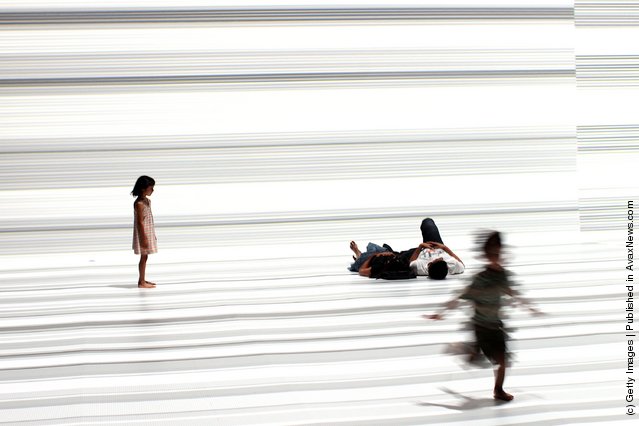
Children play at the Ryoji Ikeda exhibition “the transfinite” at the Park Avenue Armory on June 10, 2011 in New York City. The audio visual installation, which will close after tomorrow, features two back-two-back screens displaying a continual loop of sounds, fragments of numbers and strobe-lit patterns that echo the Japanese artist's interest in mathematics, the subconscious and the digital world. (Photo by Spencer Platt/Getty Images)
Details
11 Jun 2011 12:16:00
UEFA,Euro 2012, Donetsk


The European Football Championship will take place in Donetsk 2012. The city is currently home to two major professional football teams in Ukraine: Shakhtar Donetsk and Metalurh Donetsk, both of which currently play in the Ukrainian Premier League. (Photo by: LancerenoK; Source: Flickr)
Details
06 Aug 2011 14:08:00
Ray Collins is a colorblind Australian coal miner who is in love with the ocean. He spends his off days photographing it. (Photo by Ray Collins)

Ray Collins is a colorblind Australian coal miner who is in love with the ocean. He spends his off days photographing it. Collins says he enjoys capturing the moment before the moment, the anticipation, not knowing how the end of the wave's journey will play out. (Photo by Ray Collins)
Details
29 Mar 2015 12:40:00
This Fox Thinks He’s A Dog

After being rescued as a young fox cub, Todd the 11-month-old fox is getting along just fine as a domestic pet together with his owner, Emma D’Sylva. Todd goes for walks on a leash, plays with D’Sylva’s two other dogs, and wags his tail when it’s time to eat. He was rescued by D’Sylva when he was 4 months old from other owners who could no longer care for him.
Details
11 Jul 2015 10:56:00