Loading...
Done
A photo provided by the Atlanta Journal-Constitution shows Atlanta police officer T. R. Coxe removing painted material of a large swastika featuring a likeness of Republican presidential candidate, Donald Trump, along the northbound Buford Highway Connector just south of the Piedmont exit, in Atlanta, Georgia, USA, 09 December 2015. Just days after Donald Trump's call to ban Muslims from entering the United States, someone painted large swastikas featuring the Republican presidential candidate's face on at least two northeast Atlanta bridge supports. (Photo by John Spink/EPA/AJC)

A photo provided by the Atlanta Journal-Constitution shows Atlanta police officer T. R. Coxe removing painted material of a large swastika featuring a likeness of Republican presidential candidate, Donald Trump, along the northbound Buford Highway Connector just south of the Piedmont exit, in Atlanta, Georgia, USA, 09 December 2015. Just days after Donald Trump's call to ban Muslims from entering the United States, someone painted large swastikas featuring the Republican presidential candidate's face on at least two northeast Atlanta bridge supports. The symbol, which includes a cartoon of Trump sporting a Hitler-like mustache, was painted along the Buford Highway Connector. A second, similar image was found on a concrete bridge support on nearby Piedmont Road. Trump said in a statement released on 07 December that there should be a total and complete shutdown of Muslims entering the United States. (Photo by John Spink/EPA/AJC)
Details
11 Dec 2015 11:49:00
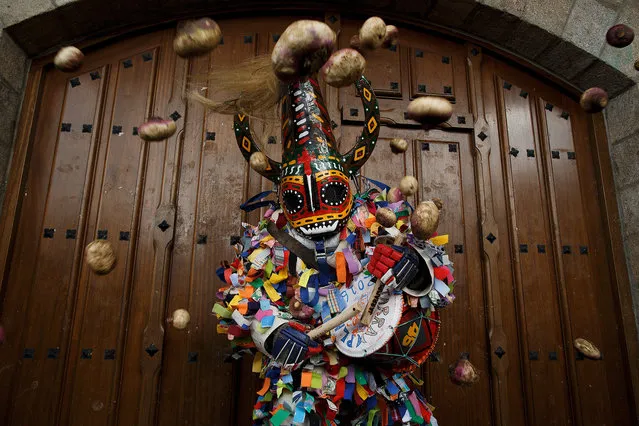
People throw turnips at the Jarramplas as he comes out from the church beating his drum during the Jarramplas Festival on January 20, 2016 in Piornal, Caceres province, Spain. The centuries old Jarramplas festival takes place annually every January 19-20 on Saint Sebastian Day and this year they expect to use more than 20 thousand kilogrames of turnips. Even though the exact origins of the festival are not known, various theories exist including the mythological punishment of Caco by Hercules. (Photo by Pablo Blazquez Dominguez/Getty Images)

People throw turnips at the Jarramplas as he comes out from the church beating his drum during the Jarramplas Festival on January 20, 2016 in Piornal, Caceres province, Spain. The centuries old Jarramplas festival takes place annually every January 19-20 on Saint Sebastian Day and this year they expect to use more than 20 thousand kilogrames of turnips. Even though the exact origins of the festival are not known, various theories exist including the mythological punishment of Caco by Hercules, a relation to ceremonies celebrated by the American Indians that were seen by the first conquerors, to a cattle thief ridiculed and expelled by his village neighbours. It is generally believed to symbolize the expulsion of everything bad. (Photo by Pablo Blazquez Dominguez/Getty Images)
Details
21 Jan 2016 13:21:00
Two women wearing nun outfits drink beer while watching the 2014 Tim Hortons Brier curling championships in Kamloops, British Columbia in this March 8, 2014 file photo. (Photo and caption by Ben Nelms/Reuters)

Two women wearing nun outfits drink beer while watching the 2014 Tim Hortons Brier curling championships in Kamloops, British Columbia in this March 8, 2014 file photo. Although some people might conclude that a curling event could produce a dull atmosphere, it is actually far from it. Some of the most energetic and loyal fans are committed to showing their colours at tournaments around the world. There was a lull in the games that were being held on this day and I remember spotting these nuns sitting in their seats earlier. Although them just sitting there didn't produce a picture, I kept my eye on them for the entire match. As soon as I spotted them with beer in their hands, I slowly turned my camera towards them and waited for them to take a drink. One of the challenges of shooting this image was to not have everyone notice me taking the photo. I had a longer lens on and was right in the middle of the rink. I slowly turned my lens, not to make my intentions too obvious, and waited until they drank from their beers together. (Photo and caption by Ben Nelms/Reuters)
Details
27 Nov 2014 14:39:00
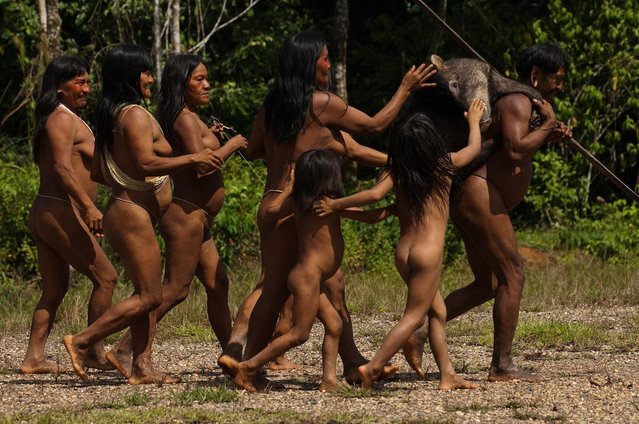
Spectacular images offering insight into the lives of the Huaorani people in the Ecuadorian Amazon have been revealed showing how they use traditional methods to hunt monkeys for food. The stunning pictures were taken by conservation photographer Pete Oxford from Torquay, Devon in the Ecuadorian Amazon. “The Huaorani Indians are a forest people highly in tune with their environment. Many are now totally acculturated since the 1950s by missionaries”, said Pete. “Today they face radical change to their culture to the proximity of oil exploration within their territory and the Yasuni National Park and Biosphere Reserve, they are vastly changed. Some still live very traditionally and for this shoot, through my Huaorani friend, a direct relative of those photographed he wanted to depict them as close to their original culture as possible. They still largely hunt with blow pipes and spears eating a lot of monkeys and peccaries”. The Huaorani are also known as the Waorani, Waodani or the Waos and are native Amerindians. Their lands are located between the Curaray and Napo rivers and speak the Huaorani language. Pete says that during his visit he was welcomed into the group and hopes that ancient cultures can be saved. Here: The tribe were seen celebrating after a hunter returned to camp with a wild pig. (Photo by Pete Oxford/Mediadrumworld.com)

Spectacular images offering insight into the lives of the Huaorani people in the Ecuadorian Amazon have been revealed showing how they use traditional methods to hunt monkeys for food. The stunning pictures were taken by conservation photographer Pete Oxford from Torquay, Devon in the Ecuadorian Amazon. Here: The tribe were seen celebrating after a hunter returned to camp with a wild pig. (Photo by Pete Oxford/Mediadrumworld.com)
Details
20 Jan 2017 07:58:00
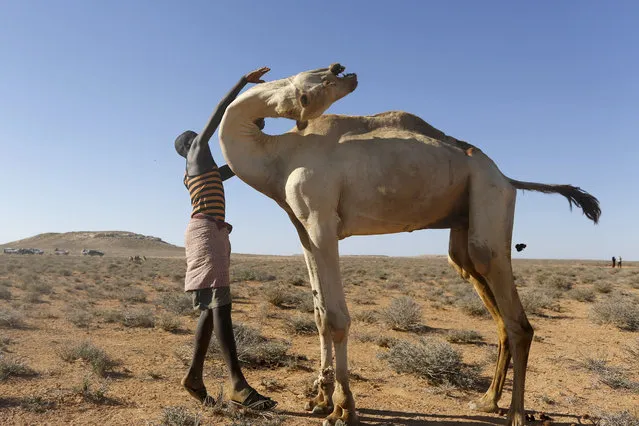
Ali Asair, who has left his family behind and traveled hundreds of kilometers in search for a pasture for his animals, attends to his camel in a pastoralists' settlement in the Bandarbeyla district in Somalia's semi-autonomous region of Puntland, Somalia, 24 March 2017. According to media reports, the United Nations says only 31 percent of 864 million US dollars appeal for a drought-hit Somalia is funded. The UN said the world is facing the largest humanitarian crisis since 1945, adding that more than 20 million people are facing the threat of famine in Somalia, Yemen, South Sudan and Nigeria and 1.4 million children could die from starvation this year. (Photo by Dai Kurokawa/EPA)

Ali Asair, who has left his family behind and traveled hundreds of kilometers in search for a pasture for his animals, attends to his camel in a pastoralists' settlement in the Bandarbeyla district in Somalia's semi-autonomous region of Puntland, Somalia, 24 March 2017. According to media reports, the United Nations says only 31 percent of 864 million US dollars appeal for a drought-hit Somalia is funded. The UN said the world is facing the largest humanitarian crisis since 1945, adding that more than 20 million people are facing the threat of famine in Somalia, Yemen, South Sudan and Nigeria and 1.4 million children could die from starvation this year. (Photo by Dai Kurokawa/EPA)
Details
28 Mar 2017 09:01:00
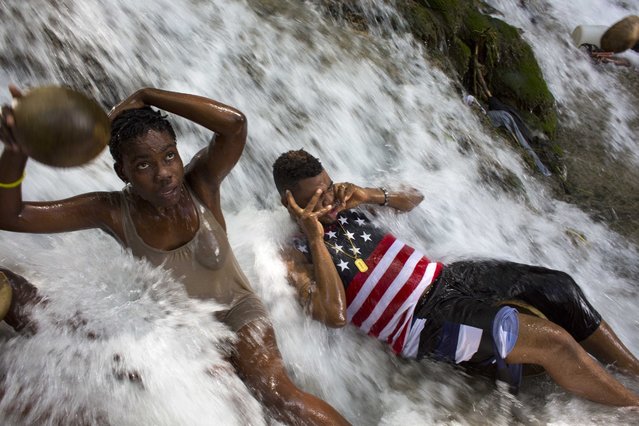
Voodoo pilgrims bathe in a waterfall believed to have purifying powers during the annual celebration in Saut d' Eau, Haiti, Saturday, July 16, 2016. Annually, the falls are the site of a large, important religious pilgrimage, during the festival of Our Lady of Carmel, from July 14–16. A Eucharistic rite is held during the festival, as well as various vodou rituals, but the penultimate devotional activity is bathing in the waters of the falls, and asking favors of the Virgin or Erzulie. After bathing, voodoo pilgrims throw away the dresses they wore to the site, and don new clothes for good luck. (Photo by Dieu Nalio Chery/AP Photo)

Voodoo pilgrims bathe in a waterfall believed to have purifying powers during the annual celebration in Saut d' Eau, Haiti, Saturday, July 16, 2016. Annually, the falls are the site of a large, important religious pilgrimage, during the festival of Our Lady of Carmel, from July 14–16. A Eucharistic rite is held during the festival, as well as various vodou rituals, but the penultimate devotional activity is bathing in the waters of the falls, and asking favors of the Virgin or Erzulie. After bathing, voodoo pilgrims throw away the dresses they wore to the site, and don new clothes for good luck. (Photo by Dieu Nalio Chery/AP Photo)
Details
18 Jul 2016 13:02:00
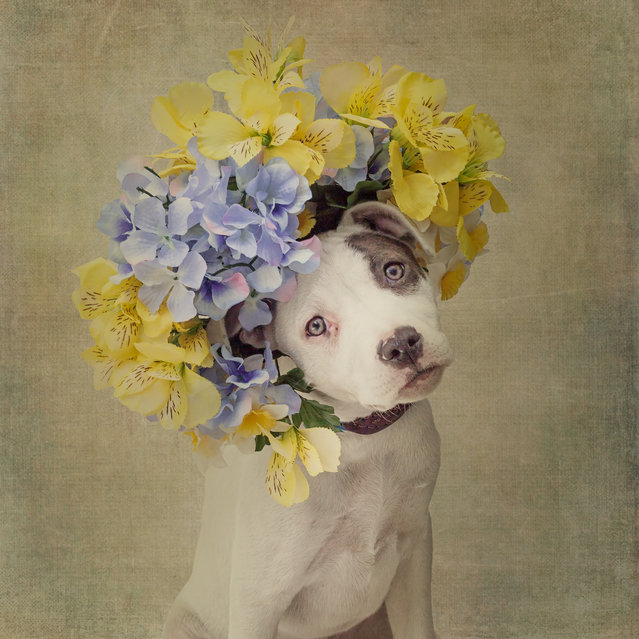
Rascal, and her brother Petey, were abandoned as pups near the railroad tracks in Union County, Arkansas. She is a pit bull cross and approximately 6 months old, in Arkansas, United States. These canine portraits will make any dog lover's day – and they're helping to get sheltered pups adopted at the same time. Kind-hearted photographer Tammy Swarek came up with the idea of dressing up rescue dogs to draw attention to their stories and help potential owners personally connect with them. Tammy, from Arkansas, drew her inspiration from Facebook after spotting another portrait project for sheltered animals. So she contacted her local dog shelter, the Union County Animal Protection Society (UCAPS) and has worked closely with shelter manager Tanja Jackson ever since. (Photo by Tammy Swarek/Barcroft Images)

Rascal, and her brother Petey, were abandoned as pups near the railroad tracks in Union County, Arkansas. She is a pit bull cross and approximately 6 months old, in Arkansas, United States. These canine portraits will make any dog lover's day – and they're helping to get sheltered pups adopted at the same time. Kind-hearted photographer Tammy Swarek came up with the idea of dressing up rescue dogs to draw attention to their stories and help potential owners personally connect with them. (Photo by Tammy Swarek/Barcroft Images)
Details
01 Sep 2016 10:35:00
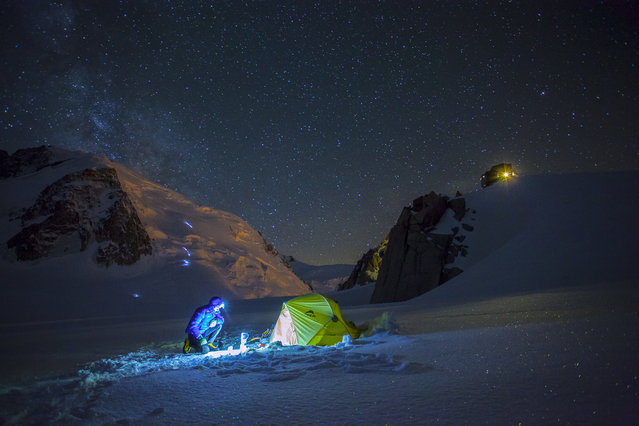
“A snapshot from mountaineer's life”. Have you ever wondered how does a mountaineer's day start? (Photo and caption by Kamil Tamiola/National Geographic Traveler Photo Contest)

“A snapshot from mountaineer's life”. Have you ever wondered how does a mountaineer's day start? I will give you a hint: you wake up at 3 am, set the stove, wake up your partner, pretend it is warm, quickly consume a high-calorie breakfast, watch your friends slowly ascending the icy slopes of your dream summit with their tiny head torches glimmering against perfectly blue ice, and hope for the good weather. One would ask: why all this trouble? The answer is easy: for the love of the adventure and the unknown. Location: Chamonix, Haute Savoye, France. (Photo and caption by Kamil Tamiola/National Geographic Traveler Photo Contest)

ATTENTION! All pictures are presented in high resolution. To see Hi-Res images – just TWICE click on any picture. In other words, click small picture – opens the BIG picture. Click BIG picture – opens VERY BIG picture.
Details
27 Jun 2013 12:47:00