Loading...
Done
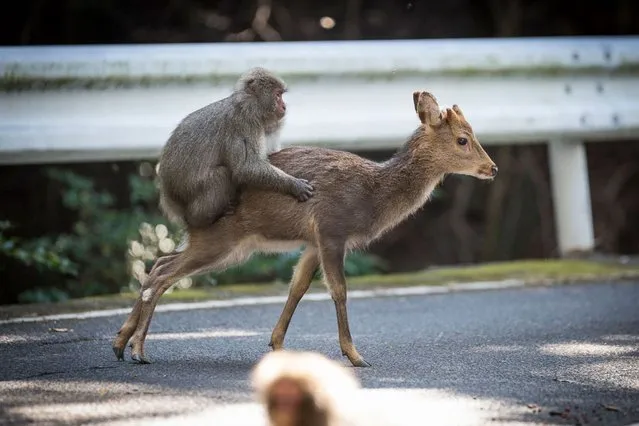
An undated handout picture released on January 10, 2017 by the Issekinicho publishing house shows an inter- species sexual behaviour between a male Japanese macaque and female sika deer, in Yakushima Scientists revealed on January 10, 2017 the “highly unusual” behaviour of a male monkey filmed trying to have s*x with female deer in Japan – a rare case of inter- species nookie. (Photo by Editions Issekinicho/AFP Photo)

An undated handout picture released on January 10, 2017 by the Issekinicho publishing house shows an inter- species sexual behaviour between a male Japanese macaque and female sika deer, in Yakushima Scientists revealed on January 10, 2017 the “highly unusual” behaviour of a male monkey filmed trying to have sеx with female deer in Japan – a rare case of inter- species nookie. (Photo by Editions Issekinicho/AFP Photo)
Details
15 Jan 2017 11:00:00
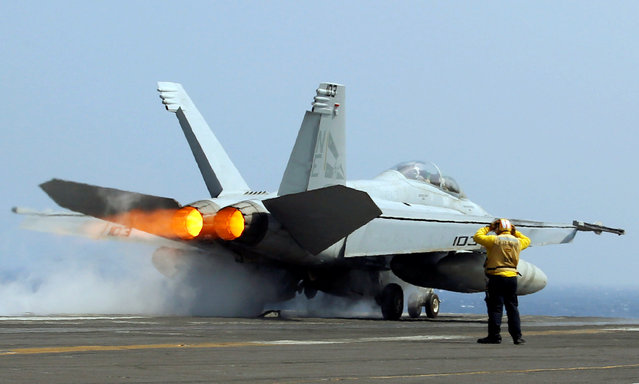
A U.S. Navy F18 fighter jet takes off from aircraft carrier USS Carl Vinson during a FONOPS (Freedom of Navigation Operation Patrol) in South China Sea, March 3, 2017. (Photo by Erik De Castro/Reuters)

A U.S. Navy F18 fighter jet takes off from aircraft carrier USS Carl Vinson during a FONOPS (Freedom of Navigation Operation Patrol) in South China Sea, March 3, 2017. The U.S. military took journalists Friday to the carrier on routine patrol off the disputed South China Sea, sending a signal to China and American allies of its resolve to ensure freedom of navigation and overflight in one of the world's security hotspots. (Photo by Erik De Castro/Reuters)
Details
06 Mar 2017 00:01:00
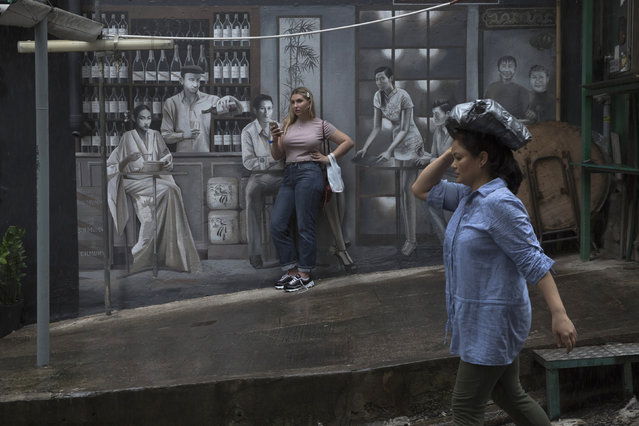
In this June 12, 2017 photo, a woman stands in front of a mural on the slope in Central district, Hong Kong. (Photo by Kin Cheung/AP Photo)

In this June 12, 2017 photo, a woman stands in front of a mural on the slope in Central district, Hong Kong. Once known as Victoria after the British queen, Hong Kong island's waterfront formed the core of the British settlement after Hong Kong island was handed over as a colony in 1842. Today as Hong Kong approaches the 20th anniversary of its return to China, it remains a bustling commercial and financial center as well as the location of the main government offices. However, along the streets that angle sharply upward toward the mountains above, a more relaxed pace of life endures. (AP Photo/Kin Cheung)
Details
28 Jun 2017 08:18:00
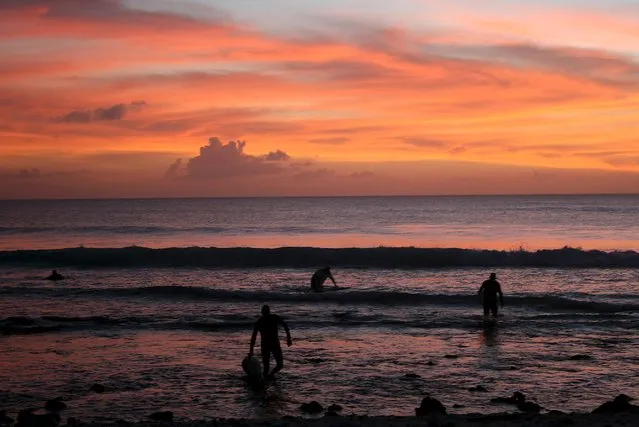
Surfers walk out of the water at sunset after surfing along the coast of Kiritimati Island, part of the Pacific Island nation of Kiribati, April 5, 2016. (Photo by Lincoln Feast/Reuters)


Kiritimati is a far-flung outpost of the Republic of Kiribati. The world's largest coral atoll, Kiritimati has just one flight a week to either Fiji or Hawaii, four-and-a-half hours in either direction. Tarawa, the capital of Kiribati lies nearly 3,300 km (2,000 miles) to the west – about three weeks by boat. No lawyers are based on Kiritimati and the High Court only comes once or twice a year to clear a backlog of the most serious cases, bringing a public lawyer for defendants who can't afford their own. (Photo by Lincoln Feast/Reuters)
Details
28 Apr 2016 12:01:00
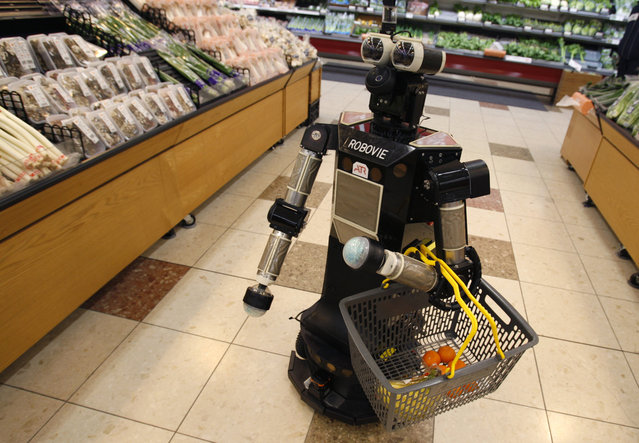
A robot named “Robovie-II”, developed by Japanese robotics research institution ATR, moves around at a grocery store during a shopping assisting experiment by utilizing the robot in an ubiquitous network technology platform in Kyoto, western Japan January 6, 2010. The robot greets the shopper at the entrance of the store, follows him to the shelves while holding a grocery basket and reminds him of the items on a shopping list, which the shopper would have entered beforehand in a specialized mobile device. The experiment is aimed to gather data in order to provide livelihood support for the elderly by using robots and network technologies, ATR's researcher Satoshi Koizumi said. (Photo by Yuriko Nakao/Reuters)

A robot named “Robovie-II”, developed by Japanese robotics research institution ATR, moves around at a grocery store during a shopping assisting experiment by utilizing the robot in an ubiquitous network technology platform in Kyoto, western Japan January 6, 2010. (Photo by Yuriko Nakao/Reuters)
Details
02 Feb 2018 06:54:00
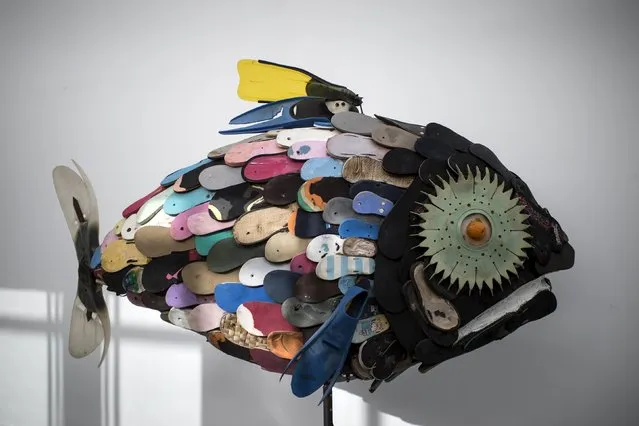
A sculpture of a fish made from waste products collected from the sea is displayed during the exhibition Keep The Oceans Clean by art collective Skeleton Sea, at the Torre Madariaga Biodiversity Centre in Busturia, Spain, May 17, 2015. (Photo by Vincent West/Reuters)

A sculpture of a fish made from waste products collected from the sea is displayed during the exhibition Keep The Oceans Clean by art collective Skeleton Sea, at the Torre Madariaga Biodiversity Centre in Busturia, Spain, May 17, 2015. Skeleton Sea, a group of surfers and artists, recycle waste collected from the world's oceans to create artworks and draw attention to the dangers faced from overfishing, pollution and oil spills. (Photo by Vincent West/Reuters)
Details
19 May 2015 11:16:00
 Kyaiktiyo Pagoda AKA  Golden Rock In Burma

Kyaiktiyo Pagoda, also known as Golden Rock is a well-known Buddhist pilgrimage site in Mon State, Burma. It is a small pagoda (7.3 metres (24 ft)) built on the top of a granite boulder covered with gold leaves pasted on by devotees. According to legend, the Golden Rock itself is precariously perched on a strand of the Buddha's hair. The balancing rock seems to defy gravity, as it perpetually appears to be on the verge of rolling down the hill. The rock and the pagoda are at the top of Mt. Kyaiktiyo. It is the third most important Buddhist pilgrimage site in Burma after the Shwedagon Pagoda and the Mahamuni Pagoda. A glimpse of the "gravity defying" Golden Rock is believed to be enough of an inspiration for any person to turn to Buddhism.
Details
04 Jun 2015 11:42:00
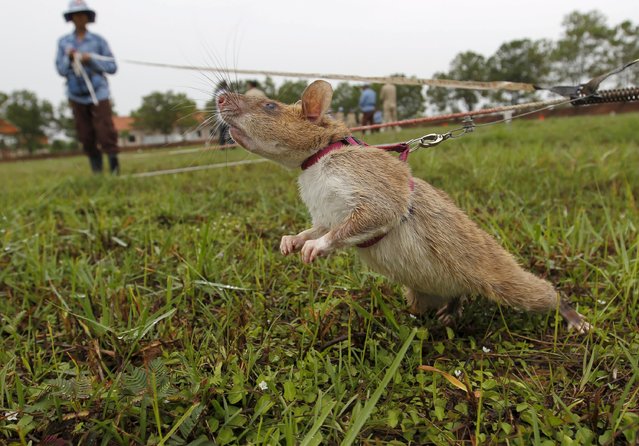
A rat being trained by the Cambodian Mine Action Centre (CMAC) is pictured on an inactive landmine field in Siem Reap province July 9, 2015. Gambian pouched rats were deployed to Cambodia from Tanzania in April by a Belgian non-profit organization, APOPO, to help clear mines. (Photo by Samrang Pring/Reuters)

A rat being trained by the Cambodian Mine Action Centre (CMAC) is pictured on an inactive landmine field in Siem Reap province July 9, 2015. Gambian pouched rats were deployed to Cambodia from Tanzania in April by a Belgian non-profit organization, APOPO, to help clear mines. They've been trained since they were 4 weeks old. Cambodia is still littered with landmines after emerging from decades of civil war, including the 1970s Khmer Rough “Killing Fields” genocide, leaving it with one of the world's highest disability rates. APOPO has used the rodents for mine-clearing projects in several countries, including Angola, Mozambique, Thailand, Laos, and Vietnam. (Photo by Samrang Pring/Reuters)
Details
14 Jul 2015 13:35:00