Loading...
Done
Festival goer practice yoga during the O.Z.O.R.A. festival on August 4, 2016 in Tolna, Hungary. Ozora is a village in Tolna County. In recent times it has become famous for the O.Z.O.R.A. psychedelic trance festival which has been held on an estate in Ozora near small village Dadpuszta every year since 2004. The first party was called Solipse and took place during the Solar eclipse of August 11, 1999. The Ozora festival (with Solar United Natives festival) is one of the two big psytrance festivals in Hungary, and is fastest growing psytrance festivals on the world, achieving incredible 60 000 visitors in 2015. (Photo by Mohai Balázs/MTI/MTVA)

Festival goer practice yoga during the O.Z.O.R.A. festival on August 4, 2016 in Tolna, Hungary. Ozora is a village in Tolna County. In recent times it has become famous for the O.Z.O.R.A. psychedelic trance festival which has been held on an estate in Ozora near small village Dadpuszta every year since 2004. The first party was called Solipse and took place during the Solar eclipse of August 11, 1999. (Photo by Mohai Balázs/MTI/MTVA)
Details
05 Aug 2016 13:40:00
NASA's rover Opportunity visits Victoria Crater, viewed from orbit by the High Resolution Imaging Science Experiment on NASA's Mars Reconnaissance Orbiter in october of 2006. Opportunity is a small dot on the crater's lip, at top right. Opportunity first reached the crater's rim on September 27, 2006. (Photo by NASA/JPL-Caltech/University of Arizona/The Atlantic)

“NASA's Mars rover Opportunity just celebrated its ninth anniversary on Mars – a mission that was originally meant to last just 90 days...” – The Atlantic. Photo: NASA's rover Opportunity visits Victoria Crater, viewed from orbit by the High Resolution Imaging Science Experiment on NASA's Mars Reconnaissance Orbiter in october of 2006. Opportunity is a small dot on the crater's lip, at top right. Opportunity first reached the crater's rim on September 27, 2006. (Photo by NASA/JPL-Caltech/University of Arizona via The Atlantic)


Details
14 Feb 2013 10:58:00
In this February 5, 2014 photo, Divaldo Aguiar, who plays the part of Pachencho, is carried in a mock coffin during the Burial of Pachencho celebration, through a cemetery in Santiago de Las Vegas, Cuba. Cuban villagers stage a mock funeral and burial of Pachencho, with a living man playing the part of Pachencho, in a boozy festival that has become an annual tradition in this small town near Havana, held each February 5 for the last 30 years. (Photo by Enric Marti/AP Photo)

In this February 5, 2014 photo, Divaldo Aguiar, who plays the part of Pachencho, is carried in a mock coffin during the Burial of Pachencho celebration, through a cemetery in Santiago de Las Vegas, Cuba. Cuban villagers stage a mock funeral and burial of Pachencho, with a living man playing the part of Pachencho, in a boozy festival that has become an annual tradition in this small town near Havana, held each February 5 for the last 30 years. (Photo by Enric Marti/AP Photo)
Details
10 Feb 2014 09:24:00
Baby Fennec Fox

“The fennec fox is a small nocturnal fox found in the Sahara of North Africa. Its most distinctive feature is unusually large ears. The name “fennec” comes from the Arabic word for fox, and the species name zerda has a Greek origin that refers to its habitat. The fennec is the smallest species of canid in the world; coat, ears and kidney functions have adapted to a high-temperature, low-water, desert environment. In addition, its hearing is sensitive enough to hear prey moving underground”. – Wikipedia

Photo: A Baby Fennec is seen at Sunshine International Aquarium on June 24, 2009 in Tokyo, Japan. The small nocturnal fox babies were born on May 17 2009. (Photo by Junko Kimura/Getty Images)
Details
16 Sep 2011 12:02:00
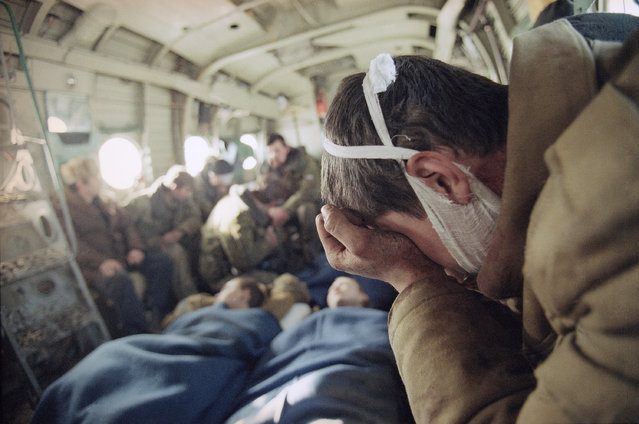
A wounded Russian soldier, who has been evacuated with his comrades, weeps in a helicopter on his way out of Grozny on Friday, February 3, 1995, as the fighting in the Chechen capital continues. The massive Russian force that invaded Chechnya has taken very heavy losses against a small but determined guerrilla force. (Photo by Karsten Thielker/AP Photo/File)

Karsten Thielker, a Pulitzer Prize-winning German photographer with The Associated Press who covered human suffering in conflict zones around the globe, has died at the age of 54. Thielker died on October 3 in Berlin of esophageal cancer, his wife Janna Ressel said. Here: A wounded Russian soldier, who has been evacuated with his comrades, weeps in a helicopter on his way out of Grozny on Friday, February 3, 1995, as the fighting in the Chechen capital continues. The massive Russian force that invaded Chechnya has taken very heavy losses against a small but determined guerrilla force. (Photo by Karsten Thielker/AP Photo/File)
Details
11 Oct 2020 00:05:00
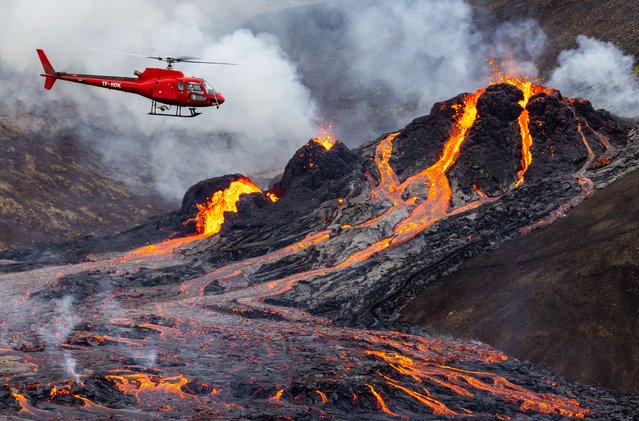
A helicopter flies close to a volcanic eruption which has begun in Fagradalsfjall near the capital Reykjavik on March 20, 2021 in Fagradalsfjall, Iceland. On Friday the Icelandic meteorological office announced a volcano, referring to a mountain located south-west of the Capital Reykjavik has erupted after thousands of small earthquakes in the area over the recent weeks. A no-fly zone has been established in the area. (Photo by Vilhelm Gunnarsson/Getty Images)

A helicopter flies close to a volcanic eruption which has begun in Fagradalsfjall near the capital Reykjavik on March 20, 2021 in Fagradalsfjall, Iceland. On Friday the Icelandic meteorological office announced a volcano, referring to a mountain located south-west of the Capital Reykjavik has erupted after thousands of small earthquakes in the area over the recent weeks. A no-fly zone has been established in the area. (Photo by Vilhelm Gunnarsson/Getty Images)
Details
21 Mar 2021 08:54:00
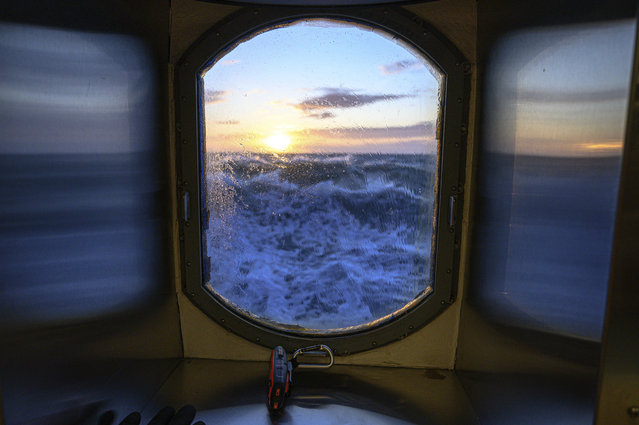
This November 8, 2019, photo provided by John Guillote shows a view from the main lab of the Sikuliaq in the Chukchi Sea. University of Washington scientists onboard the research vessel are studying the changes and how less sea ice will affect coastlines, which already are vulnerable to erosion because increased waves delivered by storms. More erosion would increase the chance of winter flooding in villages and danger to hunters in small boats. (Photo by John Guillote via AP Photo)

This November 8, 2019, photo provided by John Guillote shows a view from the main lab of the Sikuliaq in the Chukchi Sea. University of Washington scientists onboard the research vessel are studying the changes and how less sea ice will affect coastlines, which already are vulnerable to erosion because increased waves delivered by storms. More erosion would increase the chance of winter flooding in villages and danger to hunters in small boats. (Photo by John Guillote via AP Photo)
Details
26 Aug 2021 08:22:00
A woman is dragged away by Chinese men moments after she was seen talking to journalists near the site of a reported explosion outside the U.S. Embassy in Beijing, China, Thursday, July 26, 2018. A man exploded a small homemade bomb outside the U.S. Embassy in Beijing on Thursday, injuring only himself, according to police and an embassy spokesperson. (Photo by Ng Han Guan/AP Photo)

A woman is dragged away by Chinese men moments after she was seen talking to journalists near the site of a reported explosion outside the U.S. Embassy in Beijing, China, Thursday, July 26, 2018. A man exploded a small homemade bomb outside the U.S. Embassy in Beijing on Thursday, injuring only himself, according to police and an embassy spokesperson. (Photo by Ng Han Guan/AP Photo)
Details
27 Jul 2018 08:59:00