Loading...
Done
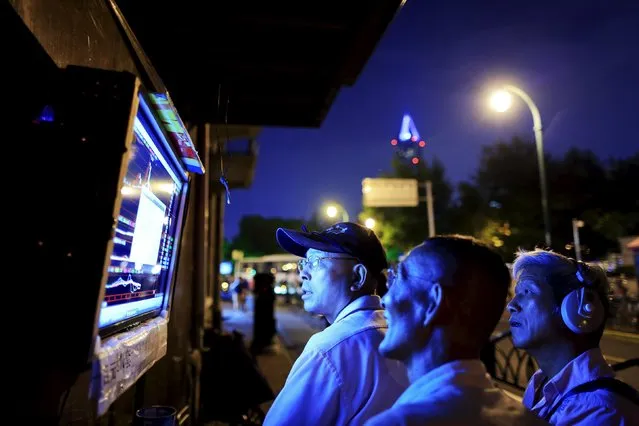
Shen Yuxi (L), introduces analysis software to investors at a “street stock salon” in central Shanghai, China, September 5, 2015. Shen carries a TV screen on his electronic bike to the "salon" every weekends where he sets it up on the wall outside a brokerage house. Shen's been selling analysis software at "the salon" for more than 10 years. (Photo by Aly Song/Reuters)

Some are in it just for the money, others to help buy a meal. Then there are those who trade for fun or to spend time among friends. Millions of investors – pensioners, security guards, high-school students – dominate China's stock markets, conducting about 80 percent of all trades. Retirees gather in brokerage houses dotted around China also to enjoy some company and savour the air conditioning on hot days. Some start as young as 13, trading from home with an eye on future careers in finance. Winning isn't guaranteed. This year, among the most turbulent in China's financial history, its stock markets more than doubled in the six months to May, only to crash amid concerns that growth in the country, which makes everything from cars to steel, is slowing faster than previously thought. (Photo by Aly Song/Reuters)
Details
13 Oct 2015 08:00:00
Nguyen Manh Quan (top), 26, a civil servant, carries a girl using his throat area as he performs during a showcase of the traditional Thien Mon Dao kung fu at Du Xa Thuong village, southeast of Hanoi, Vietnam May 10, 2015. (Photo by Reuters/Kham)

Nguyen Manh Quan (top), 26, a civil servant, carries a girl using his throat area as he performs during a showcase of the traditional Thien Mon Dao kung fu at Du Xa Thuong village, southeast of Hanoi, Vietnam May 10, 2015. Thien Mon Dao, a traditional Vietnamese martial art, was formed by 18th century villagers in Du Xa Thuong village, who believed the art form could help improve health as well as fight against foreign invaders. There are currently about 3,000 practitioners including farmers, industry workers and state servants. These practitioners say they are able to bend metal against their bodies and carry heavy objects using their throats, eyes or tongues, as well as run across the surface of a river, according to Thien Mon Dao kung fu master Nguyen Khac Phan. (Photo by Reuters/Kham)
Details
11 May 2015 12:27:00
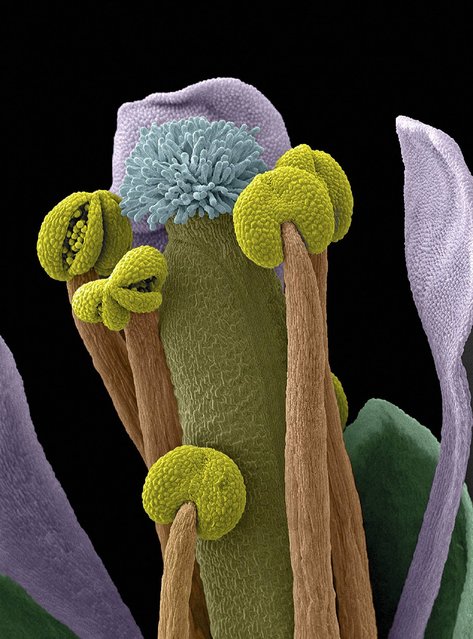
Scanning electron micrograph (SEM) of an Arabidopsis thaliana flower, also commonly known as thale cress. Some of the anthers are open, revealing pollen grains ready for dispersal. Arabidopsis was the first plant to have its entire genome sequenced and is widely used as a model organism in molecular and plant biology. Horizontal width of image is 1200 microns. Magnification 100x. (Photo by Stefan Eberhard/Wellcome Images)

Beautiful, strange and occasionally alarming pictures from the shortlist for this year’s Wellcome image awards – which celebrate the very best in science photography and imaging – from an x-ray of a bat to a micrograph of a kidney stone. The exhibition opens on 12 March at three science centres and the Museum of Science and Industry in Manchester. Photo: Scanning electron micrograph (SEM) of an Arabidopsis thaliana flower, also commonly known as thale cress. Some of the anthers are open, revealing pollen grains ready for dispersal. Arabidopsis was the first plant to have its entire genome sequenced and is widely used as a model organism in molecular and plant biology. Horizontal width of image is 1200 microns. Magnification 100x. (Photo by Stefan Eberhard/Wellcome Images)
Details
11 Mar 2014 05:58:00
Two women wearing nun outfits drink beer while watching the 2014 Tim Hortons Brier curling championships in Kamloops, British Columbia in this March 8, 2014 file photo. (Photo and caption by Ben Nelms/Reuters)

Two women wearing nun outfits drink beer while watching the 2014 Tim Hortons Brier curling championships in Kamloops, British Columbia in this March 8, 2014 file photo. Although some people might conclude that a curling event could produce a dull atmosphere, it is actually far from it. Some of the most energetic and loyal fans are committed to showing their colours at tournaments around the world. There was a lull in the games that were being held on this day and I remember spotting these nuns sitting in their seats earlier. Although them just sitting there didn't produce a picture, I kept my eye on them for the entire match. As soon as I spotted them with beer in their hands, I slowly turned my camera towards them and waited for them to take a drink. One of the challenges of shooting this image was to not have everyone notice me taking the photo. I had a longer lens on and was right in the middle of the rink. I slowly turned my lens, not to make my intentions too obvious, and waited until they drank from their beers together. (Photo and caption by Ben Nelms/Reuters)
Details
27 Nov 2014 14:39:00
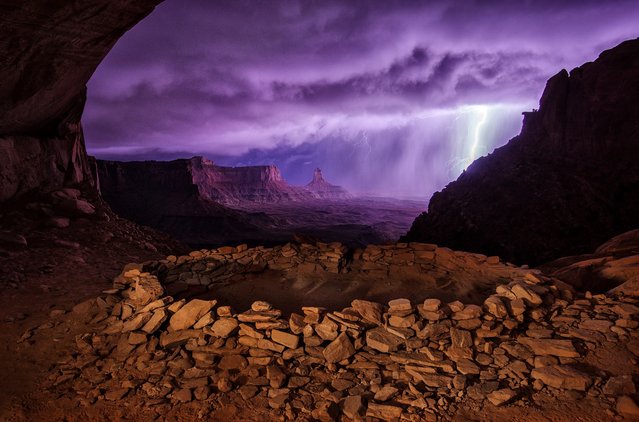
Second Place Winner: “Thunderstorm at False Kiva”. I hiked out to these ruins at night hoping to photograph them with the Milky Way, but instead a thunderstorm rolled through, creating this dramatic image. – Max Seigal. (Photo and caption by Max Seigal/National Geographic Traveler Photo Contest)

Second Place Winner: “Thunderstorm at False Kiva”. I hiked out to these ruins at night hoping to photograph them with the Milky Way, but instead a thunderstorm rolled through, creating this dramatic image. – Max Seigal. National Geographic Traveler Director of Photography Dan Westergren, one of this year's judges, shares his thoughts on the second place winner: “This photo combines two different scenes into one: the small kiva in a cliff dwelling and the grand vista of Canyonlands National Park across the valley. I really like the two different color palettes – warm inside and purple outside. This two-for-one scene was caused by the lightning storm outside the dwelling, which lit up the landscape like it was a huge electronic flash. Looking at this picture I can imagine what a wonderful sight it must have been for the ancient people who lived here. It doesn't seem too amazing now in our modern world, but might have been mind-blowing for the prehistoric residents”. Location: Utah. (Photo and caption by Max Seigal/National Geographic Traveler Photo Contest)
Details
02 Aug 2013 06:16:00
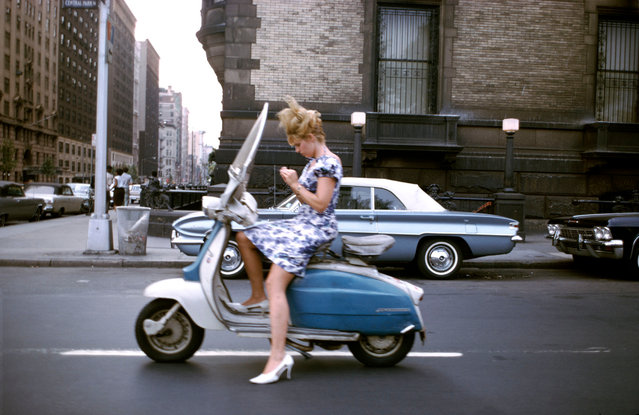
New York City, 1965, by Joel Meyerowitz. “A girl on a Vespa on her way to who knows where, when the light stopped her at the 72nd street crossing near the Dakota, where John Lennon would one day cross paths with his fate. She takes this moment to finesse a fingernail before she resumes her downtown journey, while I, stopping at the same crossing, but on foot, leap into the street to capture this vision of a dream girl before time takes her on her way”. (Photo by Joel Meyerowitz/Courtesy Aperture)

The November 2018 Square Print Sale, presented by Magnum Photos and Aperture, brings together over 100 images to explore perspectives on transition and transformation in photography. Here: New York City, 1965, by Joel Meyerowitz. “A girl on a Vespa on her way to who knows where, when the light stopped her at the 72nd street crossing near the Dakota, where John Lennon would one day cross paths with his fate. She takes this moment to finesse a fingernail before she resumes her downtown journey, while I, stopping at the same crossing, but on foot, leap into the street to capture this vision of a dream girl before time takes her on her way”. (Photo by Joel Meyerowitz/Courtesy Aperture)
Details
31 Oct 2018 00:05:00
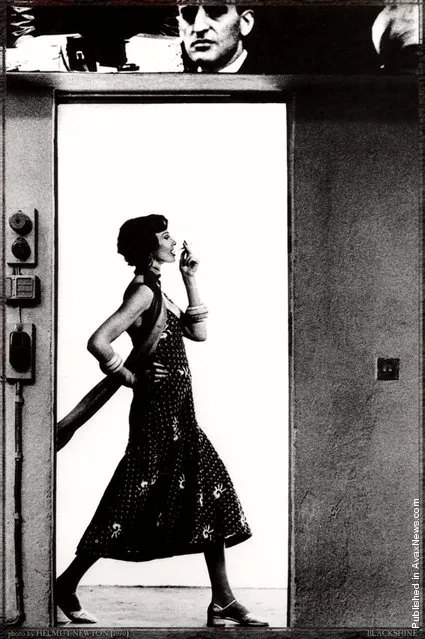
Photographers: Helmut Newton

“Newton was born in Berlin, the son of Klara “Claire” (Marquis) and Max Neustädter, a button factory owner. His family was Jewish. Newton attended the Heinrich-von-Treitschke-Realgymnasium and the American School in Berlin. Interested in photography from the age of 12 when he purchased his first camera, he worked for the German photographer Yva (Elsie Neulander Simon) from 1936. The increasingly oppressive restrictions placed on Jews by the Nuremberg laws meant that his father lost control of the factory in which he manufactured buttons and buckles; he was briefly interned in a concentration camp on “Kristallnacht”, November 9, 1938, which finally compelled the family to leave Germany. Newton's parents fled to South America. He was issued with a passport just after turning 18, and left Germany on December 5, 1938. At Trieste he boarded the “Conte Rosso” (along with about 200 others escaping the Nazis) intending to journey to China. After arriving in Singapore he found he was able to remain there, first and briefly as a photographer for the Straits Times and then as a portrait photographer”. – Wikipedia

Photo: Sigourney Weaver by Helmut Newton, 1995.
Details
08 Apr 2012 13:49:00
A Heart So White

A Heart So White

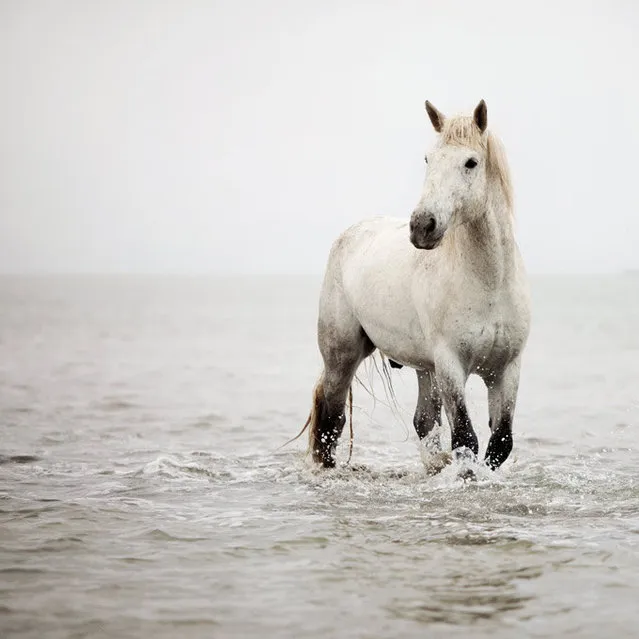
The wild white horses of Camargue, France have a mythical charm that can be difficult to capture in a photo. But Irene Suchocki has accomplished the task. Beauty, mystery and wildness are all there.
Details
21 Jun 2012 03:32:00