Loading...
Done
Amanda and her cousin Amy, Valdese, North Carolina, 1990. (Photo by Mary Ellen Mark)

Mary Ellen Mark was an American photographer known for her photojournalism / documentary photography, portraiture, and advertising photography. She photographed people who were "away from mainstream society and toward its more interesting, often troubled fringes". Here: Amanda and her cousin Amy, Valdese, North Carolina, 1990. (Photo by Mary Ellen Mark)
Details
18 Nov 2015 08:04:00
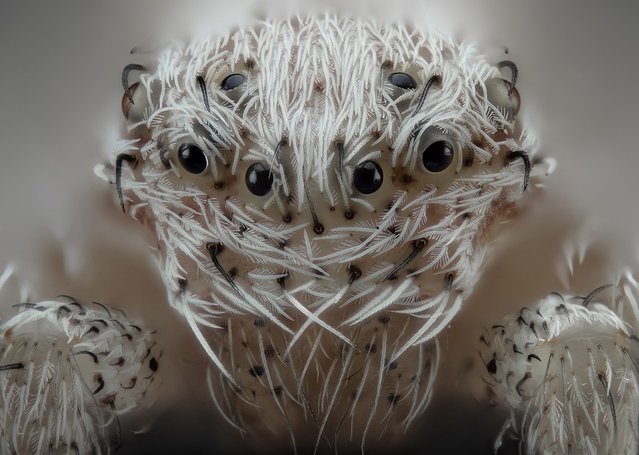
Try not to get hypnotised by this spider. (Photo by Javier Ruperez/Solent News & Photo Agency)

This extraordinary series of close-up photos turns mundane insects into terrifying beasts from another world. The bugs are captured in intricate detail by photographer Javier Ruperez, using a special lens, revealing just how complex the tiny creatures are. (Photo by Javier Ruperez/Solent News & Photo Agency)
Details
21 Jun 2018 00:03:00
A public bus makes its way on a flooded road after heavy monsoon rains in Mumbai, India on August 4, 2019. (Photo by Indranil Mukherjee/AFP Photo)

A public bus makes its way on a flooded road after heavy monsoon rains in Mumbai, India on August 4, 2019. India receives its monsoon rains from June to September. (Photo by Indranil Mukherjee/AFP Photo)
Details
08 Aug 2019 00:03:00
Suzuki's Hanare concept car is displayed during the Tokyo Motor Show, in Tokyo, Japan on October 23, 2019. (Photo by Soe Zeya Tun/Reuters)

Suzuki's Hanare concept car is displayed during the Tokyo Motor Show, in Tokyo, Japan on October 23, 2019. The 46th Tokyo Motor Show will be op​en​ to the general public from 25 October to 04 November 2019. (Photo by Soe Zeya Tun/Reuters)
Details
26 Oct 2019 00:05:00
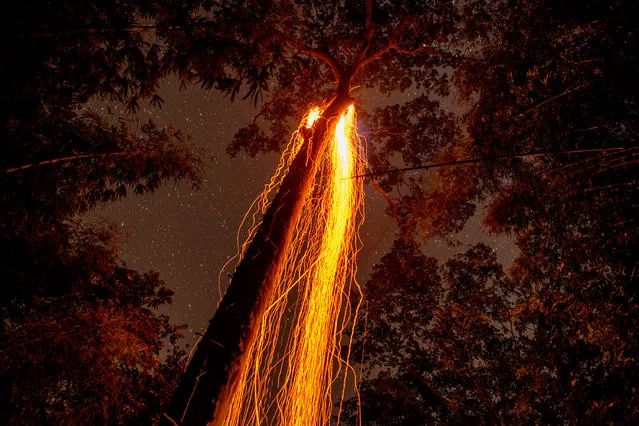
Bees are sensitive to light, which makes them follow the glowing embers down to the ground. (Photo by Hasnoor Hussain/The Guardian)

During the spring harvest season, a group of traditional Malaysian honey hunters travel to the rainforest near the Thai border to collect honeycombs from giant bees – and risk their lives climbing 200ft trees. Here: Bees are sensitive to light, which makes them follow the glowing embers down to the ground. (Photo by Hasnoor Hussain/The Guardian)
Details
22 Oct 2016 10:26:00
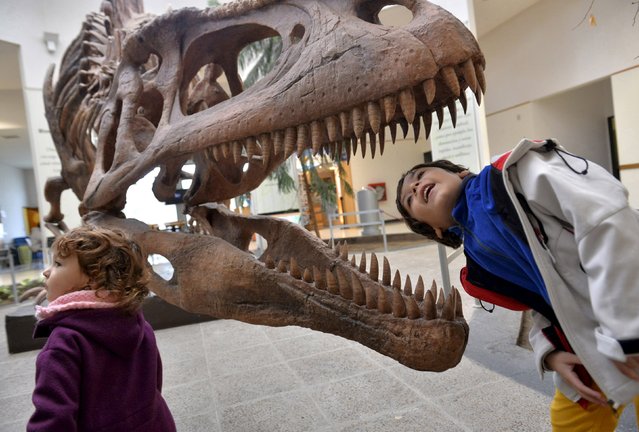
A boy looks inside the skull of a Tyrannosaurus Rex replica at the Egidio Feruglio Museum in Trelew, Argentina, in this May 18, 2014 file photograph. Scientists on July 28, 2015 unveiled a comprehensive analysis of the teeth of the group of carnivorous dinosaurs called theropods, which include the Tyrannosaurus Rex, detailing a unique serrated structure that let them chomp efficiently through the flesh and bones of large prey. (Photo by Maxi Jonas/Reuters)

A boy looks inside the skull of a Tyrannosaurus Rex replica at the Egidio Feruglio Museum in Trelew, Argentina, in this May 18, 2014 file photograph. Scientists on July 28, 2015 unveiled a comprehensive analysis of the teeth of the group of carnivorous dinosaurs called theropods, which include the Tyrannosaurus Rex, detailing a unique serrated structure that let them chomp efficiently through the flesh and bones of large prey. (Photo by Maxi Jonas/Reuters)
Details
29 Jul 2015 11:55:00
Bodies In Urban Space

“Bodies in urban spaces” is a temporarily intervention in diversified urban architectural environments. The intention of “Bodies in urban spaces” is to point out the urban functional structure and to uncover the restricted movement possibilities and behavior as well as rules and limitations.
Details
31 Jul 2014 13:41:00
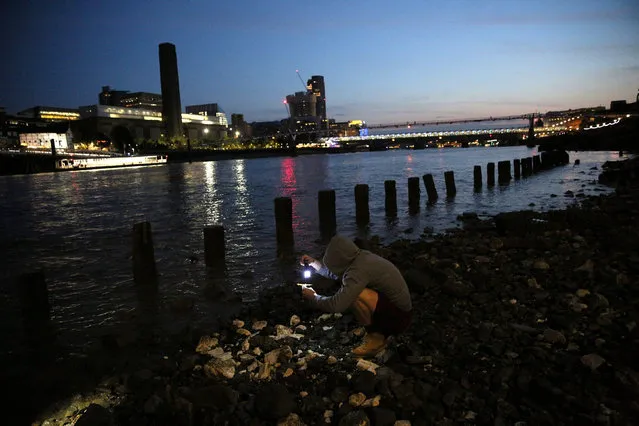
A mudlark uses a torch to look for items on the bank of the River Thames in London, Britain June 06, 2016. Mudlarking is believed to trace its origins to the 18th and 19th century, when scavengers searched the Thames' shores for items to sell. These days, history and archaeology fans are the ones hoping to find old relics such as coins, ceramics, artifacts or everyday items from across centuries. They wait for the low tide and then scour specific areas of exposed shores. "If you're in a field you could be out all day long, with the river you're restricted to about two or three hours," mudlark Nick Stevens said. While many just use the naked eye for their searches, others rely on metal detectors for which a permit from the Port of London Authority is needed. Digging also requires consent. (Photo by Neil Hall/Reuters)

A mudlark uses a torch to look for items on the bank of the River Thames in London, Britain June 06, 2016. Mudlarking is believed to trace its origins to the 18th and 19th century, when scavengers searched the Thames' shores for items to sell. These days, history and archaeology fans are the ones hoping to find old relics such as coins, ceramics, artifacts or everyday items from across centuries. their finds with the Portable Antiquities Scheme. Any item over 300 years old must be recorded. (Photo by Neil Hall/Reuters)
Details
27 Aug 2016 10:43:00