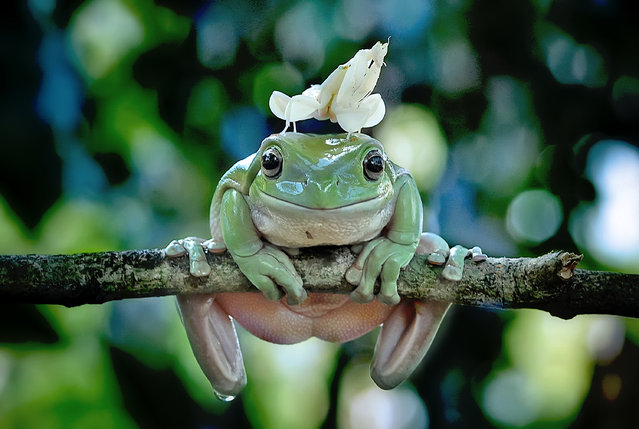
An Orchid Mantis (Hymenopus coronatus) is perched on the head of a frog hanging from a tree branch on March 15, 2017 in Padang, Indonesia. (Photo by Riau Images/Barcroft Images)
Roped up climbers leave the summit of Breithorn at 4,164 metres (13,661 feet) on the ridge marking the border with Switzerland (left) and Italy in the Alpine resort of Zermatt August 4, 2014. Switzerland will vote on November 30 on an initiative from the group Ecopop which proposes a cap on the number of immigrants. The group says it is motivated by concerns about a lack of living space exerting too much pressure on the land and natural resources, rather than by opposition to foreigners. (Photo by Denis Balibouse/Reuters)
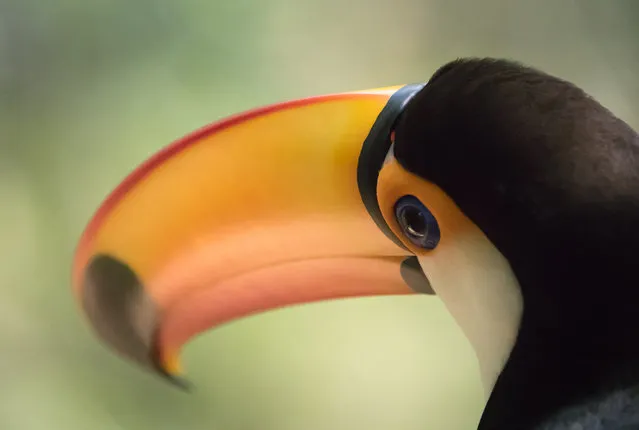
The British Ecological Society has announced the winners of its annual photography competition, Capturing Ecology. Taken by international ecologists and students, the winning images will be exhibited at the society’s joint annual meeting in Ghent in December. Here: Overall runner-up; Toucan, Mark Tatchell. (Photo by Mark Tatchell/British Ecological Society)
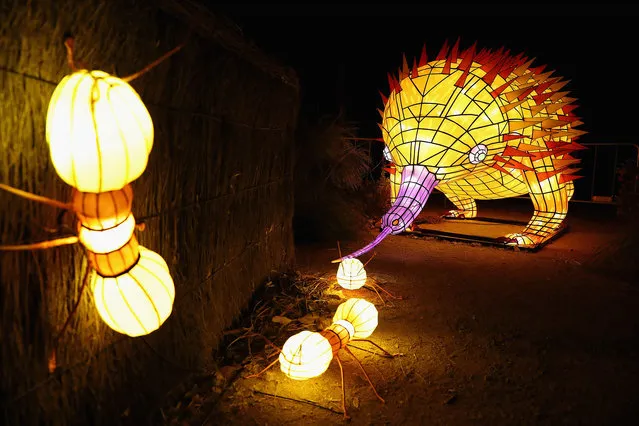
An echidna light sculpture eating ants is displayed during a media preview of Vivid Sydney illuminated displays at Taronga Zoo on May 24, 2016 in Sydney, Australia. Vivid is lighting up at Taronga Zoo for the first time with ten giant animal sculptures representing critical species the zoo is committed to protecting. Held annually, Vivid Sydney is the world's largest festival of light, music and ideas running for 23 days. (Photo by Cameron Spencer/Getty Images)
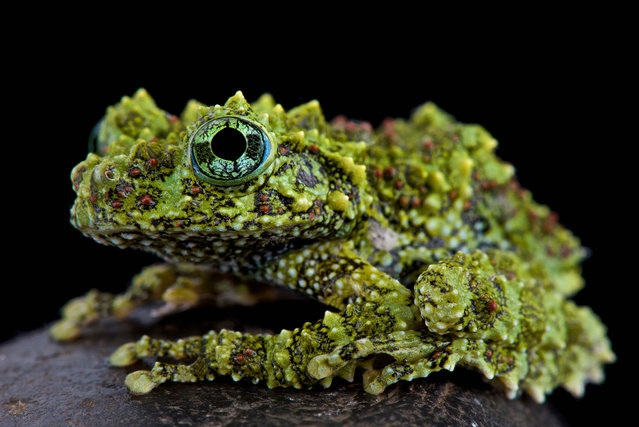
Renowned amphibian and reptile photographer Matthijs Kuijpers has released his first book, “Cold Instinct”. Kuijpers says the aim of the work is “for the viewer to abandon the fear and negative thoughts that often surround these animals”. What’s left is the bizarre beauty of these creatures in their simplest form – no backgrounds and no distractions. Here: Mossy frog (Theloderma corticale). (Photo by Matthijs Kuijpers/The Guardian)
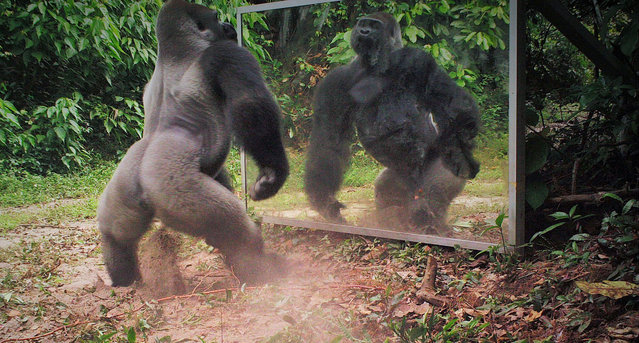
Camera trapper Xavier Hubert-Brierre put this large mirror on the side of a road through the jungle in Gabon and left a camera there to record how the animals would respond to their own reflections. A silverback gorilla thought it was seeing another silverback and responded by trying to scare off the potential challenger… (Photo by Xavier Hubert-Brierre/Johns Hopkins University Press)
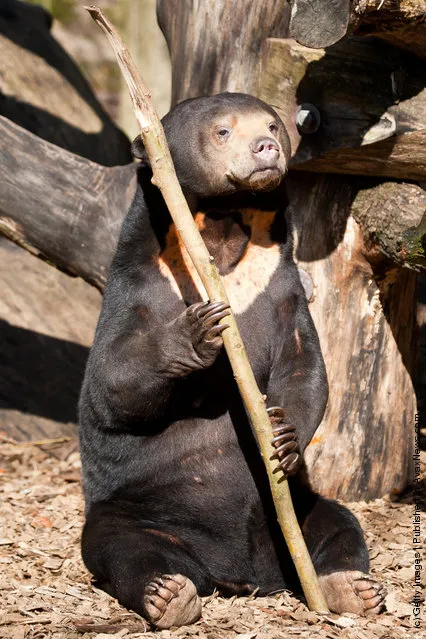
The sun bear (Ursus malayanus), also known as the honey bear, is a bear found primarily in the tropical rainforest (the dense lowland forests) in Southeast Asia; North-East India, Bangladesh, Myanmar, Thailand, Laos, Cambodia, Vietnam, Southern China, Peninsular Malaysia, and the islands of Sumatra and Borneo.
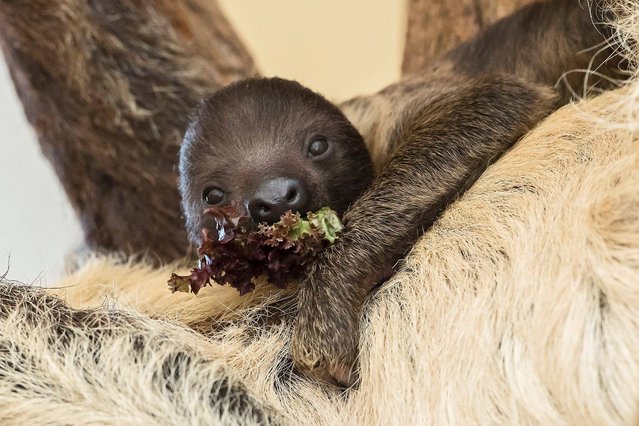
This handout picture taken on December 13, 2016 and released on December 14, 2016 by the Tiergarten Schoenbrunn zoo in Vienna, Austria, shows a baby sloth eating some salad as it hangs on it's mother's belly in their enclosure. The baby was born already on November 18, 2016, but according to the zoo it could be picured for the first time only now as it usually hides in it's mother's soft coat. (Photo by Daniel Zupanc/AFP Photo)