Loading...
Done
People immerse themselves in an ice hole in the Chulym river, with the air temperature at about minus 12 degrees Celsius (10.4 degrees Fahrenheit), during celebrations for the Russian Orthodox Epiphany outside of the town of Nazarovo, Krasnoyarsk region January 19, 2015. (Photo by Ilya Naymushin/Reuters)

People immerse themselves in an ice hole in the Chulym river, with the air temperature at about minus 12 degrees Celsius (10.4 degrees Fahrenheit), during celebrations for the Russian Orthodox Epiphany outside of the town of Nazarovo, Krasnoyarsk region January 19, 2015. (Photo by Ilya Naymushin/Reuters)
Details
19 Jan 2015 13:20:00
Secret arrive during the 1st Gaon Chart K-POP Awards at Blue Square

Secret arrive during the 1st Gaon Chart K-POP Awards at Blue Square on February 22, 2012 in Seoul, South Korea. (Photo by Chung Sung-Jun/Getty Images)
Details
26 Feb 2012 12:01:00
s*xy brunet striptease dancer dancing lap dance in front of man. (Photo by Blue SkyImages/Getty Images)

Sеxy brunet striptease dancer dancing lap dance in front of man. (Photo by Blue SkyImages/Getty Images)
Details
01 Dec 2017 05:01:00
South Koreans Celebrate Ice Festival

Anglers cast lines through holes into a frozen river during an ice fishing competition at the Hwacheon Sancheoneo Ice Festival on January 7, 2012 in Hwacheon-gun, South Korea. (Photo by Chung Sung-Jun/Getty Images)
Details
07 Jan 2012 13:35:00
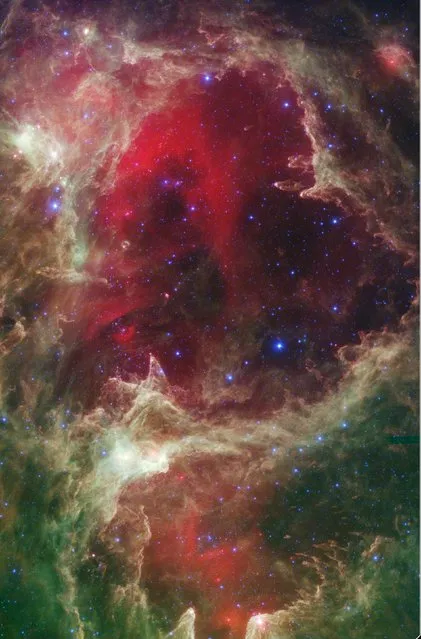
An infrared portrait from NASA's Spitzer Space Telescope which shows generations of stars is seen in this undated NASA handout image released February 14, 2013. In this wispy star-forming region, called W5, the oldest stars can be seen as blue dots in the centers of the two hollow cavities (other blue dots are background and foreground stars not associated with the region). Red shows heated dust that pervades the region's cavities, while green highlights dense clouds. (Photo by NASA/Reuters/JPL-Caltech/Harvard-Smithsonian/Handout)

An infrared portrait from NASA's Spitzer Space Telescope which shows generations of stars is seen in this undated NASA handout image released February 14, 2013. In this wispy star-forming region, called W5, the oldest stars can be seen as blue dots in the centers of the two hollow cavities (other blue dots are background and foreground stars not associated with the region). Red shows heated dust that pervades the region's cavities, while green highlights dense clouds. (Photo by NASA/Reuters/JPL-Caltech/Harvard-Smithsonian/Handout)
Details
03 Mar 2013 08:44:00
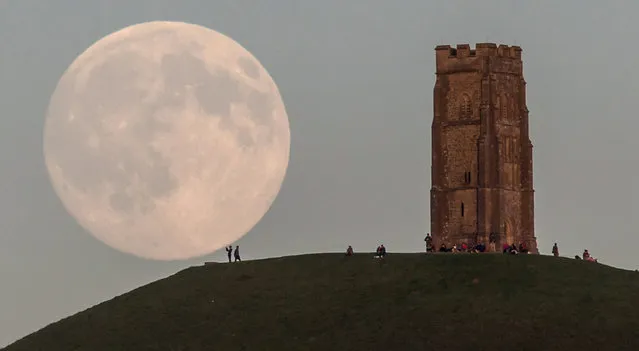
The moon rises over people gathered on Glastonbury Tor ahead of tomorrow's Blue Moon on July 30, 2015 in Somerset, England. The full moon appearing on July 31 will be what's called a Blue Moon, which refers to the second of two full moons appearing in the same calendar month. The last time this happened was in 2012 and there isn't due another until 2018. (Photo by Matt Cardy/Getty Images)

The moon rises over people gathered on Glastonbury Tor ahead of tomorrow's Blue Moon on July 30, 2015 in Somerset, England. The full moon appearing on July 31 will be what's called a Blue Moon, which refers to the second of two full moons appearing in the same calendar month. The last time this happened was in 2012 and there isn't due another until 2018. (Photo by Matt Cardy/Getty Images)
Details
02 Aug 2015 13:07:00
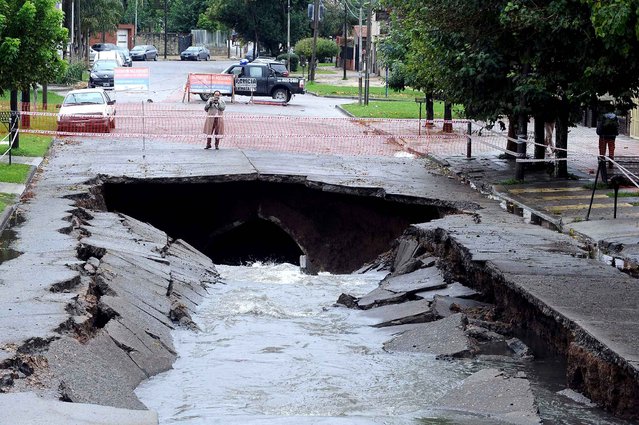
Handout picture released by Telam showing the tarmac of the Pedro Palacios Avenue in Ramos Mejia, province of Buenos Aires, Argentina, under which the channeled waters of the Maldonado stream flow, after it collapsed on April 8, 2014 leaving a 40-metre-long, 1.4-metre-deep hole. About 3000 people had to be evacuated in the Argentine provinces of Neuquen (soutwest), Catamarca (northwest), Santiago del estero (center) and Cordoba (center)due to the foods caused by heavy rain, official sources said. (Photo by Daniel Dabove/AFP Photo)

Handout picture released by Telam showing the tarmac of the Pedro Palacios Avenue in Ramos Mejia, province of Buenos Aires, Argentina, under which the channeled waters of the Maldonado stream flow, after it collapsed on April 8, 2014 leaving a 40-metre-long, 1.4-metre-deep hole. About 3000 people had to be evacuated in the Argentine provinces of Neuquen (soutwest), Catamarca (northwest), Santiago del estero (center) and Cordoba (center)due to the foods caused by heavy rain, official sources said. (Photo by Daniel Dabove/AFP Photo)
Details
12 Apr 2014 12:40:00
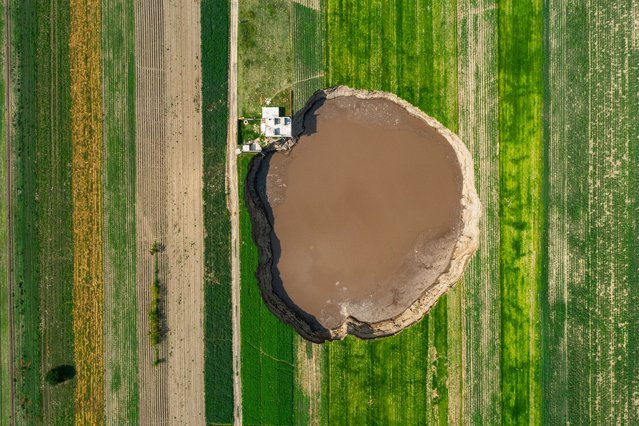
Aerial view of a giant sinkhole on June 09, 2021 in Santa María Zacatepec, Mexico. The giant sinkhole is located 20 kilometers northwest from the capital city Puebla, the hole now measures 110 meters across its widest point, covering around 11,000 square meters and damaging a house built near the place where it appeared. Farmers of the surroundings have been affected since they are not allowed to enter their fields due to the warning perimeter set up by the authorities. (Photo by Hector Vivas/Getty Images)

Aerial view of a giant sinkhole on June 09, 2021 in Santa María Zacatepec, Mexico. The giant sinkhole is located 20 kilometers northwest from the capital city Puebla, the hole now measures 110 meters across its widest point, covering around 11,000 square meters and damaging a house built near the place where it appeared. Farmers of the surroundings have been affected since they are not allowed to enter their fields due to the warning perimeter set up by the authorities. (Photo by Hector Vivas/Getty Images)
Details
10 Aug 2021 09:48:00