Loading...
Done
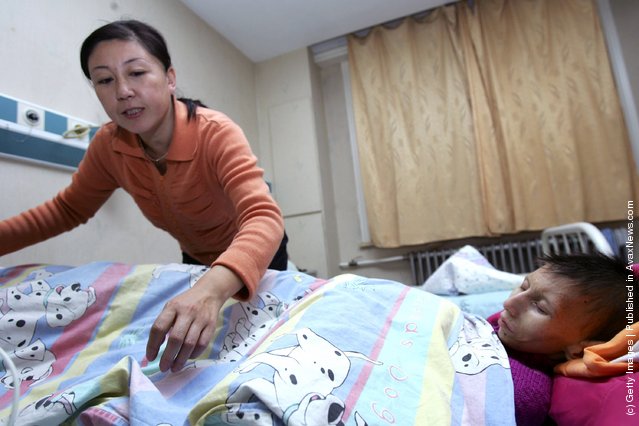
12-year-old Chinese girl Sun Yangyang suffering from Cockayne syndrome

“Cockayne syndrome (also called Weber-Cockayne syndrome, or Neill-Dingwall Syndrome) is a rare autosomal recessive congenital disorder characterized by growth failure, impaired development of the nervous system, abnormal sensitivity to sunlight (photosensitivity), and premature aging. Hearing loss and eye abnormalities (pigmentary retinopathy) are other common features, but problems with any or all of the internal organs are possible. It is associated with a group of disorders called leukodystrophies. The underlying disorder is a defect in a DNA repair mechanism. It is named after English physician Edward Alfred Cockayne (1880–1956)”. – Wikipedia

Photo: Mother of 12-year-old Chinese girl Sun Yangyang suffering from Cockayne syndrome, tends her at the First Affiliated Hospital of Jilin University on November 11, 2006 in Changchun of Jilin Province, China. The disease results in the senile appearance of Yangyang and also causes eyesight, hearing weakness and other problems. Doctors failed to cure the girl... (Photo by China Photos/Getty Images)
Details
08 Aug 2011 11:17:00
Turkish army, including cavalry, infantry and artillery. (Photo by Dr. P.A. Smithe/National World War I Museum, Kansas City, Mo.)

Dr. P.A. Smithe was sent by the American Red Cross as a doctor and surgeon to work at a hospital in Vienna. He sailed to Europe in December 1915 and returned home in August 1916, according to his daughter, who donated his images to the National World War I Museum. Photo: Turkish army, including cavalry, infantry and artillery. (Photo by Dr. P.A. Smithe/National World War I Museum, Kansas City, Mo.)
Details
29 Jul 2014 11:53:00
The symbol for “One Orlando” is spelled out at a makeshift memorial at Lake Eola in downtown Orlando, Fla., Saturday, June 18, 2016. Nearby, visitors lit candles and prayed at a larger memorial, at the Dr. Phillips Center for the Performing Arts, to mourn the victims of the Pulse massacre. (Photo by Joe Burbank/Orlando Sentinel via AP Photo)

The symbol for “One Orlando” is spelled out at a makeshift memorial at Lake Eola in downtown Orlando, Fla., Saturday, June 18, 2016. Nearby, visitors lit candles and prayed at a larger memorial, at the Dr. Phillips Center for the Performing Arts, to mourn the victims of the Pulse massacre. (Photo by Joe Burbank/Orlando Sentinel via AP Photo)
Details
19 Jun 2016 09:44:00
A pair of alpacas at a British farm in Dorchester, Dorset on October 9, 2024 pose together at the perfect time to conjure up a creature straight out of Dr Dolittle's imagination. (Phoot by MaxWillcock/Bournemouth News)

A pair of alpacas at a British farm in Dorchester, Dorset on October 9, 2024 pose together at the perfect time to conjure up a creature straight out of Dr Dolittle's imagination. (Phoot by MaxWillcock/Bournemouth News)
Details
13 Oct 2024 03:25:00
German-born American engineer Dr Wernher von Braun (1912 - 1977) with a model of the Explorer orbiting space satellite which he designed, 1958

“Wernher Magnus Maximilian Freiherr von Braun (March 23, 1912 – June 16, 1977) was a German-born rocket scientist, aerospace engineer, space architect, and one of the leading figures in the development of rocket technology in Nazi Germany during World War II and, subsequently, the United States”. – Wikipedia

Photo: German-born American engineer Dr. Wernher von Braun with a model of the Explorer orbiting space satellite which he designed. (Photo by Keystone/Getty Images). 1958
Details
22 Mar 2012 11:18:00
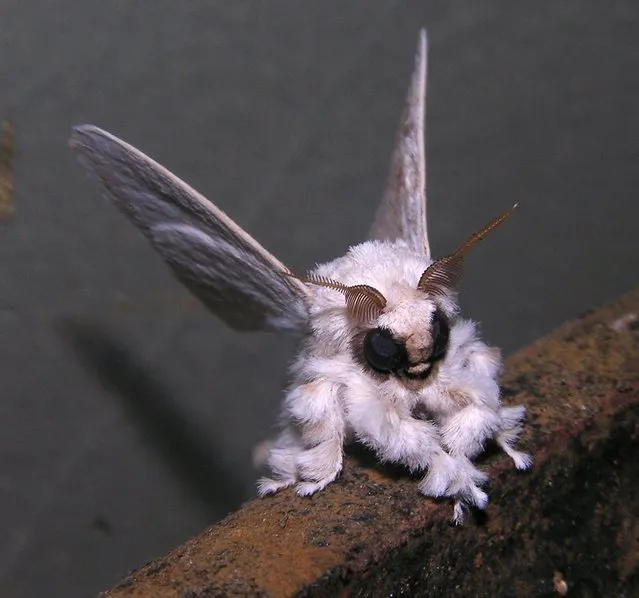
Venezuelan Poodle Moth

The Venezuelan Poodle Moth is a possible new species of moth discovered in 2009 by Dr. Arthur Anker of Bishkek, Kyrgyzstan, in the Gran Sabana region of Venezuela. It bears similarities to the Diaphora mendica, the Muslin Moth, but most likely belongs to the lepidopteran family Artace.
Details
13 Jan 2013 12:48:00
Killer Whales In McMurdo

Dr. Lisa Ballance (NOAA Fisheries Service) with a curious calf – this is a Type C killer whale, a fish-eater.
Details
06 Sep 2013 08:43:00
Girls of the Long Horn Miao ethnic minority group wear headdresses as they prepare gather for Tiaohua or Flower Festival as part of the Lunar New Year on February 6, 2017 in Longga village, Guizhou province, southern China. The Long Horn Miao are recognized for their declining practice of wrapping a blend of linen, wool, and the hair of their ancestors around animal horns or a wooden clip to make headdresses. Many young women say they now wear the headdresses only for special occasions and festivals, as the ornaments, which are attached by the horns to their real hair, have proved impractical for modern daily life in a fast changing world. China officially recognizes 56 different ethnic minorities, and statistics show over 7 million Chinese identifying themselves as Miao. But the small Long Horn Miao community counts only around 5000 people living in 12 villages, whose age-old traditions, language, and culture are fading. It is increasingly difficult in a modernizing China, as young people are drawn from remote rural villages to opportunities in bigger cities amongst wide-scale urbanization. Farming and labour remain the mainstays of life for the Long Horn Miao, leaving the area relatively poor in comparison with many parts of China. The government has invested significant amounts into local infrastructure and the tourism industry to try to bolster the local economy. (Photo by Kevin Frayer/Getty Images)

Girls of the Long Horn Miao ethnic minority group wear headdresses as they prepare gather for Tiaohua or Flower Festival as part of the Lunar New Year on February 6, 2017 in Longga village, Guizhou province, southern China. (Photo by Kevin Frayer/Getty Images)
Details
13 Feb 2017 00:01:00