Loading...
Done
Labourers walk near trucks loaded with logs, which are trapped on a muddy road, near an unreserved forest in the village of Igbatoro, southwest Nigeria, August 28, 2014. (Photo by Akintunde Akinleye/Reuters)

Labourers walk near trucks loaded with logs, which are trapped on a muddy road, near an unreserved forest in the village of Igbatoro, southwest Nigeria, August 28, 2014. Wood, a form of biomass, is the sole source of energy for hundreds of millions of Africans who lack access to modern sources of power, and logging, both legal and illegal, remains a lucrative business that has contributed to the rapid shrinking of Africa's rainforests and woodlands. (Photo by Akintunde Akinleye/Reuters)
Details
21 Nov 2014 12:50:00
Dancers perform at a Carnival parade in Les Cayes, Haiti, Tuesday, February 28, 2017. (Photo by Dieu Nalio Chery/AP Photo)

Dancers perform at a Carnival parade in Les Cayes, Haiti, Tuesday, February 28, 2017. Haiti's three-day Carnival festivities have brought rum-fueled parties, imaginative costumes and high-energy dance music to a southern city that's still recovering from last year's punishing Hurricane Matthew. (Photo by Dieu Nalio Chery/AP Photo)
Details
03 Mar 2017 00:02:00
Club-goers dance at “Morning Gloryville” at the Ministry of Sound in south London August 11, 2015. (Photo by Toby Melville/Reuters)

Club-goers dance at “Morning Gloryville” at the Ministry of Sound in south London August 11, 2015. Morning dance parties with names like “Morning Gloryville” and "Daybreaker" are gathering steam in cities across the world, giving rise to a movement known as “conscious clubbing”. Its founders aim to create the energy and community of electronic dance parties with fruit smoothies and coffee instead of the drugs and alcohol more common after nightfall. (Photo by Toby Melville/Reuters)
Details
18 Aug 2015 14:06:00
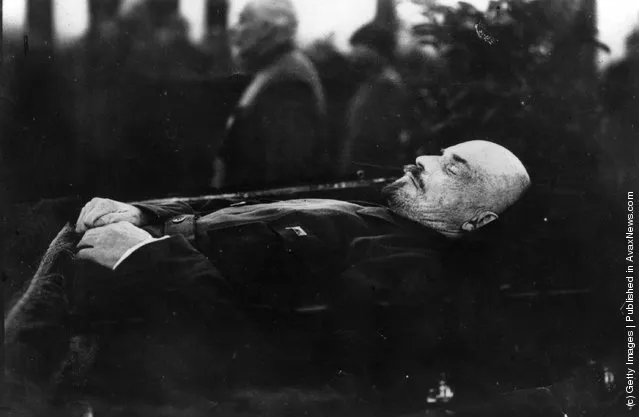
1924:  Vladimir Ilyich Lenin lying in state in the Kremlin

Photo: Vladimir Ilyich Lenin (1870 – 1924) lying in state in the Kremlin. (Photo by Hulton Archive/Getty Images). 1924

Important! For the same article in Russian language click here.

Something quite intriguing is happening within Russian-speaking internet during the last few – should you type a fully academic inquiry (at least, according to Russian academic requirements) in national search engines for "Lenin's mausoleum" – the first thing you get (even in top 10 searches) is website pages talking about black magic and occult. Website authors view this construction differently, but unconditionally agree on one thing: the mausoleum of the "leader of the world proletariat” – the essence of a magical artifact, a sort of “energy vampire”. It was built with a certain purpose: to drain the energy out of miserable Soviet citizens on one hand; and to poison the anthroposphere of one-sixth part of the earth with its vibes (the exact territory that was occupied by the former Soviet Union), depriving the Russian people of will to resist on the other hand. Complete nonsense? No doubt. Nevertheless, an intriguing one. Well, probably because some oddities do exist in mausoleum's history. These oddities are the thing we are going to discuss this time. First, let me refresh you memory on the subject.
Details
16 Oct 2011 11:27:00
In this undated handout photo taken by mrwed54, a woman poses for a photo by a lake in the Siberian city of Novosibirsk, about 2,800 kilometers (1,750 miles) east of Moscow, Russia. Thousands of Novosibirsk residents, from scantily clad women to newlyweds have been instagramming selfies near the lake nicknamed the “Siberian Malvides” after the far-flung tropical islands in the Indian Ocean. This is in fact is a man-made dumb of coal from a nearby power station that provides for most of Novosibirsk’s energy needs. Environmentalists are warning people against coming into contact with the water. (Photo by mrwed54 via AP Photo)

In this undated handout photo taken by mrwed54, a woman poses for a photo by a lake in the Siberian city of Novosibirsk, about 2,800 kilometers (1,750 miles) east of Moscow, Russia. Thousands of Novosibirsk residents, from scantily clad women to newlyweds have been instagramming selfies near the lake nicknamed the “Siberian Malvides” after the far-flung tropical islands in the Indian Ocean. This is in fact is a man-made dumb of coal from a nearby power station that provides for most of Novosibirsk’s energy needs. Environmentalists are warning people against coming into contact with the water. (Photo by mrwed54 via AP Photo)
Details
15 Jul 2019 00:07:00


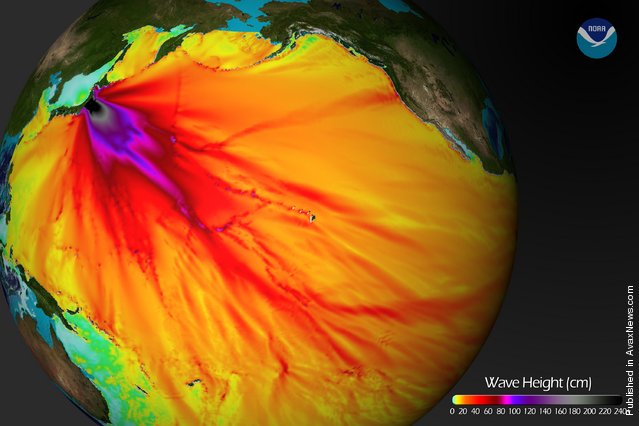
In this handout image provided by the National Oceanic and Atmospheric Administration (NOAA), model runs from the Center for Tsunami Research at the NOAA Pacific Marine Environmental Laboratory show the expected wave heights of the tsunami as it travels across the Pacific basin March 11, 2011. The largest wave heights are expected near the earthquake epicenter, off Japan. The wave will decrease in height as it travels across the deep Pacific but grow taller as it nears coastal areas. In general, as the energy of the wave decreases with distance, the near shore heights will also decrease (e.g., coastal Hawaii will not expect heights of that encountered in coastal Japan). (Photo by NOAA via Getty Images)
Details
13 Mar 2011 14:29:00
Trees

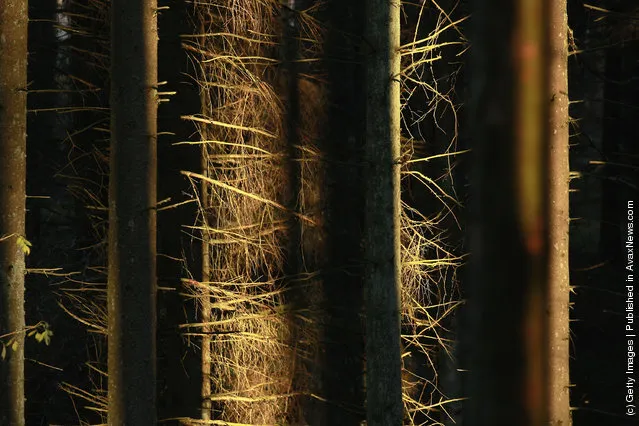
Tree trunks are seen in a forest on November 8, 2011 near Landau an der Isar, Germany. The German government is conducting a nationwide project to estimate the number, variety and geographic distribution of trees and forests in Germany, as well as their condition and health. Approximately a third of Germany is covered in woodlands, and though that territory has actually expanded since 1989, some analysts fear demand for wood will outstrip supply in coming years due to national growth in industry and bio-energy needs. (Photo by Johannes Simon/Getty Images)
Details
13 Nov 2011 11:07:00
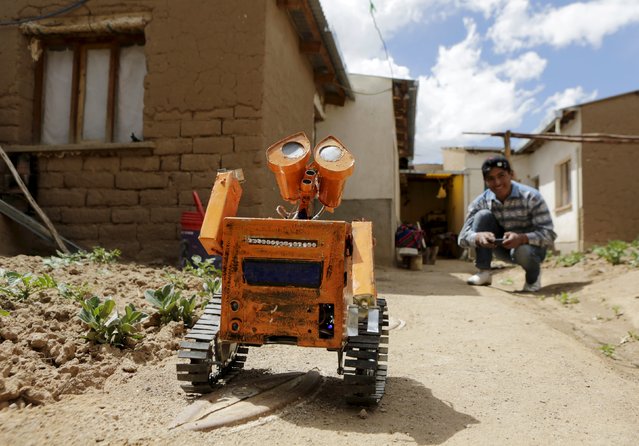
A replica of the Wall-E character is remotely controlled with a mobile phone by Bolivian student Esteban Quispe, 17, in Patacamaya, south of La Paz, December 10, 2015. (Photo by David Mercado/Reuters)

A replica of the Wall-E character is remotely controlled with a mobile phone by Bolivian student Esteban Quispe, 17, in Patacamaya, south of La Paz, December 10, 2015. Quispe built the Wall-E robot using materials he obtained from a rubbish dump in the town located in the Andean highland region. He hopes to mechanize agriculture in Patacamaya by making use of robots that operate on solar energy, Quispe told Reuters. (Photo by David Mercado/Reuters)
Details
13 Dec 2015 08:05:00