Loading...
Done
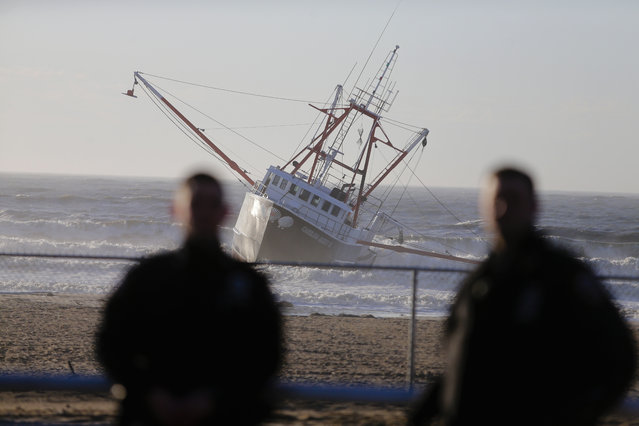
Police officers stand near a fishing boat, the Carolina Queen III, as it rests in shallow water just off Rockaway Beach, Thursday, February 25, 2016, in the Queens borough of New York. Authorities say a Coast Guard vessel overturned while assisting the fishing boat that ran aground in an inlet off New York City. (Photo by Frank Franklin II/AP Photo)

Police officers stand near a fishing boat, the Carolina Queen III, as it rests in shallow water just off Rockaway Beach, Thursday, February 25, 2016, in the Queens borough of New York. Authorities say a Coast Guard vessel overturned while assisting the fishing boat that ran aground in an inlet off New York City. (Photo by Frank Franklin II/AP Photo)
Details
26 Feb 2016 10:29:00
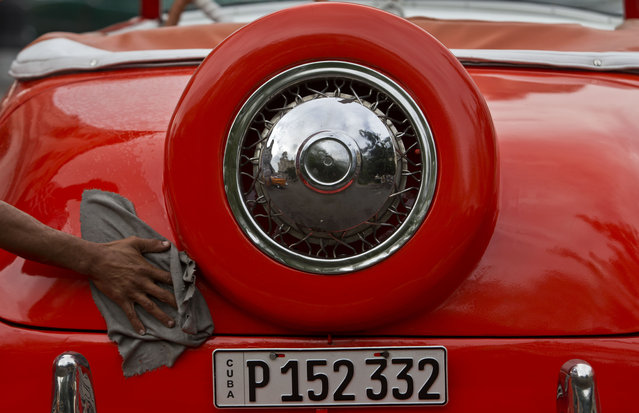
In this October 16, 2014 photo, a man cleans his American classic car before going to work in Havana, Cuba. While the U.S. embargo that took effect in 1961 stopped the flow of new cars, and most parts, a few Cubans now manage to bring in replacement parts when friends or family visit from the U.S. (Photo by Franklin Reyes/AP Photo)

In this October 16, 2014 photo, a man cleans his American classic car before going to work in Havana, Cuba. While the U.S. embargo that took effect in 1961 stopped the flow of new cars, and most parts, a few Cubans now manage to bring in replacement parts when friends or family visit from the U.S. (Photo by Franklin Reyes/AP Photo)
Details
20 Oct 2014 09:01:00
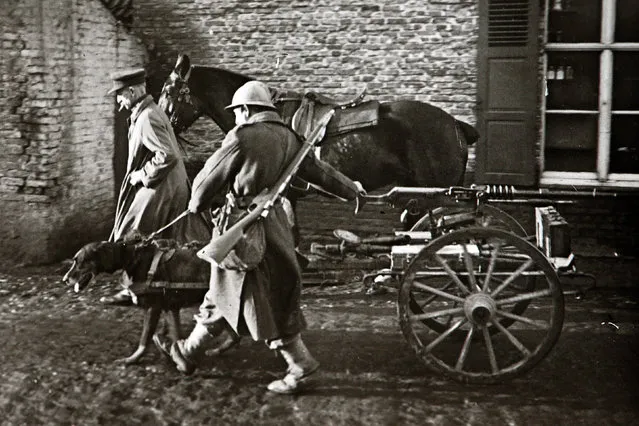
An undated archive picture shows a dog pulling a Belgian machine gun at an unknown location in northern France. (Photo by Collection Odette Carrez/Reuters)

An undated archive picture shows a dog pulling a Belgian machine gun at an unknown location in northern France. A Viscount in the Armoured Cavalry Branch of the French Army left behind a collection of hundreds of glass plates taken during World War One (WWI) that have never before been published. The images, by an unknown photographer, show the daily life of soldiers in the trenches, destruction of towns and military leaders. The year 2014 marks the 100th anniversary of the start of WWI. (Photo by Collection Odette Carrez/Reuters)
Details
23 May 2014 09:11:00
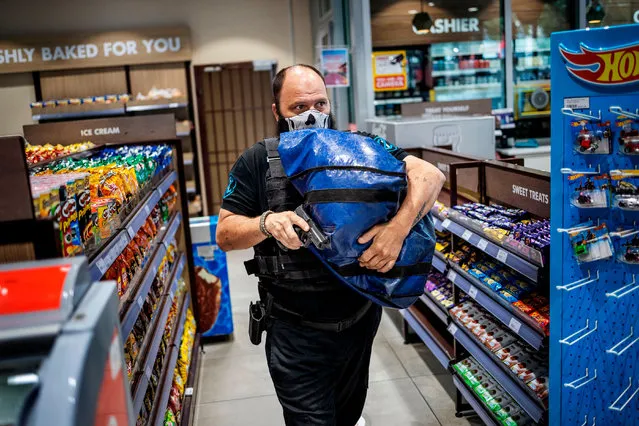
A CIT guard carries his gun handgun while bringing a bag containing cash inside an armoured vehicle during a money collection in Johannesburg's CBD, on December 8, 2020. As the Christmas festive season approaches, cash-in-transit (CIT) companies are gearing up as they continue to be target of crime, with about 3000 money vans traveling daily nationwide. Despite the COVID-19 lockdown, there have been 260 cash-in-transit heist incidents in South Africa this year, with 19 CIT crew members killed. Cash-in-transit heists in the country are often military-style planned operations with criminals recurring to bomb making and assault rifles attacks. (Photo by Michele Spatari/AFP Photo)

A CIT guard carries his gun handgun while bringing a bag containing cash inside an armoured vehicle during a money collection in Johannesburg's CBD, on December 8, 2020. As the Christmas festive season approaches, cash-in-transit (CIT) companies are gearing up as they continue to be target of crime, with about 3000 money vans traveling daily nationwide. Despite the COVID-19 lockdown, there have been 260 cash-in-transit heist incidents in South Africa this year, with 19 CIT crew members killed. Cash-in-transit heists in the country are often military-style planned operations with criminals recurring to bomb making and assault rifles attacks. (Photo by Michele Spatari/AFP Photo)
Details
18 Dec 2020 00:01:00


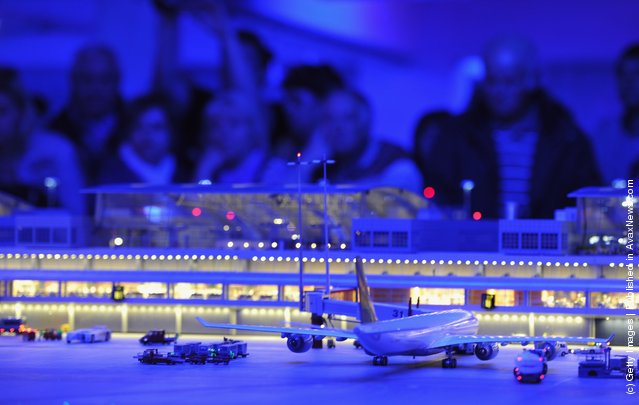
The public get the first view at the opening of the new miniature model Knuffingen Aiport at Miniatur Wunderland on the airport's opening day on May 4, 2011 in Hamburg, Germany. Miniatur Wunderland is the world's largest model railroad landscape, and the model airport, also the world’s largest, goes into operation following 6 years of development and construction and an investment of EUR 3.5 million. The airport is a reproduction of Hamburg’s international airport and includes 40 aircraft that take off and land and 90 vehicles that autonomously move around the runways on May 4, 2011 in Hamburg, Germany. (Photo by Stuart Franklin/Getty Images)
Details
04 May 2011 13:07:00
In this August 2, 2014 photo, Maria Torero, plays with a group of 175 cats with leukemia in her home in Lima, Peru. Torero says caring for cats with feline leukemia is her responsibility. Anybody else can care for healthy animals. (Photo by Martin Mejia/AP Photo)

“At her job, Maria Torero cares for sick human beings. At home, she lavishes love on slowly dying cats – 175 of them at last count. The 45-year-old nurse has turned her two-story, eight-room apartment into a hospice for cats with feline leukemia, scattering it with scores of feeding dishes and at least two dozen boxes litter boxes. Some have suggested she shelter healthy cats instead. “That's not my role”, she told The Associated Press. “I'm a nurse. My duty is to the cats that nobody cares about”. She said that “people don't adopt adult cats, especially if they are terminally ill”. – Franklin Briceno via Associated Press. (Photo by Martin Mejia/AP Photo)
Details
24 Aug 2014 09:28:00
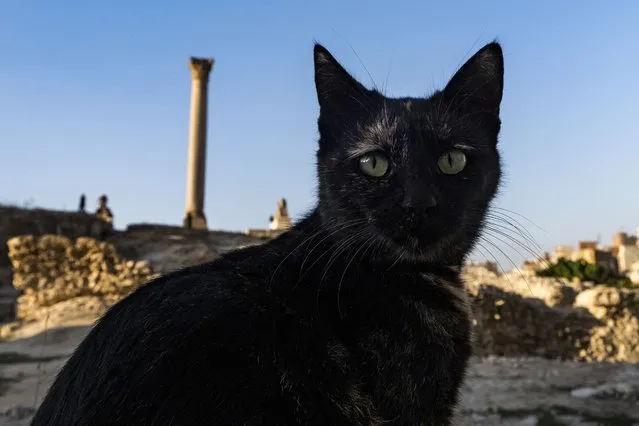
A cat looks on near the Victory Pillar at the ruins of the Serapeum of Alexandria, an ancient Greek temple dating to the Ptolemaic and Roman periods (246 BC – 391 AD) dedicated to the city's protector deity Serapis, in Egypt's northern coastal city of Alexandria on November 24, 2023. The giant Corinthian column, commonly misidentified as “Pompey's Pillar”, is a Roman triumphal column set up in honour of the Roman emperor Diocletian (298–302 AD), and originally supported a colossal porphyry statue of the emperor in armour. (Photo by Amir Makar/AFP Photo)

A cat looks on near the Victory Pillar at the ruins of the Serapeum of Alexandria, an ancient Greek temple dating to the Ptolemaic and Roman periods (246 BC – 391 AD) dedicated to the city's protector deity Serapis, in Egypt's northern coastal city of Alexandria on November 24, 2023. The giant Corinthian column, commonly misidentified as “Pompey's Pillar”, is a Roman triumphal column set up in honour of the Roman emperor Diocletian (298–302 AD), and originally supported a colossal porphyry statue of the emperor in armour. (Photo by Amir Makar/AFP Photo)
Details
13 Dec 2023 23:52:00
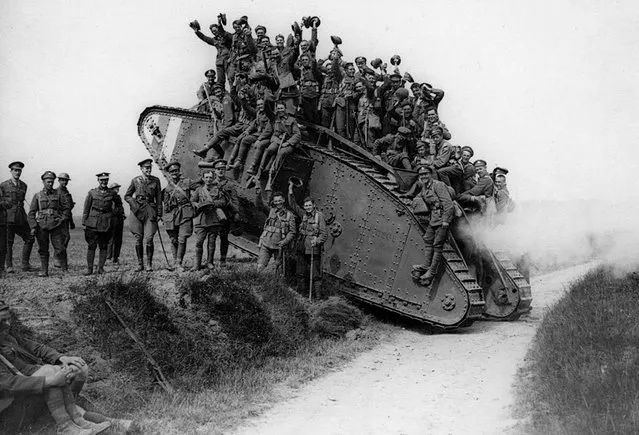
These black-and-white photos are taken from the new book “Armoured Warfare in the First World War 1916 – 1918” by Anthony Tucker-Jones and published by Pen & Sword Military. “Interestingly the British, French and Germans took completely different approaches with varying results”. The British military produced “Little Willie” in Autumn 1915 weighing 18 tonnes, which had a crew of two plus four gunners. “Inspired by a tracked artillery tractor “Little Willie” was referred to as a water tank – hence the name tank – to ensure secrecy”, said Anthony. “This led to the strange looking Mark I with its peculiar rhomboid shape, designed to cross trenches with guns in sponsons on either side. The Germans saw the tank as unchivalrous and were slow to grasp its utility. They favoured the Stormtrooper (specialist soldiers used to infiltrate enemy trenches) and artillery, not the tank”, said Anthony. “However, they didn’t hesitate to make use of captured British tanks. Although the tank helped secure victory and German soldiers dubbed it “Germany’s Downfall” the country was ultimately brought to its knees by the Allies blockade”. Here: British troops hitch a ride on a Mark IV after the massed tank fleet spearheading attack at Cambrai on November 20, 1917. (Photo by Anthony Tucker-Jones/Mediadrumworld.com)

These black-and-white photos are taken from the new book “Armoured Warfare in the First World War 1916 – 1918” by Anthony Tucker-Jones and published by Pen & Sword Military. Here: British troops hitch a ride on a Mark IV after the massed tank fleet spearheading attack at Cambrai on November 20, 1917. (Photo by Anthony Tucker-Jones/Mediadrumworld.com)
Details
23 Feb 2017 00:02:00