Loading...
Done
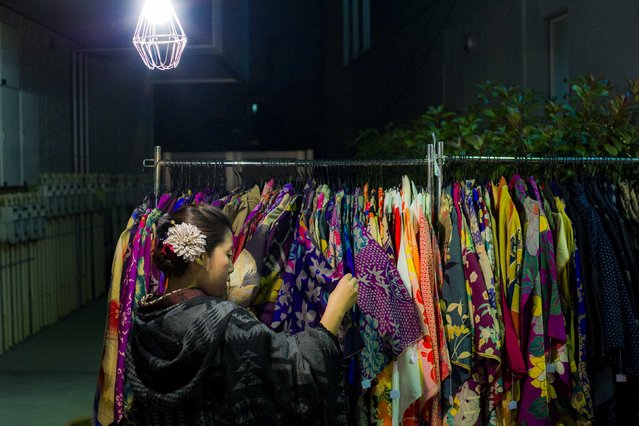
A woman browses through kimonos for sale at Boroichi flea market in Tokyo December 15, 2014. In the 16th century, Boroichi was a place for farmers to buy and sell rags, known as boro, for mending clothes and weaving sandals. Now in its 436th year, the original spirit lingers, with about 700 stands hawking fabric, used clothes and piles of rags. Others sell kitchen tools, pottery, seaweed and spices. (Photo by Thomas Peter/Reuters)

A woman browses through kimonos for sale at Boroichi flea market in Tokyo December 15, 2014. In the 16th century, Boroichi was a place for farmers to buy and sell rags, known as boro, for mending clothes and weaving sandals. Now in its 436th year, the original spirit lingers, with about 700 stands hawking fabric, used clothes and piles of rags. Others sell kitchen tools, pottery, seaweed and spices. About 200,000 people flock to the market, which is only open for four mid-winter days a year – two in December and two in January. (Photo by Thomas Peter/Reuters)
Details
19 Dec 2014 12:50:00
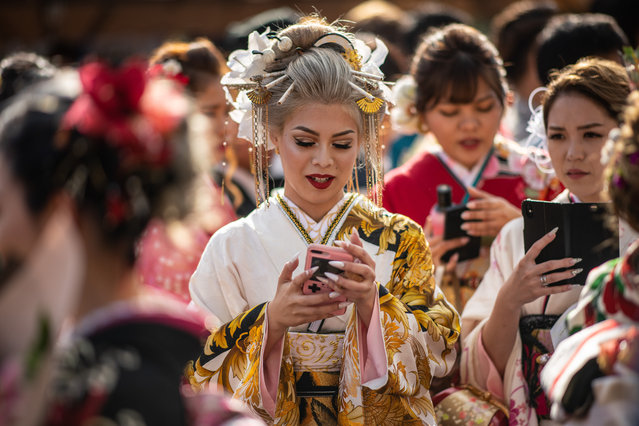
An Okinawan woman in a kimono checks her phone before attending a ceremony on Coming of Age Day on January 13, 2019 in Okinawa City, Japan. Coming of Age Day is a Japanese holiday held every January to celebrate people who have reached 20 – the official age of adulthood in Japan. Despite being a solemn affair in some parts of Japan, Okinawans have become known for their flamboyant and occasionally boisterous celebrations. (Photo by Carl Court/Getty Images)

An Okinawan woman in a kimono checks her phone before attending a ceremony on Coming of Age Day on January 13, 2019 in Okinawa City, Japan. Coming of Age Day is a Japanese holiday held every January to celebrate people who have reached 20 – the official age of adulthood in Japan. Despite being a solemn affair in some parts of Japan, Okinawans have become known for their flamboyant and occasionally boisterous celebrations. (Photo by Carl Court/Getty Images)
Details
15 Jan 2019 00:05:00
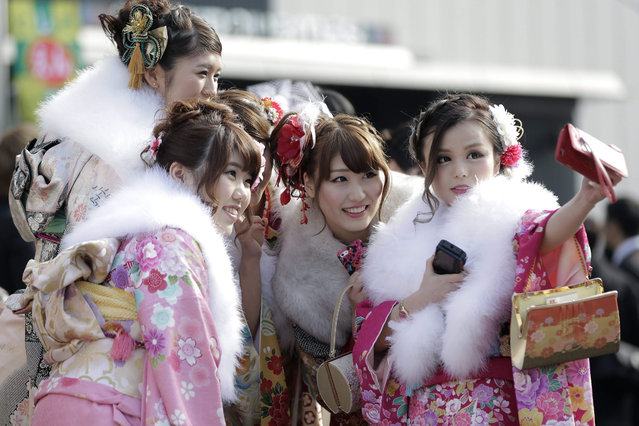
Young Japanese women dressed in colourful Kimonos take a photo of themselves as they gather for a ceremony marking the 'Coming of Age Day' at the Toshimaen Amusement Park in Tokyo, Japan, 11 January 2016. The Coming of Age Day is the day to celebrate young people who turn 20 years old while the age of 20 is considered the beginning of adulthood and is the minimum legal age for voting, drinking and smoking in Japan. (Photo by Kiyoshi Ota/EPA)

Young Japanese women dressed in colourful Kimonos take a photo of themselves as they gather for a ceremony marking the “Coming of Age Day” at the Toshimaen Amusement Park in Tokyo, Japan, 11 January 2016. The Coming of Age Day is the day to celebrate young people who turn 20 years old while the age of 20 is considered the beginning of adulthood and is the minimum legal age for voting, drinking and smoking in Japan. (Photo by Kiyoshi Ota/EPA)
Details
13 Jan 2016 08:02:00
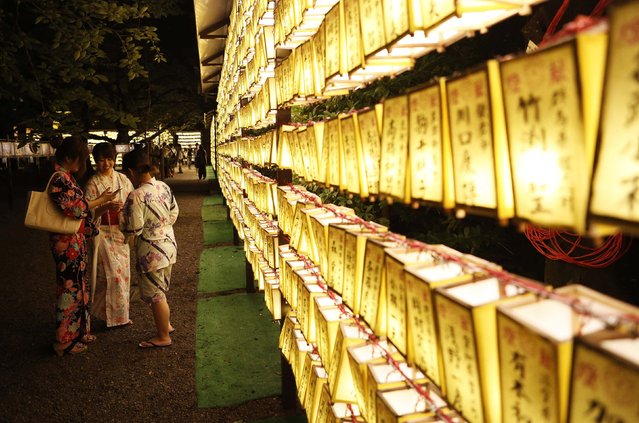
Women in kimonos look at pictures they took in front of paper lanterns during the annual Mitama Festival at the Yasukuni Shrine in Tokyo July 13, 2014. Over 30,000 lanterns light up the precincts of the shrine, where more than 2.4 million war dead are enshrined, during the four-day festival. The festival goes on till July 16. (Photo by Yuya Shino/Reuters)

Women in kimonos look at pictures they took in front of paper lanterns during the annual Mitama Festival at the Yasukuni Shrine in Tokyo July 13, 2014. Over 30,000 lanterns light up the precincts of the shrine, where more than 2.4 million war dead are enshrined, during the four-day festival. The festival goes on till July 16. (Photo by Yuya Shino/Reuters)
Details
15 Jul 2014 10:41:00
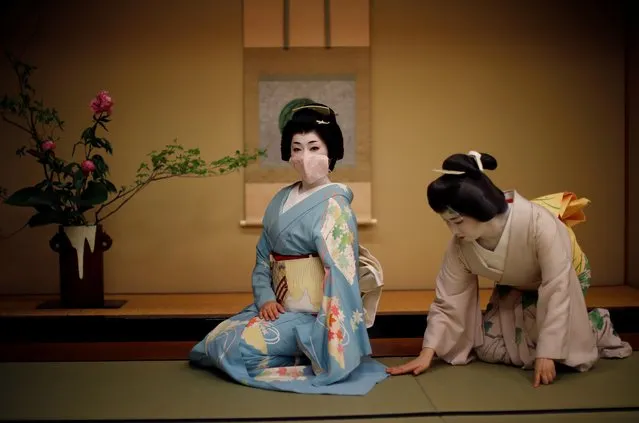
Mayu adjusts Koiku’s kimono, as Koiku wears a protective face mask while posing for a photograph, before they work at a party where they will entertain with other geisha at Japanese luxury restaurant Asada in Tokyo, Japan, June 23, 2020. The coronavirus pandemic has made Tokyo's geisha fear for their centuries-old profession as never before. Though the number of geisha - famed for their witty conversation, beauty and skill at traditional arts - has been falling for years, they were without work for months due to Japan's state of emergency and now operate under awkward social distancing rules. Engagements are down 95 percent, and come with new rules: no pouring drinks for customers or touching them even to shake hands, and sitting 2 meters apart. Masks are hard to wear with their elaborate wigs, so they mostly don't. “I was just full of anxiety”, said Mayu, 47. “I went through my photos, sorted my kimonos ... The thought of a second wave is terrifying”. (Photo by Kim Kyung-Hoon/Reuters)

Mayu adjusts Koiku’s kimono, as Koiku wears a protective face mask while posing for a photograph, before they work at a party where they will entertain with other geisha at Japanese luxury restaurant Asada in Tokyo, Japan, June 23, 2020. (Photo by Kim Kyung-Hoon/Reuters)
Details
23 Jul 2020 00:03:00
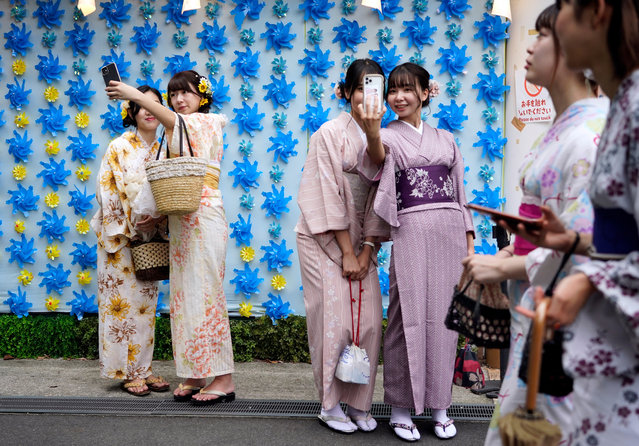
Japanese women wearing “yukata” casual summer kimono take selfies at Asakusa district in Tokyo, Japan, 13 September 2020. Asakusa is one of Tokyo's most-visited areas and is usually crowded with tourists. In Japan, the numbers of visitors from abroad fell by 99.9 percent from a year earlier in July due to the ban for entries of foreign visitors amid the coronavirus pandemic. (Photo by Franck Robichon/EPA/EFE)

Japanese women wearing “yukata” casual summer kimono take selfies at Asakusa district in Tokyo, Japan, 13 September 2020. Asakusa is one of Tokyo's most-visited areas and is usually crowded with tourists. In Japan, the numbers of visitors from abroad fell by 99.9 percent from a year earlier in July due to the ban for entries of foreign visitors amid the coronavirus pandemic. (Photo by Franck Robichon/EPA/EFE)
Details
24 Sep 2020 00:01:00
Maasai men of Matapato jostle to parade as they attend the Olng'esherr (meat-eating) passage ceremony to unite two age-sets; the older Ilpaamu and the younger Ilaitete into senior elderhood as the final rite of passage, in Maparasha hills of Kajiado, Kenya on September 23, 2020. Thousands of Maasai men clad in red and purple shawls and with their heads coated in red ochre gathered this week for a ceremony that transforms them from Moran (warriors) to Mzee (elders). (Photo by Thomas Mukoya/Reuters)

Maasai men of Matapato jostle to parade as they attend the Olng'esherr (meat-eating) passage ceremony to unite two age-sets; the older Ilpaamu and the younger Ilaitete into senior elderhood as the final rite of passage, in Maparasha hills of Kajiado, Kenya on September 23, 2020. Thousands of Maasai men clad in red and purple shawls and with their heads coated in red ochre gathered this week for a ceremony that transforms them from Moran (warriors) to Mzee (elders). (Photo by Thomas Mukoya/Reuters)
Details
29 Sep 2020 00:01:00
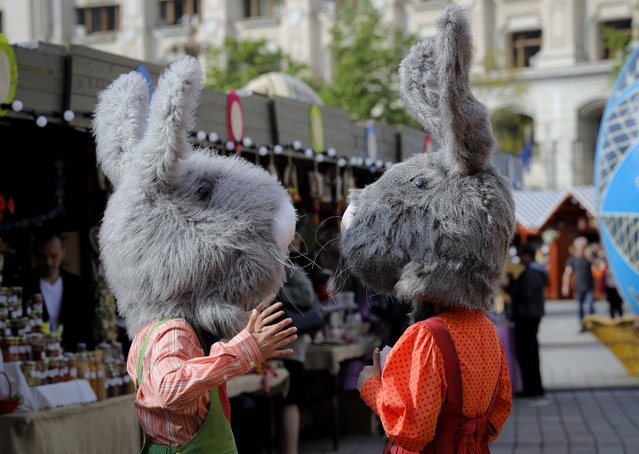
In this Thursday, April 13, 2017, picture entertainers wearing rabbit costumes speak at a fair in Bucharest, Romania. Ahead of Easter, celebrated by both Orthodox and Catholic believers on April 16 processions of priests clad in golden robes carrying foliage on Palm Sunday in a recreation of Jesus' ride into Jerusalem, mixed with more commercial flavored celebrations like an Easter fair outside the giant palace built by late Communist leader Nicolae Ceausescu where entertainers strutted around wearing giant rabbit heads. (Photo by Vadim Ghirda/AP Photo)

In this Thursday, April 13, 2017, picture entertainers wearing rabbit costumes speak at a fair in Bucharest, Romania. Ahead of Easter, celebrated by both Orthodox and Catholic believers on April 16 processions of priests clad in golden robes carrying foliage on Palm Sunday in a recreation of Jesus' ride into Jerusalem, mixed with more commercial flavored celebrations like an Easter fair outside the giant palace built by late Communist leader Nicolae Ceausescu where entertainers strutted around wearing giant rabbit heads. (Photo by Vadim Ghirda/AP Photo)
Details
17 Apr 2017 08:01:00