Loading...
Done
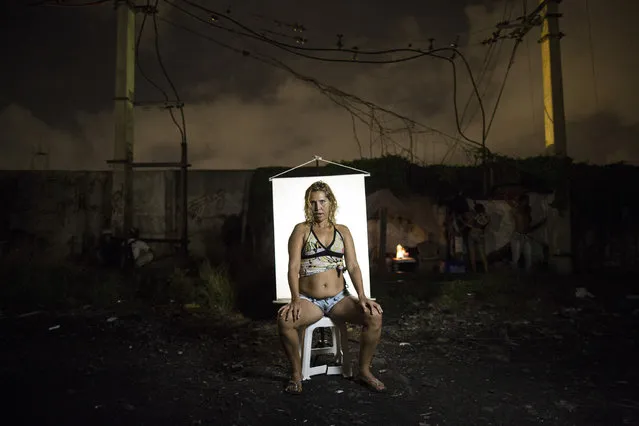
In this March 18, 2015 photo, Andrea, better known as Loira, which is the Portuguese word for 'blonde," poses for a portrait in an open-air crack cocaine market, known as a “cracolandia” or crackland where users can buy crack, and smoke it in plain sight, day or night, in Rio de Janeiro, Brazil. Andrea says she is married and has a home, but she keeps returning to crackland to feed her addiction. (Photo by Felipe Dana/AP Photo)

In this March 18, 2015 photo, Andrea, better known as Loira, which is the Portuguese word for “blonde”, poses for a portrait in an open-air crack cocaine market, known as a “cracolandia” or crackland where users can buy crack, and smoke it in plain sight, day or night, in Rio de Janeiro, Brazil. Andrea says she is married and has a home, but she keeps returning to crackland to feed her addiction. (Photo by Felipe Dana/AP Photo)
Details
09 Apr 2015 13:05:00
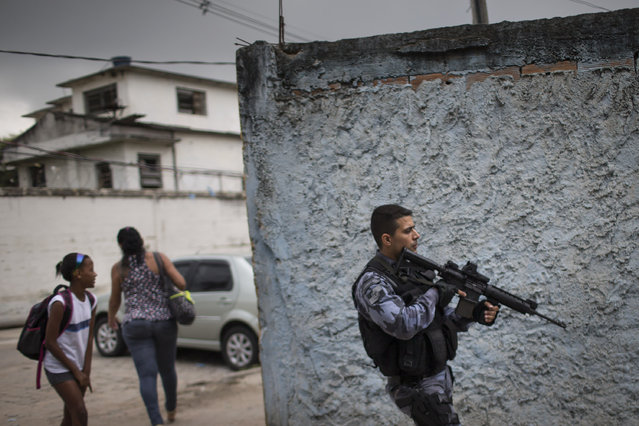
A military police officer patrols in the Roquette Pinto shantytown, part of the Mare slum complex in Rio de Janeiro, Brazil, Wednesday, April 1, 2015. The Brazilian army has begun to pull out of one of Rio de Janeiro's most violent slums, with police assuming responsibility for security in the area. (Photo by Felipe Dana/AP Photo)

A military police officer patrols in the Roquette Pinto shantytown, part of the Mare slum complex in Rio de Janeiro, Brazil, Wednesday, April 1, 2015. The Brazilian army has begun to pull out of one of Rio de Janeiro's most violent slums, with police assuming responsibility for security in the area. (Photo by Felipe Dana/AP Photo)
Details
02 Apr 2015 12:26:00
In this September 14, 2017 photo, young women pose for a photo inside their squatter building that used to house the Brazilian Institute of Geography and Statistics (IBGE) in the Mangueira slum of Rio de Janeiro, Brazil. Many lower-middle class Brazilians who gained ground during the boom years have since slid back closer to the poverty line. (Photo by Felipe Dana/AP Photo)

In this September 14, 2017 photo, young women pose for a photo inside their squatter building that used to house the Brazilian Institute of Geography and Statistics (IBGE) in the Mangueira slum of Rio de Janeiro, Brazil. Many lower-middle class Brazilians who gained ground during the boom years have since slid back closer to the poverty line. (Photo by Felipe Dana/AP Photo)
Details
14 Dec 2017 06:54:00
A man takes a photo of a radio antenna that's part of the Atacama Large Milimeter Array Observatory on March 12, 2013 at Llano de Chajnantor, about 43 miles (70 kilometers) from San Pedro de Atacama, Chile. The $1.5 billion ALMA facility, which had its official inauguration on March 13, is considered the world's most expensive ground-based observatory. (Photo by Felipe Trueba/EPA)

A man takes a photo of a radio antenna that's part of the Atacama Large Milimeter Array Observatory on March 12, 2013 at Llano de Chajnantor, about 43 miles (70 kilometers) from San Pedro de Atacama, Chile. The $1.5 billion ALMA facility, which had its official inauguration on March 13, is considered the world's most expensive ground-based observatory. (Photo by Felipe Trueba/EPA)
Details
03 Apr 2013 09:25:00
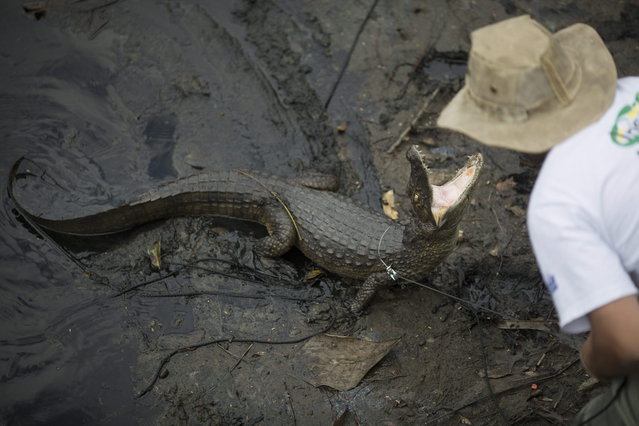
In this October 14, 2013 photo, ecology professor Ricardo Freitas catches a broad-snouted caiman to examine, then release back into the water channel in the affluent Recreio dos Bandeirantes suburb of Rio de Janeiro, Brazil. (Photo by Felipe Dana/AP Photo)

In this October 14, 2013 photo, ecology professor Ricardo Freitas catches a broad-snouted caiman to examine, then release back into the water channel in the affluent Recreio dos Bandeirantes suburb of Rio de Janeiro, Brazil. Caimans are like tanks, a very old species with a remarkable capacity for renovation that allows them to survive under extreme conditions where others couldn't, said Freitas, who runs the Instituto Jacare, or the Caiman Institute, which aims to protect the reptiles. (Photo by Felipe Dana/AP Photo)
Details
18 Oct 2013 09:05:00
Carolaine Reis and her son Miguel Alves, residents of the Aglomerado da Serra favela, wear a protective mask against the spread of the new Coronavirus (COVID-19) made by the seamstresses of the Remexe Favelinha studio, in the Aglomerado da Serra favela, on April 13, 2020 in Belo Horizonte, Brazil. Facial masks follow the protocol and guidelines defined by the Ministry of Health. Around 6,000 masks have already been produced. The masks are being distributed to a part of the population and sold throughout the country, in the amount of 5 reais per unit. (Photo by Pedro Vilela/Getty Images)

Carolaine Reis and her son Miguel Alves, residents of the Aglomerado da Serra favela, wear a protective mask against the spread of the new Coronavirus (COVID-19) made by the seamstresses of the Remexe Favelinha studio, in the Aglomerado da Serra favela, on April 13, 2020 in Belo Horizonte, Brazil. Facial masks follow the protocol and guidelines defined by the Ministry of Health. Around 6,000 masks have already been produced. The masks are being distributed to a part of the population and sold throughout the country, in the amount of 5 reais per unit. (Photo by Pedro Vilela/Getty Images)
Details
16 Apr 2020 00:03:00
Picture shows a mural painting in Ferrol, on September 2, 2018, during the annual street art festival “Meninas de Canido” set up in 2008 to breathe new life in a dying neighborhood. Angry at the announced death of his neighborhood, Canido, in Ferrol, Eduardo Hermida painted his version of Velazquez's “Meninas” on a wall. An act of protest that gave birth to a festival and gave new colors to this city of Galicia. (Photo by Miguel Riopa/AFP Photo)

Picture shows a mural painting in Ferrol, on September 2, 2018, during the annual street art festival “Meninas de Canido” set up in 2008 to breathe new life in a dying neighborhood. Angry at the announced death of his neighborhood, Canido, in Ferrol, Eduardo Hermida painted his version of Velazquez's “Meninas” on a wall. An act of protest that gave birth to a festival and gave new colors to this city of Galicia. (Photo by Miguel Riopa/AFP Photo)
Details
02 Nov 2018 00:01:00
A woman pushes a child aboard a plastic basin as they wade through floodwaters brought about by Super Typhoon Noru on September 26, 2022 in San Miguel, Bulacan province, Philippines. Super Typhoon Noru made landfall in the Philippines overnight, causing widespread flooding and leaving at least five dead. High winds and heavy rains have flattened villages and have increased the threat of landslides. (Photo by Ezra Acayan/Getty Images)

A woman pushes a child aboard a plastic basin as they wade through floodwaters brought about by Super Typhoon Noru on September 26, 2022 in San Miguel, Bulacan province, Philippines. Super Typhoon Noru made landfall in the Philippines overnight, causing widespread flooding and leaving at least five dead. High winds and heavy rains have flattened villages and have increased the threat of landslides. (Photo by Ezra Acayan/Getty Images)
Details
30 Sep 2022 04:43:00