Loading...
Done
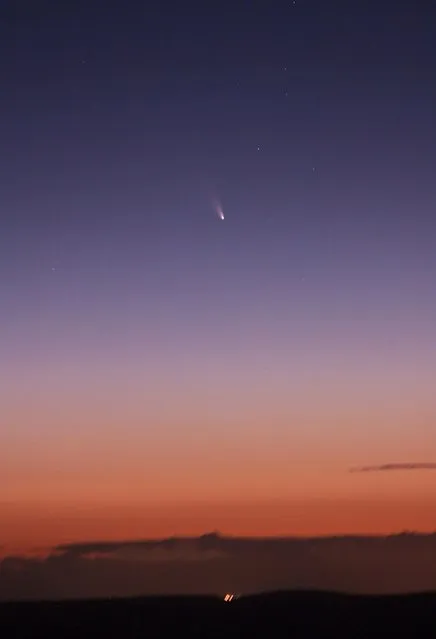
This image provided by NASA shoaws the comet PANSTARRS as seen from Mount Dale, Western Australia on March 5, 2013. According to NASA on March 10, it will make its closest approach to the sun about 28 million miles (45 million kilometers) away. As it continues its nightly trek across the sky, the comet may get lost in the sun's glare but should return and be visible to the naked eye by March 12. (Photo by AP Photo/NASA)

It’s time to start watching for Comet PANSTARRS, one of two comets to get excited about in 2013. Photo: This image provided by NASA shoaws the comet PANSTARRS as seen from Mount Dale, Western Australia on March 5, 2013. According to NASA on March 10, it will make its closest approach to the sun about 28 million miles (45 million kilometers) away. As it continues its nightly trek across the sky, the comet may get lost in the sun's glare but should return and be visible to the naked eye by March 12. (Photo by AP Photo/NASA)
Details
13 Mar 2013 08:03:00
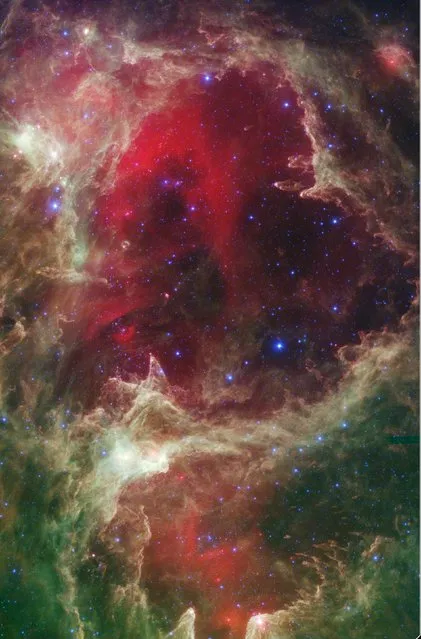
An infrared portrait from NASA's Spitzer Space Telescope which shows generations of stars is seen in this undated NASA handout image released February 14, 2013. In this wispy star-forming region, called W5, the oldest stars can be seen as blue dots in the centers of the two hollow cavities (other blue dots are background and foreground stars not associated with the region). Red shows heated dust that pervades the region's cavities, while green highlights dense clouds. (Photo by NASA/Reuters/JPL-Caltech/Harvard-Smithsonian/Handout)

An infrared portrait from NASA's Spitzer Space Telescope which shows generations of stars is seen in this undated NASA handout image released February 14, 2013. In this wispy star-forming region, called W5, the oldest stars can be seen as blue dots in the centers of the two hollow cavities (other blue dots are background and foreground stars not associated with the region). Red shows heated dust that pervades the region's cavities, while green highlights dense clouds. (Photo by NASA/Reuters/JPL-Caltech/Harvard-Smithsonian/Handout)
Details
03 Mar 2013 08:44:00
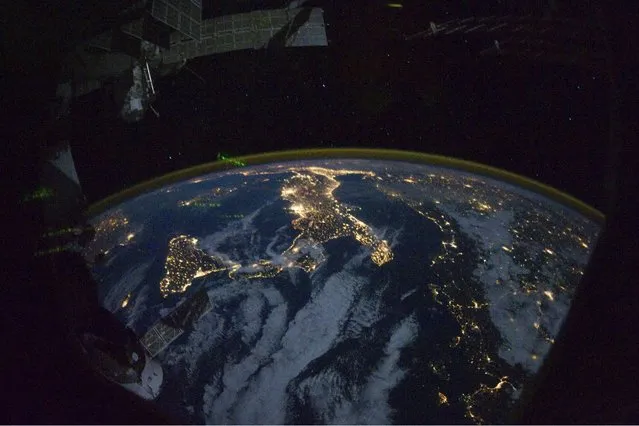
This image provided by NASA shows parts of Europe and Africa very easily recognizable in this night time image shot by one of the Expedition 25 crew members aboard the International Space Station flying 220 miles above Earth on Thursday Oct. 28, 2010. The view “looks” northward over Sicily and the “boot” of Italy, with the Mediterranean Sea representing most of the visible water in the view and the Adriatic Sea to the right of center. Tunisia is partially visible at left. Part of a docked Russian spacecraft and other components of the ISS are in the foreground. (Photo by AP photo/NASA)

This image provided by NASA shows parts of Europe and Africa very easily recognizable in this night time image shot by one of the Expedition 25 crew members aboard the International Space Station flying 220 miles above Earth on Thursday October 28, 2010. The view “looks” northward over Sicily and the “boot” of Italy, with the Mediterranean Sea representing most of the visible water in the view and the Adriatic Sea to the right of center. Tunisia is partially visible at left. Part of a docked Russian spacecraft and other components of the ISS are in the foreground. (Photo by AP Photo/NASA)
Details
11 May 2013 12:29:00
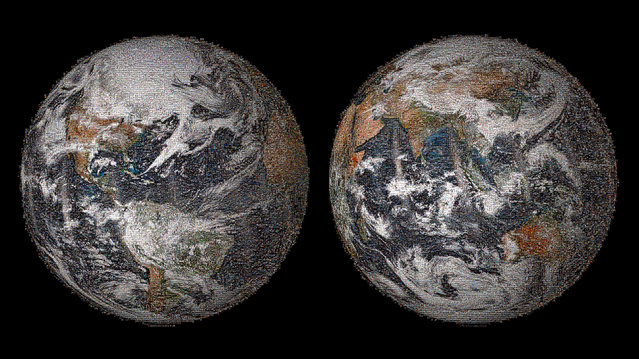
NASA’s “Global Selfie” Earth mosaic contains more than 36,000 individual photographs from the more than 50,000 images posted around the world. (Photo by NASA)

On Earth Day this year, NASA asked people all around the world a question: “Where are you on Earth Right Now?” To answer this question people were asked to post their selfie on social media. The goal was to use each picture as a pixel in the creation of a “Global Selfie” – a mosaic image that would look like Earth appeared from the space. The 3.2 gigapixel “Global Selfie”, was made the with 36,422 individual images.
Details
25 May 2014 08:37:00
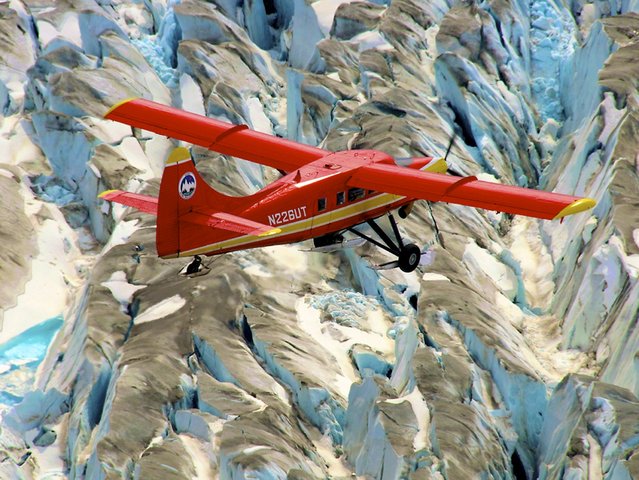
NASA's DHC-3 Otter plane flies in Operation IceBridge-Alaska surveys of mountain glaciers in Alaska in this image released on September 18, 2014. Over the past few decades, average global temperatures have been on the rise, and this warming is happening two to three times faster in the Arctic. (Photo by Chris Larsen/Reuters/NASA/University of Alaska-Fairbanks)

NASA's DHC-3 Otter plane flies in Operation IceBridge-Alaska surveys of mountain glaciers in Alaska in this image released on September 18, 2014. Over the past few decades, average global temperatures have been on the rise, and this warming is happening two to three times faster in the Arctic. (Photo by Chris Larsen/Reuters/NASA/University of Alaska-Fairbanks)
Details
20 Sep 2014 10:28:00
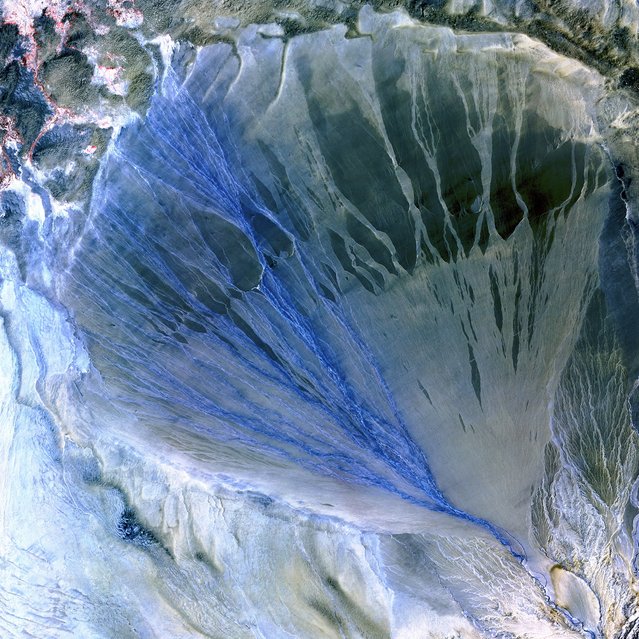
Alluvial Fan, China. A vast alluvial fan blossoms across the desolate landscape between the Kunlun and Altun mountain ranges that form the southern border of the Taklimakan Desert in China’s XinJiang Province. Image taken by the ASTER instrument on NASA’s Terra satellite on May 2nd, 2002. (Photo by NASA/GSFC/USGS EROS Data Center)

Alluvial Fan, China. A vast alluvial fan blossoms across the desolate landscape between the Kunlun and Altun mountain ranges that form the southern border of the Taklimakan Desert in China’s XinJiang Province. Image taken by the ASTER instrument on NASA’s Terra satellite on May 2nd, 2002. (Photo by NASA/GSFC/USGS EROS Data Center)
Details
07 Jan 2013 09:27:00
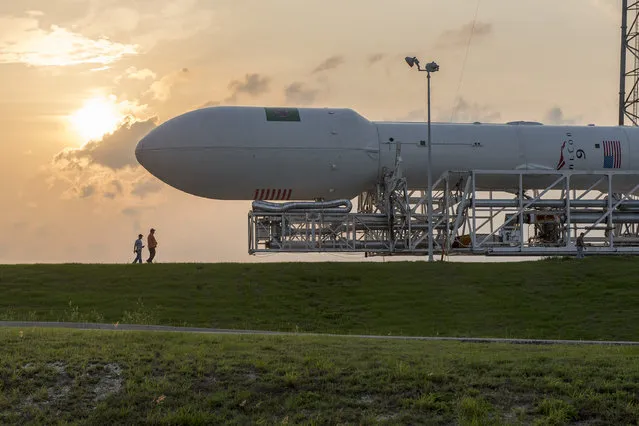
In this handout provided by the National Aeronautics and Space Administration (NASA), SpaceX's Falcon 9 is moved to the launch pad prior to the rocket's Thales Alenia Space launch attempt on April 26, 2015 in Cape Canaveral, Florida. (Photo by NASA via Getty Images)

In this handout provided by the National Aeronautics and Space Administration (NASA), SpaceX's Falcon 9 is moved to the launch pad prior to the rocket's Thales Alenia Space launch attempt on April 26, 2015 in Cape Canaveral, Florida. (Photo by NASA via Getty Images)
Details
05 Jun 2017 07:25:00


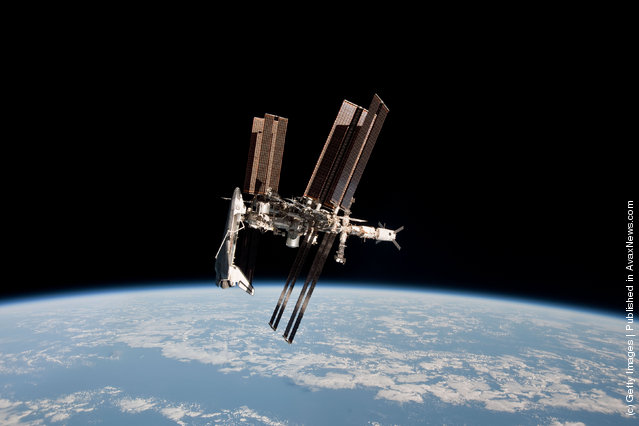
In this handout image provided by the European Space Agency (ESA) and NASA, the International Space Station and the docked space shuttle Endeavour orbit Earth during Endeavour's final sortie on May 23, 2011 in Space. Italian astronaut Paolo Nespoli captured the first-ever images of an orbiter docked to the International Space Station from the viewpoint of a departing vessel as he returned to Earth in a Soyuz capsule. (Photo by Paolo Nespoli - ESA/NASA via Getty Images)
Details
09 Jun 2011 11:28:00