Loading...
Done
The eruption of Cordon Caulle began on June 4, 2011, located in the Region of Los Rios in Chile. For about 12 months, people and animals became accustomed to living with the daily fall of ash, which also caused problems in the air traffic in South America. The explosions and lightning during first days of the eruption could be seen from hundreds of miles around. This photograph was taken on the second night of eruption from the town of Lago Ranco. (Photo and caption by Francisco Negroni/National Geographic Traveler Photo Contest)

The eruption of Cordon Caulle began on June 4, 2011, located in the Region of Los Rios in Chile. For about 12 months, people and animals became accustomed to living with the daily fall of ash, which also caused problems in the air traffic in South America. The explosions and lightning during first days of the eruption could be seen from hundreds of miles around. This photograph was taken on the second night of eruption from the town of Lago Ranco. (Photo and caption by Francisco Negroni/National Geographic Traveler Photo Contest)

ATTENTION! All pictures are presented in high resolution. To see Hi-Res images – just TWICE click on any picture. In other words, click small picture – opens the BIG picture. Click BIG picture – opens VERY BIG picture.
Details
23 Jun 2013 11:24:00
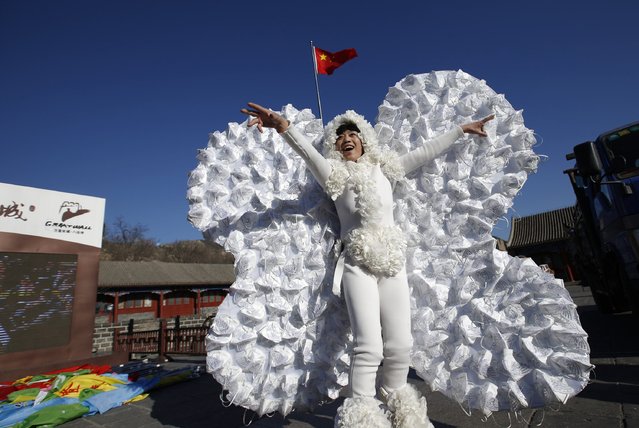
Chinese artist Kong Ning poses in a costume symbolizing a butterfly, which is decorated with 365 masks on its wings to represent the number of days in a year, during her performance art at the Badaling section of the Great Wall on the outskirts of Beijing January 1, 2015. (Photo by Kim Kyung-Hoon/Reuters)

Chinese artist Kong Ning poses in a costume symbolizing a butterfly, which is decorated with 365 masks on its wings to represent the number of days in a year, during her performance art at the Badaling section of the Great Wall on the outskirts of Beijing January 1, 2015. Kong, whose works include themes related to China's air pollution problem, named her new performance art “Hua Die” (transforming into a butterfly) and performed it on the first day of the new year as she hopes that China has clean air for this year. (Photo by Kim Kyung-Hoon/Reuters)
Details
02 Jan 2015 12:24:00
An ATF agent holds a generic unfinished receiver, back, and one that has been machined, front, at an ATF field office, on May, 06, 2014 in Washington, DC. Unfinished receivers can be turned into working automatic weapons that are untraceable. (Photo by Bill O'Leary/The Washington Post)

An unknown number of guns are being built with the mechanisms, causing problems for the police and ATF officials. Photo: An ATF agent holds a generic unfinished receiver, back, and one that has been manufactured, front, at an ATF field office in Washington, on May 06, 2014. The ATF is trying to crack down on the trade in the makeshift guns by targeting shops and individuals who offer to turn the unfinished receivers into functional pieces for firearms. (Photo by Bill O'Leary/The Washington Post)
Details
19 May 2014 09:22:00
A girl paddles on her stand-up board on the waters of Guanabara bay at Bica beach in Rio de Janeiro Brazil, January 10, 2016. (Photo by Ricardo Moraes/Reuters)

A girl paddles on her stand-up board on the waters of Guanabara bay at Bica beach in Rio de Janeiro Brazil, January 10, 2016. Few features capture the beauty, or the problems, of one of the world's most dramatic urban landscapes like Guanabara Bay - the finger-like inlet that forms the shoreline and harbor for Rio de Janeiro. The bay, which carves into southeast Brazil from the Atlantic Ocean, literally gave Rio its name when Portuguese mariners mistook it for a “rio”, or “river”. Four centuries later, the bay is preparing to welcome another sort of seafarer – Olympic sailors, who will navigate the bay when the 2016 Rio Olympics kick off in August. (Photo by Ricardo Moraes/Reuters)
Details
28 Apr 2016 12:13:00
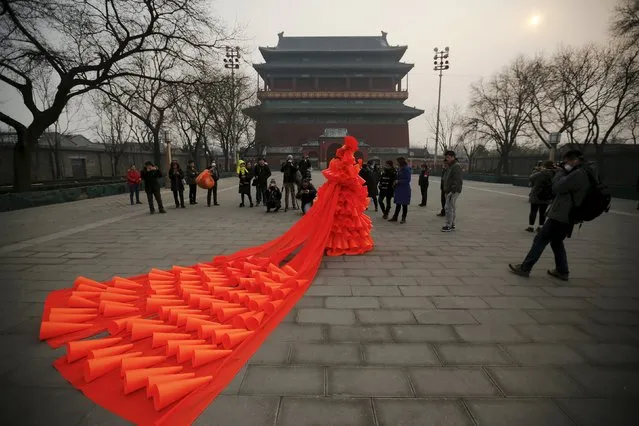
Chinese artist Kong Ning walks in her costume made of hundreds of orange plastic blowing horns during her art performance raising awareness of the hazardous smog in front of the Drum tower in a historical part of Beijing on a very polluted day December 7, 2015. (Photo by Damir Sagolj/Reuters)

Chinese artist Kong Ning walks in her costume made of hundreds of orange plastic blowing horns during her art performance raising awareness of the hazardous smog in front of the Drum tower in a historical part of Beijing on a very polluted day December 7, 2015. Kong, whose works include themes related to China's air pollution problem, named her new performance “The Orange Horns Bride Marries the Blue Sky” and presented it dressed in orange, the colour of the second highest pollution alert level issued again in Beijing as hazardous smog blankets the capital. (Photo by Damir Sagolj/Reuters)
Details
09 Dec 2015 08:05:00
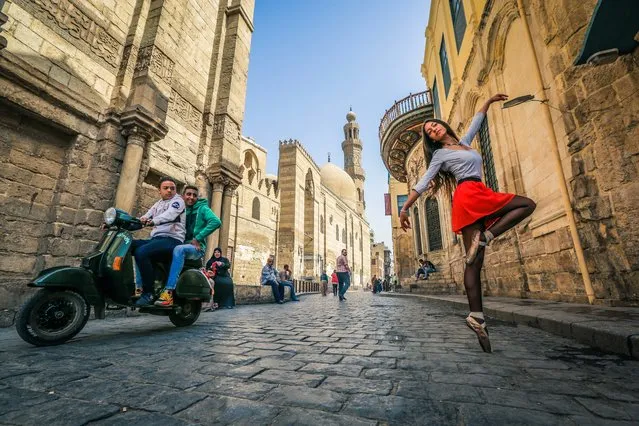
In his series “Ballerinas of Cairo”, photographer Mohamed Taher documents Egyptian dancers making the city streets their stage – pirouetting, leaping and posing their way through their country’s sprawling capital. The photos are, at first glance, stunning snapshots of a city’s vibrant culture in motion. But considering the dangers Egyptian women face for roaming these same streets on a daily basis, their impact is far deeper. Sexual harassment continues to present not just a possibility but a terrifying reality in present-day Egypt. A 2013 United Nations report calculated that 99.3 percent of women in the country have experienced sexual harassment on the streets, a problem that’s sparked initiatives giving women a way to fight back. The violence is rooted in an extreme conservative perspective encouraging women to stay in the home. (Photo by Mohamed Taher/Ballerinas of Cairo)

In his series “Ballerinas of Cairo”, photographer Mohamed Taher documents Egyptian dancers making the city streets their stage – pirouetting, leaping and posing their way through their country’s sprawling capital. The photos are, at first glance, stunning snapshots of a city’s vibrant culture in motion. (Photo by Mohamed Taher/Ballerinas of Cairo)
Details
17 Jan 2017 12:30:00
Black women in Brazil sit at the intersection of racism and misogyny, and have in recent years been at the forefront of a movement that challenges issues ranging from sexual and domestic violence to police brutality and stereotyping. Kolor Collective considers itself to be a part of this movement and questions expectations imposed on black women with satirical and subversive images, as seen here. (Photo by Kolor Art Collective/The Guardian)

Photographer Pol Kurucz’s vivid collection of photos explores issues faced by black Brazilian women, from political misrepresentation to unrealistic beauty standards. Kolor Collective is a Rio de Janeiro-based creative group that challenges the struggle faced by black women in Brazil through theatrical and provocative art. It was founded in 2015 by Franco-Hungarian photographer Pol Kurucz, who often touches on his own experiences of discrimination to call out sensitive social problems. (Photo by Kolor Art Collective/The Guardian)
Details
28 Dec 2016 07:24:00
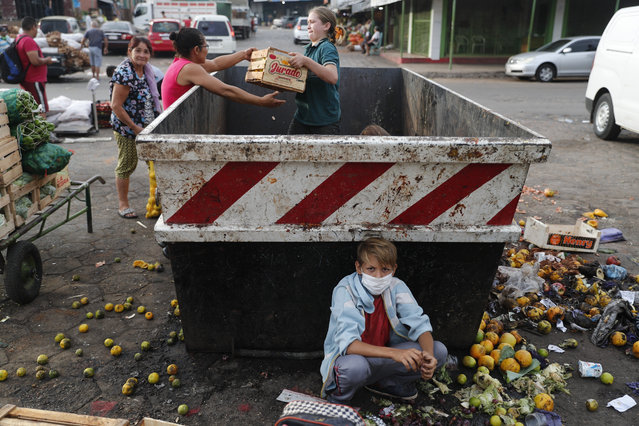
Fabian Ramirez, 11, scavenges a trash container for vegetables with his family that were discarded at the “Mercado de Abasto”, a market for vendors, during the fourth week of a quarantine to help contain the spread of the new coronavirus in Asuncion, Paraguay, Thursday, April 2, 2020. COVID-19 causes mild or moderate symptoms for most people, but for some, especially older adults and people with existing health problems, it can cause more severe illness or death. (Photo by Jorge Saenz/AP Photo)

Fabian Ramirez, 11, scavenges a trash container for vegetables with his family that were discarded at the “Mercado de Abasto”, a market for vendors, during the fourth week of a quarantine to help contain the spread of the new coronavirus in Asuncion, Paraguay, Thursday, April 2, 2020. (Photo by Jorge Saenz/AP Photo)
Details
05 Apr 2020 00:07:00