A ballerina from Kyiv City ballet prepares in the wings on stage during the opening night gala performance at The Theatre Royal in Bath, Britain on April 16, 2023. (Photo by Lee Smith/Reuters)
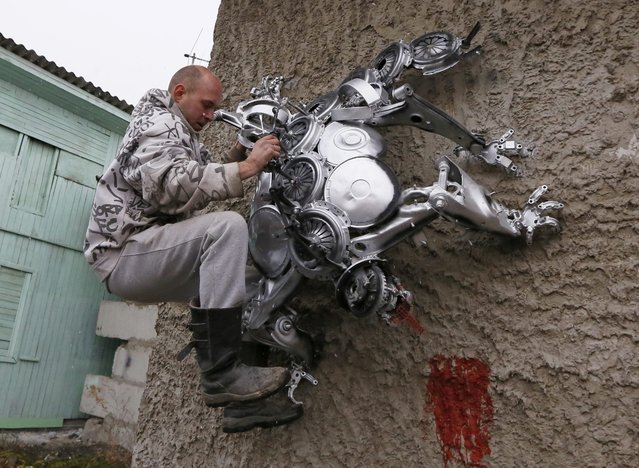
Mechanic and welder Sergei Kulagin, 32, strengthens the bracing of a spider sculpture, made by Kulagin, during a demonstration on the wall of an automobile repair workshop in the town of Divnogorsk outside Krasnoyarsk, Siberia, October 15, 2014. Enthusiast Kulagin, who works as a mechanic of an automobile service station, created about 20 sculptures made of used car parts and components during his non-working hours. (Photo by Ilya Naymushin/Reuters)
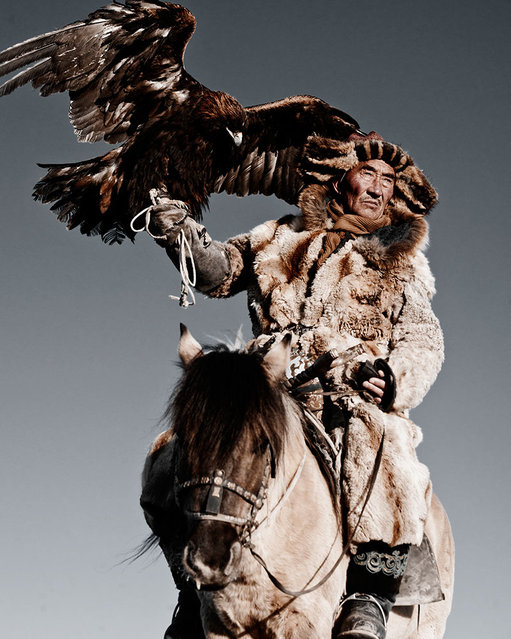
In one of the planet’s most desolate and harsh terrains, the Altai Mountains which run from Siberia in Russia down to Mongolia’s Gobi Desert, hunting with eagles is currently only practiced by a handful of Kyrgyz and Kazakhs. This form of falconry, the practice of hunting with the aid of birds of prey, can be traced back as far as 4,000 years in Central Asia. Here: after a successful hunt, a proud hunter rewards his eagle by feeding it the lungs of the prey, which is considered the most highly prized part of the animal. (Photo by Tariq Zaidi/The Washington Post)
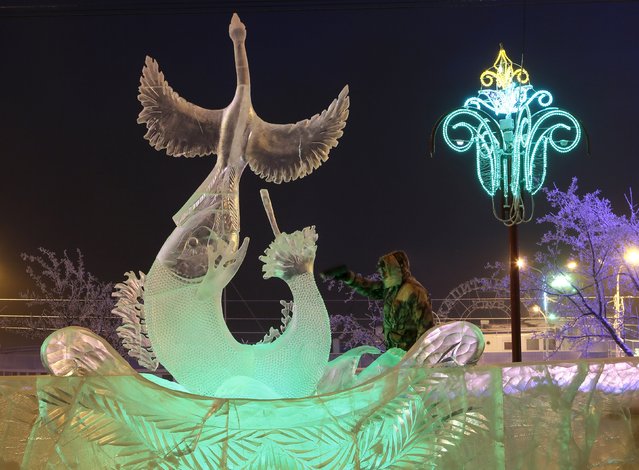
Mikhail Vasilenko, a participant from the Siberian town of Nizhny Tagil, works on an ice sculpture called “The Predator”, on the last day of the annual international festival of snow and ice sculptures “The Magical Ice of Siberia”, with the air temperature at about minus 28 degrees Celsius (minus 18.4 degrees Fahrenheit), in Krasnoyarsk, Russia, January 17, 2016. (Photo by Ilya Naymushin/Reuters)
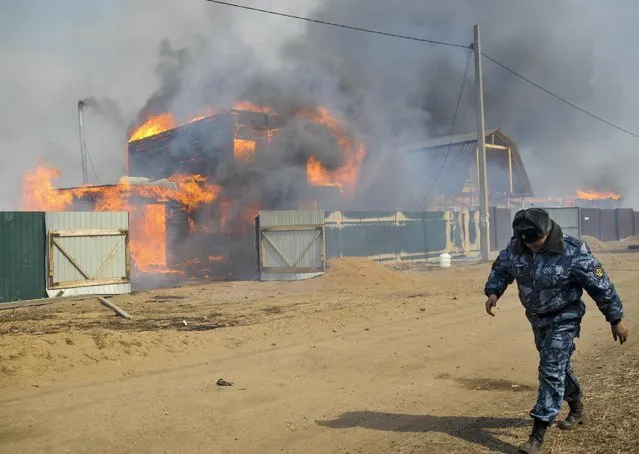
A police officer walks along a street of the burning village of Smolenka near Chita on Monday, April 13, 2015. Russian authorities say out-of-control agricultural fires have killed at least 15 people, injured hundreds more and destroyed or damaged more than 1,000 homes in Siberia. The fires were started by farmers burning the grass in their fields, but spread quickly because of strong winds. (Photo by Evgeny Yepanchintsev/AP Photo)
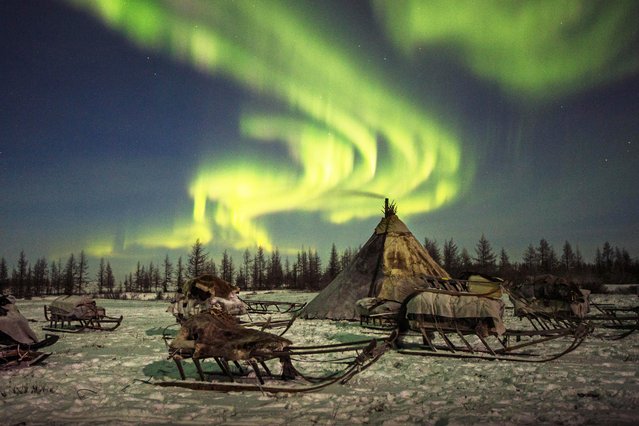
A British photographer has captured life at the “edge of the world”. Timothy Allen, best known for his work on BBC's Human Planet, trekked through the freezing Siberian wilderness for 16 days as he joined part of an 800km migration of reindeer in the Yamal-Nenets region – a name that roughly translates to “edge of the world”. The stunning pictures feature the nomadic Nenets tribe, who drink blood to survive in -45°C temperatures. Timothy's epic journey, which will be revealed in an eight-minute documentary on Animal Planet USA, saw him travel across the bleak terrain of the frozen Ob River with the Nenets people in December last year. Here: An empty camp is shown beneath a colourful sky in Siberia, December 2016. (Photo by Timothy Allen/Barcroft Productions)
A printed photograph taken on September 28, 2017 shows people bathing on the highway after Hurricane Maria destroyed people's homes, held up at the same spot of the highway where motorcyclists ride past in Naranjito, Puerto Rico, May 27, 2018. Thanks to the owners of the land alongside the highway, creek water was piped to the side of the road for people without water to use for bathing, washing clothes and dishes. (Photo by Ramon Espinosa/AP Photo)
An Indian sadhu (Hindu holy man) sits on the banks of Sangam – the confluence of the Ganges, Yamuna and mythical Saraswati rivers – on the auspicious bathing day of 'Maghi Purnima' during the Kumbh Mela festival in Allahabad on February 19, 2019. Millions of Hindu pilgrims took the plunge in holy rivers on the most auspicious bathing days of the Kumbh Mela festival, led by naked, ash-smeared holy men and accompanied by chants from Hindu holy texts. (Photo by Sanjay Kanojia/AFP Photo)