Loading...
Done
A person gestures during the “NYC Dyke March” have a moment of silence for the LGBT community in Manhattan in New York City, New York, U.S., June 26, 2021. (Photo by David Dee Delgado/Reuters)

A person gestures during the “NYC Dyke March” have a moment of silence for the LGBT community in Manhattan in New York City, New York, U.S., June 26, 2021. (Photo by David Dee Delgado/Reuters)
Details
05 Jul 2021 04:33:00
Zeebra  Lisa Thrower, New Zealand is modelled in the Bizarre Bra Section during the 2023 World of WearableArt Awards Night at TSB Bank Arena on September 22, 2023 in Wellington, New Zealand. (Photo by Hagen Hopkins/Getty Images for World of WearableArt)

Zeebra Lisa Thrower, New Zealand is modelled in the Bizarre Bra Section during the 2023 World of WearableArt Awards Night at TSB Bank Arena on September 22, 2023 in Wellington, New Zealand. (Photo by Hagen Hopkins/Getty Images for World of WearableArt)
Details
11 Dec 2024 04:09:00
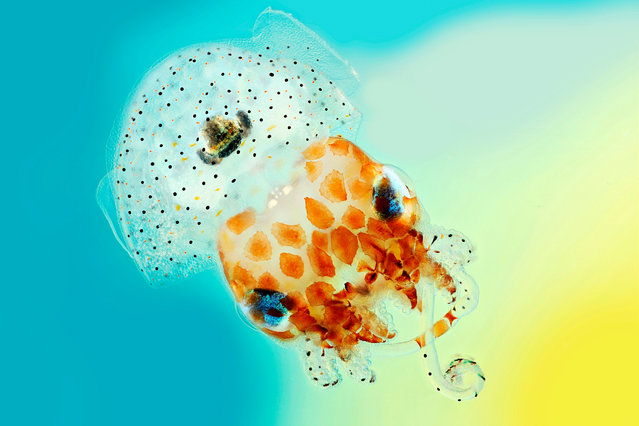
With its huge eyes, comical name and diminutive size, Mark R. Smith’s image of a baby Hawaiian bobtail squid can’t help but raise a smile. A curiously endearing creature, the cephalopod is just 1.5cm across, its mantle cavity bearing more than a passing resemblance to a rather natty shower cap. But it is also a beautiful example of symbiosis – nature’s version of “I’ll scratch your back if you scratch mine” – for on the underside of the squid is a light organ which houses bioluminescent bacteria. The squid offers the bacteria protection and food, while the bacteria emit a glow – a handy trait that the squid uses to offset its silhouette, helping it to evade predators in the depths below. Mark R. Smith’s entry combines several images of a Hawaiian bobtail squid with different focus lengths to create a final picture with greater depth of field than normal. (Photo by Mark R. Smith/Wellcome Images/Macroscopic Solutions)


With its huge eyes, comical name and diminutive size, Mark R. Smith’s image of a baby Hawaiian bobtail squid can’t help but raise a smile. A curiously endearing creature, the cephalopod is just 1.5cm across, its mantle cavity bearing more than a passing resemblance to a rather natty shower cap. But it is also a beautiful example of symbiosis – nature’s version of “I’ll scratch your back if you scratch mine” – for on the underside of the squid is a light organ which houses bioluminescent bacteria. The squid offers the bacteria protection and food, while the bacteria emit a glow – a handy trait that the squid uses to offset its silhouette, helping it to evade predators in the depths below. Mark R. Smith’s entry combines several images of a Hawaiian bobtail squid with different focus lengths to create a final picture with greater depth of field than normal. (Photo by Mark R. Smith/Wellcome Images/Macroscopic Solutions)

Details
08 Mar 2017 00:05:00
Turks stand in a silent protest in Kugulu Park in Ankara, Turkey, Wednesday, June 19, 2013. After weeks of sometimes-violent confrontation with police, Turkish protesters have found a new form of resistance: standing still and silent. The banner with an image of Turkey's founder Kemal Ataturk reads: “Which crazy person thinks they can put me in chains”. (Photo by Burhan Ozbilic/AP Photoi)

Turks stand in a silent protest in Kugulu Park in Ankara, Turkey, Wednesday, June 19, 2013. After weeks of sometimes-violent confrontation with police, Turkish protesters have found a new form of resistance: standing still and silent. The banner with an image of Turkey's founder Kemal Ataturk reads: “Which crazy person thinks they can put me in chains”. (Photo by Burhan Ozbilic/AP Photoi)
Details
20 Jun 2013 09:37:00


Paint splattered police officers look on during clashes outside Top Shop on Oxford Street, during marches in protest at government cuts on March 26, 2011 in London, England. Thousands are taking part in the Trades Union Congress (TUC) organised march to Hyde Park where a rally will take place. Police say they are deploying 4500 officers. (Photo by Dan Kitwood/Getty Images)
Details
28 Mar 2011 08:52:00
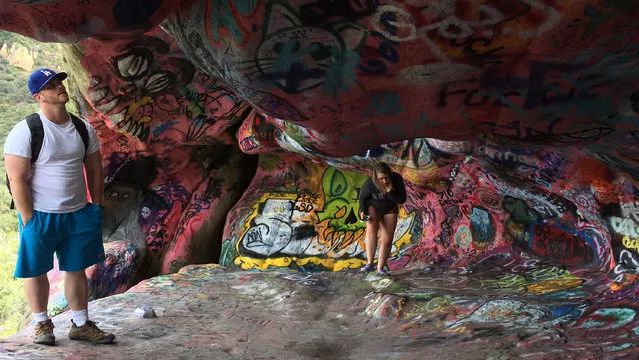
Tourists visit the Corral Canyon Cave in Malibu, Calif., Friday, May, 6, 2016. The cave, better known by the misleading moniker “Jim Morrison Cave” is now closed to the public until further notice. Large crowds have shown up on a daily basis to see the often vandalized cave and in some cases add to the vandalism with graffiti of their own. (Photo by Damian Dovarganes/AP Photo)

Tourists visit the Corral Canyon Cave in Malibu, Calif., Friday, May, 6, 2016. The cave, better known by the misleading moniker “Jim Morrison Cave” is now closed to the public until further notice. Large crowds have shown up on a daily basis to see the often vandalized cave and in some cases add to the vandalism with graffiti of their own. (Photo by Damian Dovarganes/AP Photo)
Details
07 May 2016 12:43:00
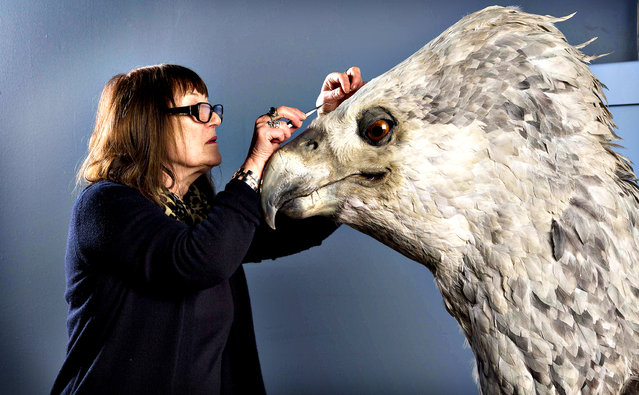
Undated handout photo of Buckbeak, a Hippogriff that lived with Rubeus Hagrid in the Harry Potter series, has his feathers preened and replenished by featherologist Val Jones, as he will feature in the the Feathers and Flight event at Warner Bros. Studio Tour London. (Photo credit should read: Tim Anderson/PA Wire)

Undated handout photo of Buckbeak, a Hippogriff that lived with Rubeus Hagrid in the Harry Potter series, has his feathers preened and replenished by featherologist Val Jones, as he will feature in the the Feathers and Flight event at Warner Bros. Studio Tour London. This is the first make-over Buckbeak has received since the hugely popular Harry Potter film series was made. His intricate coat is created from thousands of individually airbrushed chicken and goose feathers that Val will carefully clean and replenish in time for the start of Feathers and Flight. Val will lead an expert team to demonstrate the techniques that made winged wonders such as Buckbeak and Fawkes the Phoenix a reality on screen. (Photo by Tim Anderson/PA Wire)
Details
22 Mar 2014 13:56:00
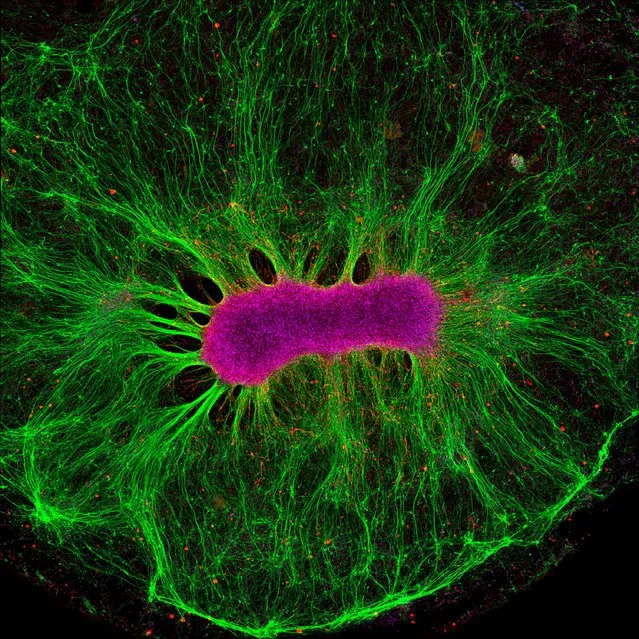
Brain-on-a-chip. Dazzling in green and magenta this image shows the nerve fibres (in green) produced by neural stem cells (in magenta) as they grow on a synthetic gel. Captured by a technique known as confocal microscopy, the image is part of research shedding light on how tinkering with the environment can affect the way in which nerve fibres grow. (Photo by Collin Edington and Iris Lee/Massachusetts Institute of Technology/Wellcome Images)

Brain-on-a-chip. Dazzling in green and magenta this image shows the nerve fibres (in green) produced by neural stem cells (in magenta) as they grow on a synthetic gel. Captured by a technique known as confocal microscopy, the image is part of research shedding light on how tinkering with the environment can affect the way in which nerve fibres grow. (Photo by Collin Edington and Iris Lee/Massachusetts Institute of Technology/Wellcome Images)
Details
17 Mar 2017 00:01:00