Loading...
Done
Drawings By Jennifer Healy

“I was born in the United States in 1985. As early as I can remember I’ve been a “doodler”. From even the early days I’ve always loved strange, offbeat, beautiful, and slightly melancholy things. Something about the mixed grabbed me. My love for sketching carried on throughout my high school days. Which is when I took a small class on watercolor. Watercolor is what birthed my passion for mixing colors and how a color can tell a story. In year 2009 I discovered digital painting and my new found passion for the medium. It’s been the favored medium for the past years since. I’ve used online tutorials and videos to help me learn along the way and then in late 2011 I took a workshop called Becoming a Better Artist. The beginning of 2013 I won a class from The Art Department which will start this spring.”
Jennifer Healy
Details
05 Dec 2013 12:04:00
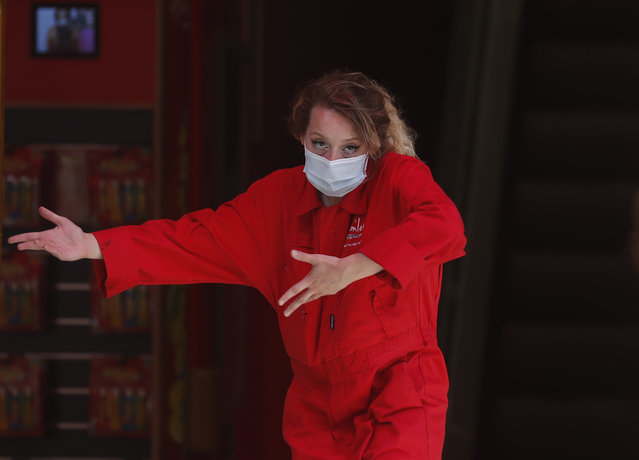
A staff member of a toy store wears a face mask as she invites customers to enter the store, in London, Tuesday, September 22, 2020. British Prime Minister Boris Johnson has slammed the brakes on the country's return to offices, saying people should work from home if possible to help slow the spread of the coronavirus. Johnson on Tuesday announced a package of new restrictions, including a requirement for pubs, restaurants and other hospitality venues in England to close between 10 p.m. and 5 a.m. (Photo by Frank Augstein/AP Photo)

A staff member of a toy store wears a face mask as she invites customers to enter the store, in London, Tuesday, September 22, 2020. British Prime Minister Boris Johnson has slammed the brakes on the country's return to offices, saying people should work from home if possible to help slow the spread of the coronavirus. Johnson on Tuesday announced a package of new restrictions, including a requirement for pubs, restaurants and other hospitality venues in England to close between 10 p.m. and 5 a.m. (Photo by Frank Augstein/AP Photo)
Details
24 Sep 2020 00:07:00
A destroyed T-72 tank, which presumably came from Russia, is seen on a battlefield near separatist-controlled Starobesheve, eastern Ukraine, October 2, 2014.(Photo by Maria Tsvetkova/Reuters)

A destroyed T-72 tank, which presumably came from Russia, is seen on a battlefield near separatist-controlled Starobesheve, eastern Ukraine, October 2, 2014. The burnt-out remains of dozens of tanks and armoured vehicles in fields near the small village of Horbatenko bear witness to the ferocity of a battle that turned the tide of the conflict in eastern Ukraine. Among the debris, Reuters found the blackened carcasses of what military experts have since identified as two Russian army tanks, supporting statements by Kiev and the West that the rebels were backed by troops and equipment sent by Moscow. (Photo by Maria Tsvetkova/Reuters)
Details
24 Oct 2014 12:14:00
An animal advocate lays in fake blood in a replica of a meat package with a label that reads “meat” during a protest “The meat is murder” in the Bulgarian capital Sofia on May 8, 2016. (Photo by Nikolay Doychinov/AFP Photo)

An animal advocate lays in fake blood in a replica of a meat package with a label that reads “meat” during a protest “The meat is murder” in the Bulgarian capital Sofia on May 8, 2016. (Photo by Nikolay Doychinov/AFP Photo)
Details
10 May 2016 13:32:00
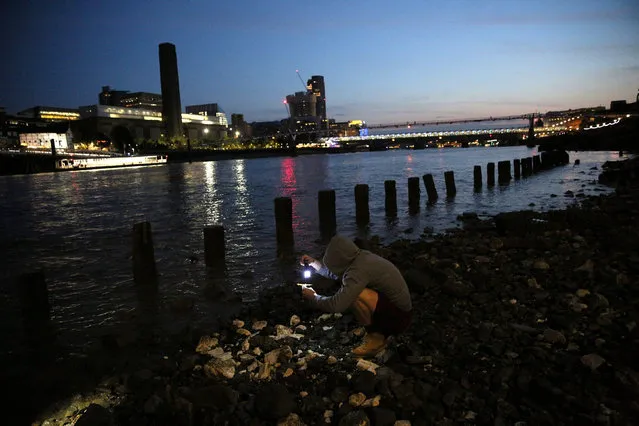
A mudlark uses a torch to look for items on the bank of the River Thames in London, Britain June 06, 2016. Mudlarking is believed to trace its origins to the 18th and 19th century, when scavengers searched the Thames' shores for items to sell. These days, history and archaeology fans are the ones hoping to find old relics such as coins, ceramics, artifacts or everyday items from across centuries. They wait for the low tide and then scour specific areas of exposed shores. "If you're in a field you could be out all day long, with the river you're restricted to about two or three hours," mudlark Nick Stevens said. While many just use the naked eye for their searches, others rely on metal detectors for which a permit from the Port of London Authority is needed. Digging also requires consent. (Photo by Neil Hall/Reuters)

A mudlark uses a torch to look for items on the bank of the River Thames in London, Britain June 06, 2016. Mudlarking is believed to trace its origins to the 18th and 19th century, when scavengers searched the Thames' shores for items to sell. These days, history and archaeology fans are the ones hoping to find old relics such as coins, ceramics, artifacts or everyday items from across centuries. their finds with the Portable Antiquities Scheme. Any item over 300 years old must be recorded. (Photo by Neil Hall/Reuters)
Details
27 Aug 2016 10:43:00
A Somali woman shows traditional items and food during an event to showcase traditional Somali culture in Hamarweyne district in the capital Mogadishu, December 3, 2015. (Photo by Feisal Omar/Reuters)

A Somali woman shows traditional items and food during an event to showcase traditional Somali culture in Hamarweyne district in the capital Mogadishu, December 3, 2015. (Photo by Feisal Omar/Reuters)
Details
05 Dec 2015 08:05:00
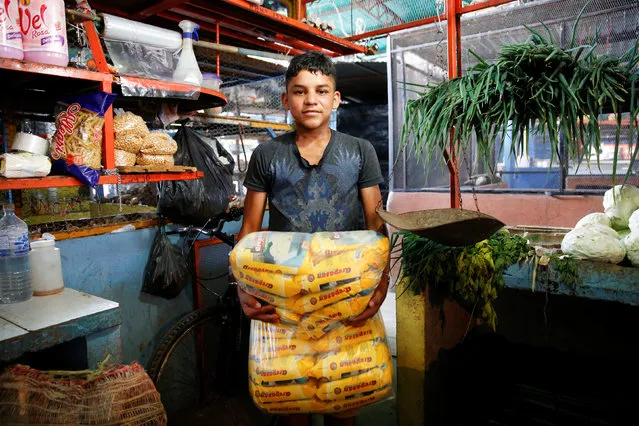
Carlos Cure holds packets of corn flour made in Colombia as he poses for a picture at a stall that sells food and staple items at a market in La Fria, Venezuela, June 2, 2016. (Photo by Carlos Garcia Rawlins/Reuters)

Carlos Cure holds packets of corn flour made in Colombia as he poses for a picture at a stall that sells food and staple items at a market in La Fria, Venezuela, June 2, 2016. (Photo by Carlos Garcia Rawlins/Reuters)
Details
09 Jun 2016 09:09:00
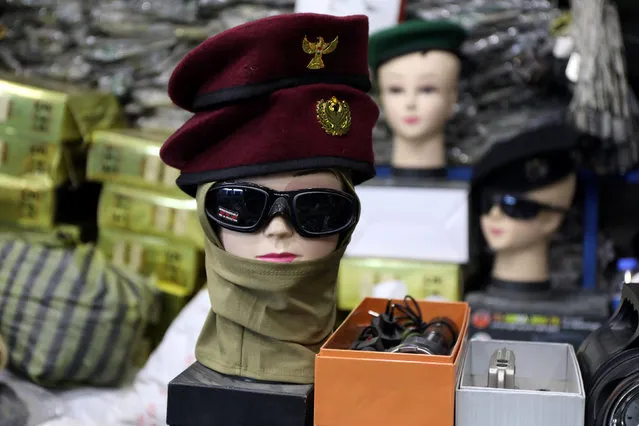
Military items for women are seen in a store in Erbil, Iraq January 24, 2017. (Photo by Marius Bosch/Reuters)

Military items for women are seen in a store in Erbil, Iraq January 24, 2017. (Photo by Marius Bosch/Reuters)
Details
28 Jan 2017 07:06:00