American actress Logan Browning attends Cocktails with the SAG Awards at The Shrine Auditorium on January 16, 2020 in Los Angeles, California. (Photo by Rich Fury/Getty Images)
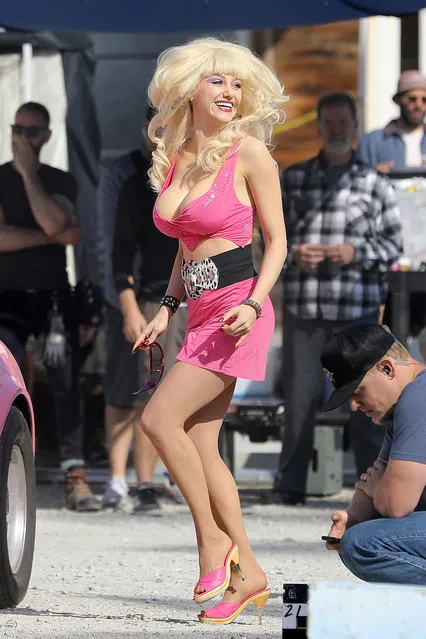
Emmy Rossum strikes a pose as she displays ample assets as she continues her transformation into 80's Los Angeles billboard icon Angelyne on February 24, 2020. (Photo by PhamousFotos/Splash News and Pictures)
A girl looks on at a diver dressed as Santa Claus performing during a promotional event for Christmas in Seoul, South Korea on December 3, 2021. (Photo by Kim Hong-Ji/Reuters)
A string art picture made by artist Ani Abakumova in a workshop in the village of Romashkovo in Moscow Region, Russia on August 2, 2019. Ani Abakumova and her husband Andrei Abakumov create string art replicas of famous paintings. Andrei makes computer calculations that show patterns for future images, then Ani winds coloured strings around nails hammered around a plywood board. (Photo by Anton Novoderezhkin/TASS)
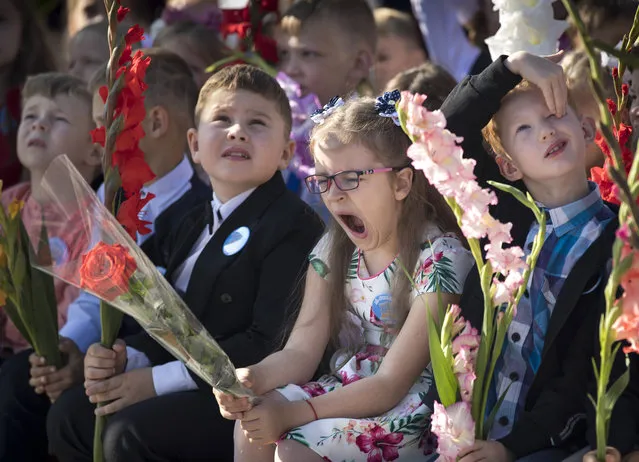
A girl yawns as she and others wait for the start of their first day in school, an occasion known as the Day of Knowledge, in the small town Ignalina, some 110km (68 miles) north of the capital Vilnius, Lithuania, Monday, September 2, 2019. (Photo by Mindaugas Kulbis/AP Photo)
Demi Sims her older sisters Chloe and Frankie, cast members of the British television series “The Only Way Is Essex” during filming in Marbella, resort area on southern Spain’s Costa del Sol on September 17, 2019. (Photo by Beretta/Sims/Rex Features/Shutterstock)
Tom Kaulitz and Heidi Klum attend Heidi Klum's 20th Annual Halloween Party presented by Amazon Prime Video and SVEDKA Vodka at Cathédrale New York on October 31, 2019 in New York City. (Photo by Craig Barritt/Getty Images for SVEDKA)
American singer Rebbeca Marie Gomez, known as Becky G attending the MTV Europe Music Awards 2019, held at the FIBES Conference & Exhibition Centre of Seville, Spain on November 03, 2019. (Photo by PA Wire Press Association)