Loading...
Done
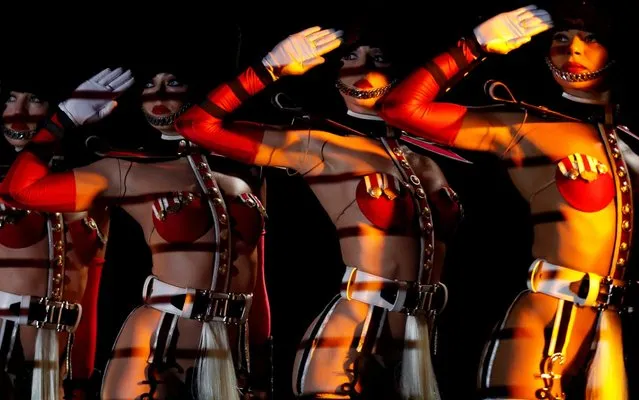
Dancers perform on stage during the Crazy Horse Paris ‘Forever Crazy’ Media Call at The MasterCard Theatres at Marina Bay Sands on October 11, 2017 in Singapore. Forever Crazy consists of a series of highly aesthetic and visual tableaus presented by a classically trained dancers clad only in textured lighting and projection. The show runs from 11 October 2017 till 22 October 2017 in Singapore. (Photo by Suhaimi Abdullah/Getty Images)

Dancers perform on stage during the Crazy Horse Paris “Forever Crazy” Media Call at The MasterCard Theatres at Marina Bay Sands on October 11, 2017 in Singapore. Forever Crazy consists of a series of highly aesthetic and visual tableaus presented by a classically trained dancers clad only in textured lighting and projection. The show runs from 11 October 2017 till 22 October 2017 in Singapore. (Photo by Suhaimi Abdullah/Getty Images)
Details
12 Oct 2017 09:08:00
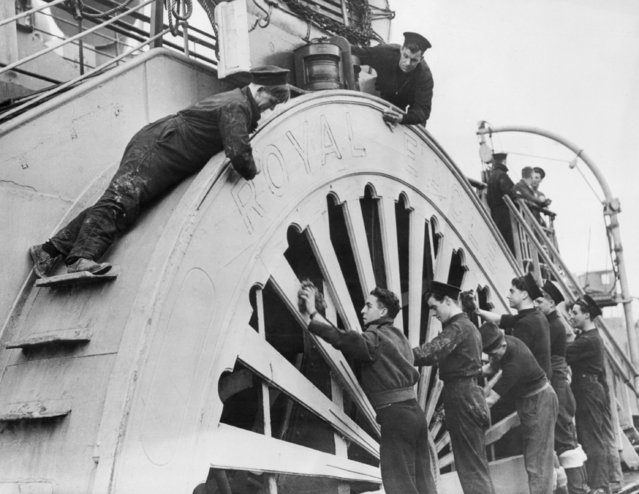
One of the largest paddle steamers afloat in Britain is the H.M.S. Royal Eagle, former peacetime excursion boat which carried passengers on pleasure jaunts from Tower Bridge to Southend, Ramscate and Margate. Commissioned two years ago as a warship of the Royal Navy, the craft has been in action 52 times against enemy aircraft. The Eagle took part in the evacuation from Dunkirk where she was dive-bombed 48 times and brought home nearly 3,000 British troops. Members of the crew cleaning the paddle boxes of H.M.S. Royal Eagle in London on January 18, 1943. (Photo by AP Photo)

One of the largest paddle steamers afloat in Britain is the H.M.S. Royal Eagle, former peacetime excursion boat which carried passengers on pleasure jaunts from Tower Bridge to Southend, Ramscate and Margate. Commissioned two years ago as a warship of the Royal Navy, the craft has been in action 52 times against enemy aircraft. The Eagle took part in the evacuation from Dunkirk where she was dive-bombed 48 times and brought home nearly 3,000 British troops. Members of the crew cleaning the paddle boxes of H.M.S. Royal Eagle in London on January 18, 1943. (Photo by AP Photo)
Details
21 Apr 2018 00:05:00
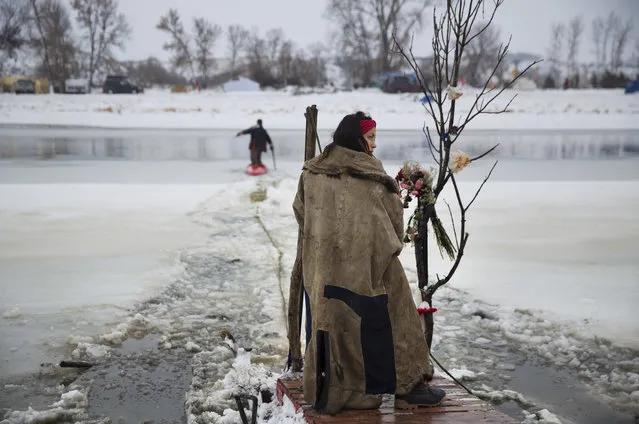
In this Thursday, December 1, 2016 photo, Cat Bigney, part of the Oglala Native American tribe, waits on the shore of the Cannonball river for travelers to arrive by canoe at the Oceti Sakowin camp where people have gathered to protest the Dakota Access oil pipeline in Cannon Ball, N.D. So far, those at the camp have shrugged off the heavy snow, icy winds and frigid temperatures. But if they defy next week's government deadline to abandon the camp, demonstrators know the real deep freeze lies ahead. Life-threatening wind chills and towering snow drifts could mean the greatest challenge is simple survival. (Photo by David Goldman/AP Photo)

In this Thursday, December 1, 2016 photo, Cat Bigney, part of the Oglala Native American tribe, waits on the shore of the Cannonball river for travelers to arrive by canoe at the Oceti Sakowin camp where people have gathered to protest the Dakota Access oil pipeline in Cannon Ball, N.D. So far, those at the camp have shrugged off the heavy snow, icy winds and frigid temperatures. But if they defy next week's government deadline to abandon the camp, demonstrators know the real deep freeze lies ahead. Life-threatening wind chills and towering snow drifts could mean the greatest challenge is simple survival. (Photo by David Goldman/AP Photo)
Details
06 Dec 2016 10:22:00
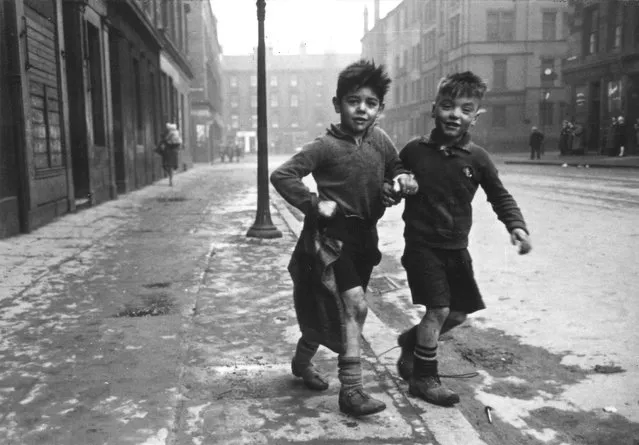
Two boys in the Gorbals area of Glasgow, UK on January 31, 1948. The Gorbals tenements were built quickly and cheaply in the 1840s, providing housing for Glasgow's burgeoning population of industrial workers. Conditions were appalling; overcrowding was standard and sewage and water facilities inadequate. The tenements housed about 40,000 people with up to eight family members sharing a single room, 30 residents sharing a toilet and 40 sharing a tap. By the time this photograph was taken 850 tenements had been demolished since 1920. Redevelopment of the area began in the late 1950s and the tenements were replaced with a modern tower block complex in the sixties. (Photo by Bert Hardy/Getty Images)

Two boys in the Gorbals area of Glasgow, UK on January 31, 1948. The Gorbals tenements were built quickly and cheaply in the 1840s, providing housing for Glasgow's burgeoning population of industrial workers. Conditions were appalling; overcrowding was standard and sewage and water facilities inadequate. The tenements housed about 40,000 people with up to eight family members sharing a single room, 30 residents sharing a toilet and 40 sharing a tap. By the time this photograph was taken 850 tenements had been demolished since 1920. Redevelopment of the area began in the late 1950s and the tenements were replaced with a modern tower block complex in the sixties. (Photo by Bert Hardy/Getty Images)
Details
09 Mar 2017 00:03:00
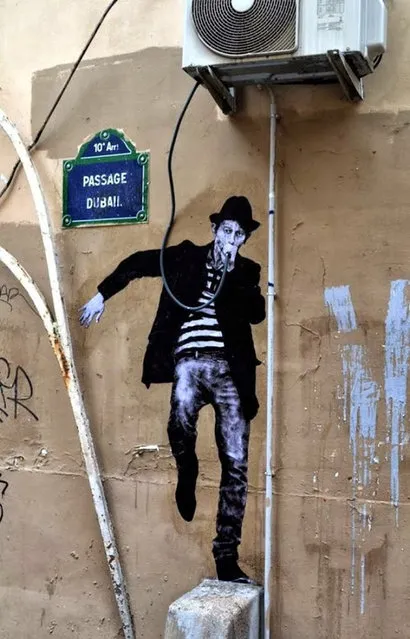
Street Art By Parisian Artist Levalet

French Levalet is back in the streets of Paris with this new piece entitled ‘Le marchand de sable’/’The Sandman’, a rather literal interpretation of the mythical character in central and northern European folklore who brings good dreams by sprinkling magical sand onto the eyes of children while they sleep at night. Funny and smart as usual.
Details
07 Jun 2014 09:23:00
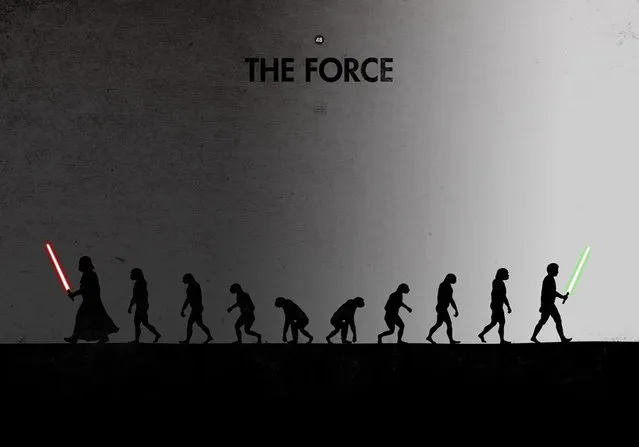
99 Steps of Progress By Maentis

99 Steps of Progress is an illustrated series of parodies created by the Paris artist collective known as Maentis that put a clever spin on the famed scientific March of Progress drawing. A new illustration is being released in this series every day for 99 days. T-shirts, prints and more of each design are available to purchase on RedBubble.
Details
02 Sep 2013 10:14:00
A woman poses for a picture next to a caterpillar-tracked Bentley Continental GT, which was modified by Russian car engineering enthusiasts, during a demonstration in St. Petersburg, Russia on June 7, 2019. (Photo by Anton Vaganov/Reuters)

A woman poses for a picture next to a caterpillar-tracked Bentley Continental GT, which was modified by Russian car engineering enthusiasts, during a demonstration in St. Petersburg, Russia on June 7, 2019. (Photo by Anton Vaganov/Reuters)
Details
16 Jun 2019 00:05:00


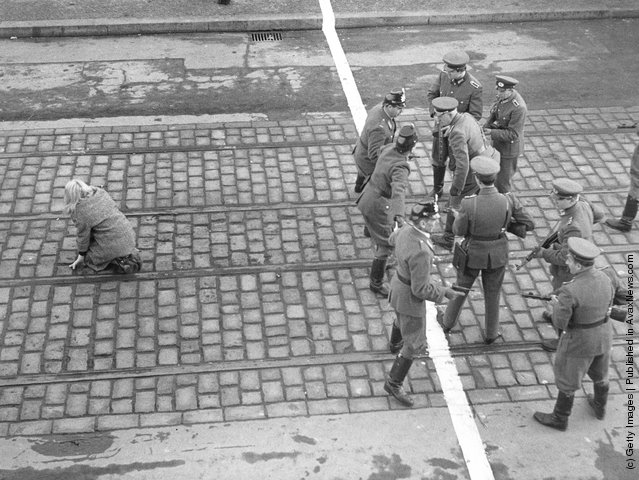
“The Berlin Wall (German: Berliner Mauer) was a barrier constructed by the German Democratic Republic (GDR, East Germany) starting on 13 August 1961, that completely cut off West Berlin from surrounding East Germany and from East Berlin. The barrier included guard towers placed along large concrete walls, which circumscribed a wide area (later known as the “death strip”) that contained anti-vehicle trenches, “fakir beds” and other defenses. The Soviet-dominated Eastern Bloc officially claimed that the wall was erected to protect its population from fascist elements conspiring to prevent the “will of the people” in building a socialist state in East Germany. However, in practice, the Wall served to prevent the massive emigration and defection that marked Germany and the communist Eastern Bloc during the post-World War II period”. – Wikipedia

Photo: West Berlin policemen and East German Volkspolizei face each other across the border in Berlin, circa 1955. (Photo by Three Lions/Hulton Archive/Getty Images)
Details
22 May 2011 10:49:00