Loading...
Done
Jaida Zuniga #5 returns a volley against Northview during a girls volleyball match on grass as part of the newly formed Grass Valley League at Northview High School in West Covina on Thursday, March 4, 2021. South Hills defeated Northview (21-25), 25-13, 25-9, 25-12. (Photo by Keith Birmingham, Pasadena Star-News/SCNG)

Jaida Zuniga #5 returns a volley against Northview during a girls volleyball match on grass as part of the newly formed Grass Valley League at Northview High School in West Covina on Thursday, March 4, 2021. South Hills defeated Northview (21-25), 25-13, 25-9, 25-12. (Photo by Keith Birmingham, Pasadena Star-News/SCNG)
Details
08 Mar 2021 11:02:00
TikTok chef Abir El Saghir prepares a pastry dish at her kitchen in Jeb Jennin, west Bekaa, Lebanon on June 30, 2022. (Photo by Issam Abdallah/Reuters)

TikTok chef Abir El Saghir prepares a pastry dish at her kitchen in Jeb Jennin, west Bekaa, Lebanon on June 30, 2022. (Photo by Issam Abdallah/Reuters)
Details
22 Jul 2022 04:14:00
Michael Cimino, Amanda Diaz and Xochitl Gomez attend the world premiere of “The Flash”, in Hollywood, Los Angeles, California, U.S., June 12, 2023. (Photo by Mike Blake/Reuters)

Michael Cimino, Amanda Diaz and Xochitl Gomez attend the world premiere of “The Flash”, in Hollywood, Los Angeles, California, U.S., June 12, 2023. (Photo by Mike Blake/Reuters)
Details
23 Jun 2023 04:57:00


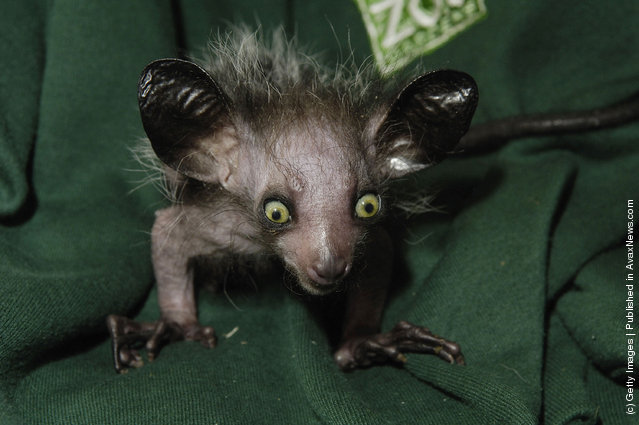
“The aye-aye (Daubentonia madagascariensis) is a lemur, a strepsirrhine primate native to Madagascar that combines rodent-like teeth and a special thin middle finger to fill the same ecological niche as a woodpecker. It is the world's largest nocturnal primate, and is characterized by its unusual method of finding food; it taps on trees to find grubs, then gnaws holes in the wood and inserts its narrow middle finger to pull the grubs out. The only other animal species known to find food in this way is the striped possum. From an ecological point of view the aye-aye fills the niche of a woodpecker as it is capable of penetrating wood to extract the invertebrates within”. – Wikipedia

Photo: In this handout image from Bristol Zoo is seen the first captive bred aye-aye in the UK named “Kintana” (meaning star in Malagasy) April 15, 2005 at Bristol Zoo Gardens, England. The zoo announced today only the second baby aye-aye to be hand-reared in the world (the first was in Jersey Zoo) and has now made his first public appearance since his birth on 11 February 2005. (Photo by Rob Cousins/Bristol Zoo via Getty Images)
Details
13 Apr 2011 13:33:00
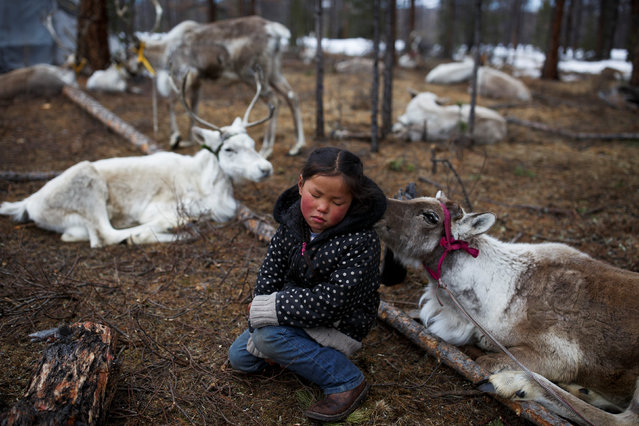
Tsetse, six-year-old daughter of Dukha herder Erdenebat Chuluu, sits among her family's reindeer in a forest near the village of Tsagaannuur, Khovsgol aimag, Mongolia, April 21, 2018. (Photo by Thomas Peter/Reuters)

Tsetse, six-year-old daughter of Dukha herder Erdenebat Chuluu, sits among her family's reindeer in a forest near the village of Tsagaannuur, Khovsgol aimag, Mongolia, April 21, 2018. Nyamaa is an ethnic Darkhad, herders of northern Mongolia who have historically inhabited the steppe that borders the Taiga forests. (Photo by Thomas Peter/Reuters)
Details
26 May 2018 00:03:00
Guards wait for the start of former Egyptian President Hosni Mubarak's funeral at Field Marshal Mohammed Hussein Tantawi Mosque east of Cairo, Egypt on February 26, 2020. (Photo by Amr Abdallah Dalsh/Reuters)

Guards wait for the start of former Egyptian President Hosni Mubarak's funeral at Field Marshal Mohammed Hussein Tantawi Mosque east of Cairo, Egypt on February 26, 2020. (Photo by Amr Abdallah Dalsh/Reuters)
Details
28 Feb 2020 00:01:00
A 16-meter-high snowman is nearly completed by the Songhua River in Harbin City, northeast China's Heilongjiang Province on December 7, 2022. (Photo by Rex Features/Shutterstock)

A 16-meter-high snowman is nearly completed by the Songhua River in Harbin City, northeast China's Heilongjiang Province on December 7, 2022. (Photo by Rex Features/Shutterstock)
Details
13 Dec 2022 05:12:00


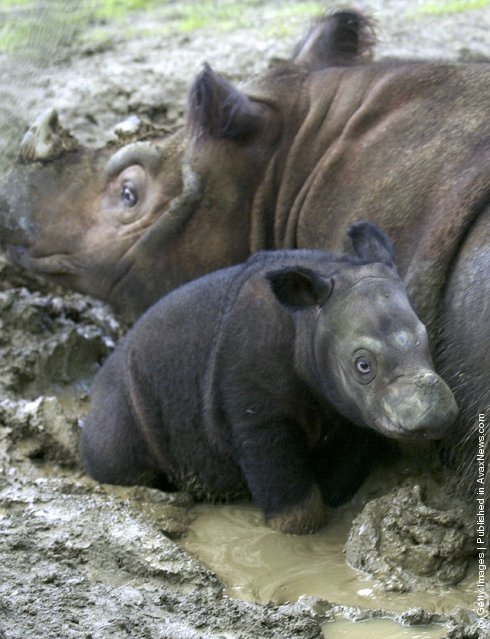
“The Sumatran Rhinoceros (Dicerorhinus sumatrensis) is a member of the family Rhinocerotidae and one of five extant rhinoceroses. It is the only extant species of the genus Dicerorhinus. It is the smallest rhinoceros, standing about 120–145 centimetres (3.9–4.76 ft) high at the shoulder, with a body length of 250 centimetres (8.2 ft) and weight of 500–800 kilograms (1,100–1,800 lb). Like the African species, it has two horns; the larger is the nasal horn, typically 15–25 centimetres (5.9–9.8 in), while the other horn is typically a stub. A coat of reddish-brown hair covers most of the Sumatran Rhino's body”. – Wikipedia

Photo: Emi, a Sumatran rhinoceros lies in the mud with her three-week-old female calf at the Cincinnati Zoo and Botanical Garden August 19, 2004 in Cincinnati, Ohio. Emi made history by becoming the first Sumatran rhino to produce two calves in captivity. (Photo by Mike Simons/Getty Images)

Details
22 Jun 2011 12:37:00