Loading...
Done
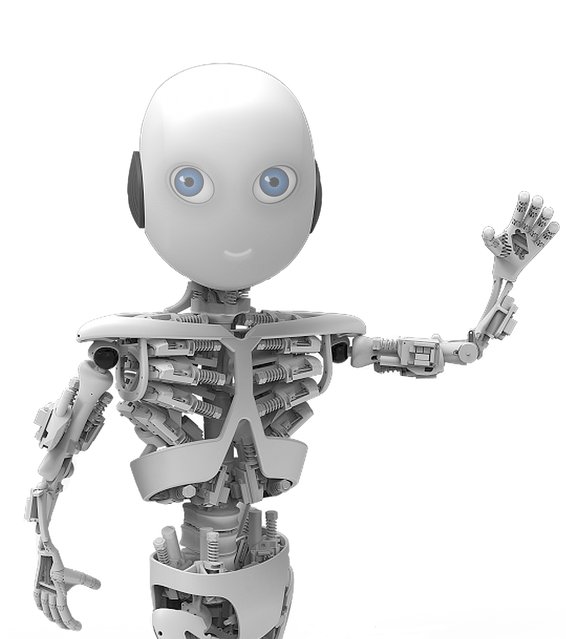
ROBOY: Tendon Driven Humanoid Robot

Roboy has a bright future, as he represents a completely new generation of robots. The pioneer project of the Artificial Intelligence Laboratory (AI Lab) of the University of Zurich started six months ago, with the target of developing one of the most modern humanoid robots within nine months. Now the robot has received a new face and is able to move his arms driven by maxon DC motors. On March 9, 2013, Roboy will be presented to the public at the “Robots on Tour” robotics exhibition held in Zurich on the 25th anniversary of the lab.
Details
06 Mar 2013 10:10:00
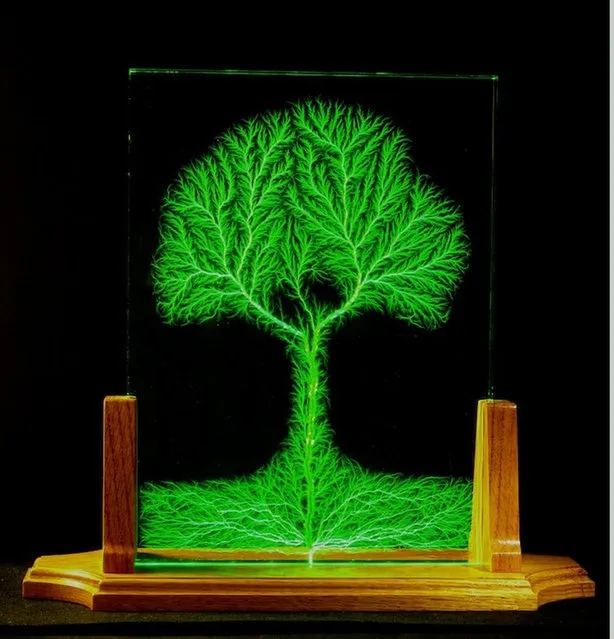
A Flash of Lightning by Bert Hickman

Hickman's experimental art, which reflects the vein-like extensions that electrical charges burn into surfaces they come in contact with, are referred to as Lichtenberg figures. The diverging patterns present in each of the artist's "paintings" are natural occurrences from subjecting the panels to tiny lightning storms through a handy device known as a particle accelerator. Hickman is like a modern-day Zeus, painting with lightning bolts.
Details
26 Nov 2012 14:15:00
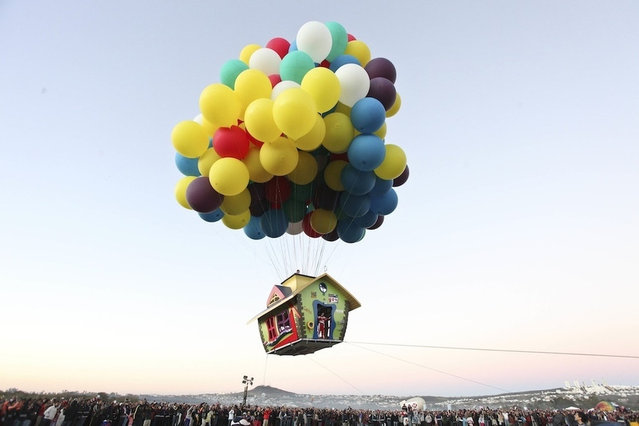
Real-life Up House Flys

Adventurer Jonathan Trappe, successfully flew a house over 20,000 feet in the air, lifted by helium-filled balloons in Leon, Mexico, as inspired by the Pixar film Up.
Details
28 Nov 2012 10:14:00
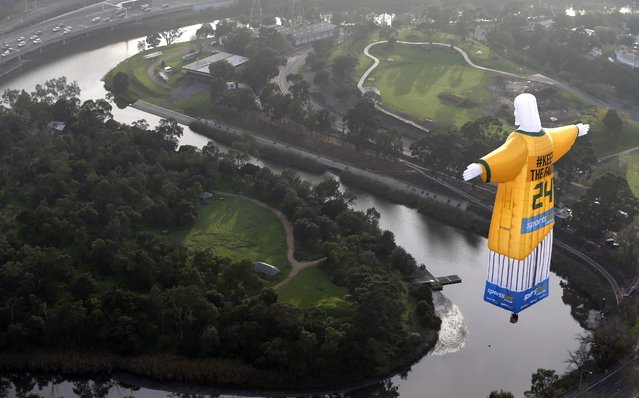
Jesus World Cup Balloon

A giant floating replica of the Brazilian Christ The Redeemer statue rolled into Melbourne today ahead of next week’s World Cup, and the city wasn’t overly pleased with the display.
Details
21 Jun 2014 12:24:00
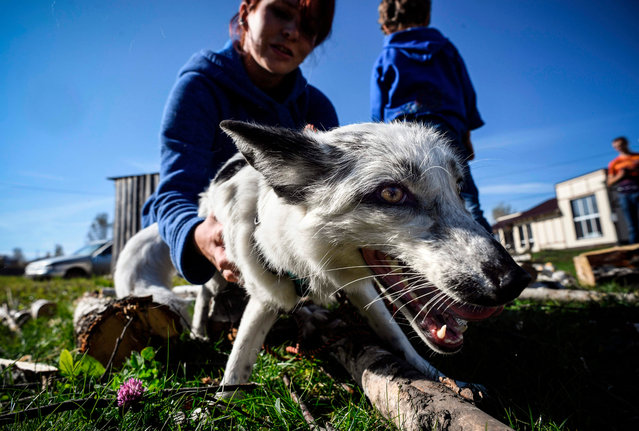
Tatyana Abramova, 33, plays with her home fox Plombir at her countryside house outside Siberian city of Novosibirsk on September 12, 2020. The official start of the Soviet experiment to better understand the domestication of animals by humans began in 1959, and was initiated by geneticists Dmitri Beliaiev and Lioudmila Trout on a farm in Akademgorodok, the scientific center of excellence in Siberia. Their primary objective was to domesticate foxes, to understand how the ancestor of wolves, another canine, evolved into a loyal and loving dog. And understand what this domestication tells us about the genetic evolution of species. (Photo by Alexander Nemenov/AFP Photo)

Tatyana Abramova, 33, plays with her home fox Plombir at her countryside house outside Siberian city of Novosibirsk on September 12, 2020. The official start of the Soviet experiment to better understand the domestication of animals by humans began in 1959, and was initiated by geneticists Dmitri Beliaiev and Lioudmila Trout on a farm in Akademgorodok, the scientific center of excellence in Siberia. Their primary objective was to domesticate foxes, to understand how the ancestor of wolves, another canine, evolved into a loyal and loving dog. And understand what this domestication tells us about the genetic evolution of species. (Photo by Alexander Nemenov/AFP Photo)
Details
25 Oct 2020 00:05:00
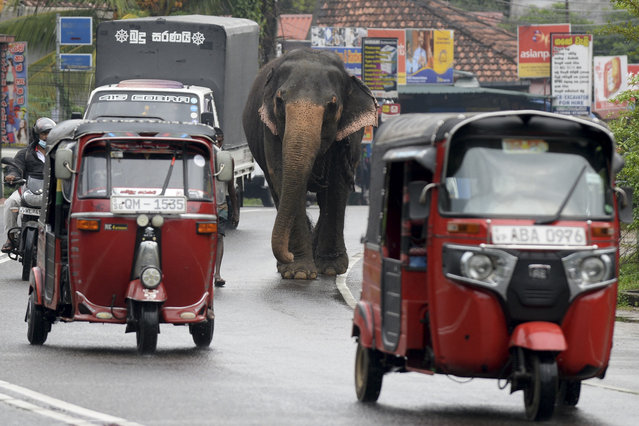
A mahout walks next to his elephant through a busy street in Horana, a suburb of Sri Lanka's capital Colombo on March 23, 2021. (Photo by Lakruwan Wanniarachchi/AFP Photo)

A mahout walks next to his elephant through a busy street in Horana, a suburb of Sri Lanka's capital Colombo on March 23, 2021. (Photo by Lakruwan Wanniarachchi/AFP Photo)
Details
04 Apr 2021 08:42:00
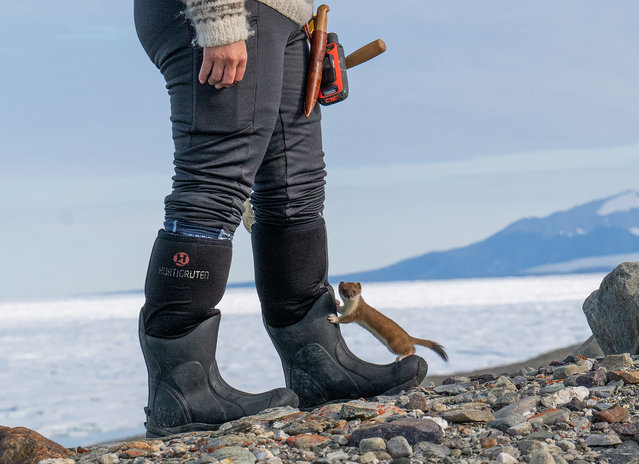
Scientists trekking for days to the undisputed furthest north land point on the planet, in October 2024 were greeted by an unexpected welcoming party: a stoat, whom they named Randall. The team were heading to Kaffeklubben Island, also known as Inuit Qeqertaat, off the northern tip of Greenland, about 440 miles from the North Pole, when Randall emerged from a cairn of rocks, showing no fear as he went to investigate them. (Photo by Jeff Kerby/Magnus News)

Scientists trekking for days to the undisputed furthest north land point on the planet, in October 2024 were greeted by an unexpected welcoming party: a stoat, whom they named Randall. The team were heading to Kaffeklubben Island, also known as Inuit Qeqertaat, off the northern tip of Greenland, about 440 miles from the North Pole, when Randall emerged from a cairn of rocks, showing no fear as he went to investigate them. (Photo by Jeff Kerby/Magnus News)
Details
27 Oct 2024 04:30:00
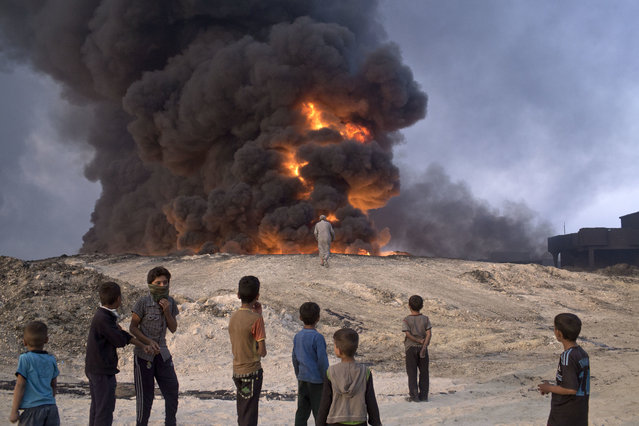
in Qayyarah, about 31 miles (50 km) south of Mosul, Iraq, Sunday, October 23, 2016.in Qayyarah, some 50 kilometers south of Mosul, Iraq, Sunday, Oct. 23, 2016. Islamic State fighters torched a sulfur plant south of Mosul, sending a cloud of toxic fumes into the air that mingled with oil wells the militants had lit on fire to create a smoke screen. (Photo by Marko Drobnjakovic/AP Photo)

in Qayyarah, about 31 miles (50 km) south of Mosul, Iraq, Sunday, October 23, 2016.in Qayyarah, some 50 kilometers south of Mosul, Iraq, Sunday, Oct. 23, 2016. Islamic State fighters torched a sulfur plant south of Mosul, sending a cloud of toxic fumes into the air that mingled with oil wells the militants had lit on fire to create a smoke screen. (Photo by Marko Drobnjakovic/AP Photo)
Details
24 Oct 2016 12:56:00