Loading...
Done
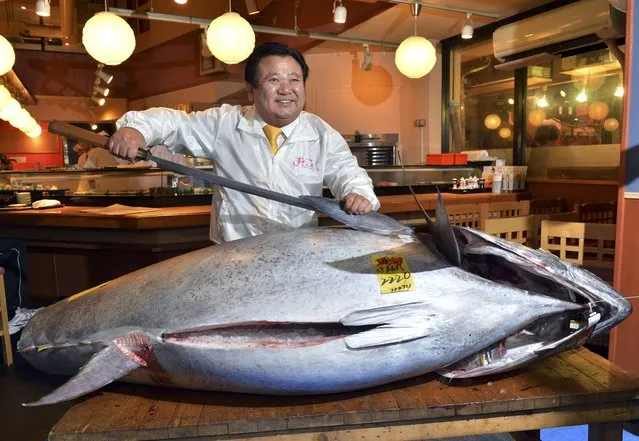
President of sushi restaurant chain Sushi-Zanmai, Kiyoshi Kimura, displays a 222kg bluefin tuna at his main restaurant near Tokyo's Tsukiji fish market on January 5, 2013. The bluefin tuna was traded at 155.4 million yen (1.77 million USD) at the wholesale market, smashing a previous record. (Photo by Yoshikazu Tsuno/AFP Photo)

Japanese businessman Kiyoshi Kimura has paid 1.38 million euros ($1.76 million, or 155.4 million yen) for a blue fin tuna – more than three times the previous high – which he also set one year ago. The 222-kilogram fish will be served to Kimura’s customers. Blue fin tuna is annually sold in a traditional New Year’s auction. Japan consumes 80 percent blue fin tuna caught worldwide.

Photo: President of sushi restaurant chain Sushi-Zanmai, Kiyoshi Kimura, displays a 222kg bluefin tuna at his main restaurant near Tokyo's Tsukiji fish market on January 5, 2013. The bluefin tuna was traded at 155.4 million yen (1.77 million USD) at the wholesale market, smashing a previous record. (Photo by Yoshikazu Tsuno/AFP Photo)
Details
06 Jan 2013 13:26:00
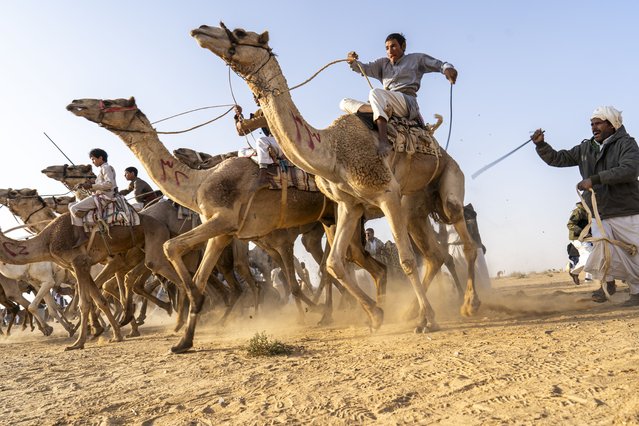
The start of the Al-Sirr camel race on November 19, 2025 in El Hassana, Egypt. The Al-Sirr camel race is one of the most culturally significant and widely celebrated sporting events among the Bedouin communities of Sinai. Every year, Bedouin tribes gather here to hold this traditional race, an event that preserves its authentic heritage. Unlike modern camel races elsewhere, the Bedouin here do not use robotic jockeys or advanced racing technologies. Instead, the camels are ridden by young boys aged approximately 5 to 16, maintaining a long-standing cultural practice. (Photo by Ali Moustafa/Getty Images)

The start of the Al-Sirr camel race on November 19, 2025 in El Hassana, Egypt. The Al-Sirr camel race is one of the most culturally significant and widely celebrated sporting events among the Bedouin communities of Sinai. Every year, Bedouin tribes gather here to hold this traditional race, an event that preserves its authentic heritage. Unlike modern camel races elsewhere, the Bedouin here do not use robotic jockeys or advanced racing technologies. Instead, the camels are ridden by young boys aged approximately 5 to 16, maintaining a long-standing cultural practice. (Photo by Ali Moustafa/Getty Images)
Details
03 Jan 2026 12:49:00


A member of staff stands in front of a CRH high-speed train at Shanghai Hongqiao Railway Station during its test run on May 11, 2011 in Shanghai, China. After 3 years construction, from April in 2008, with total investment estimated at 220.9 billion yuan (around 32.5 billion U.S. dollars), the Beijing-Shanghai high-speed railway begins a one-month trial operation. It is expected to start operation in June this year, with the travel time between the two cities reducing to five hours from the previous 10. (Photo by ChinaFotoPress/Getty Images)
Details
11 May 2011 09:59:00
High Flying Photography With Karim Nafatni

Karim Nafatni is an Airline Captain and photography enthusiast. He seriously got into the Art when he got his first DSLR 3 years ago. Addicted to height and fan of architecture,he climbs the highest skyscrapers of Dubai to take his pictures ,sometimes more than 300 meters above ground. As the top of the biggest buildings in the world is not high enough for him,he carries his camera with him during work to document his daily routine in"his Office" and shoots from his flight deck.
Details
26 Sep 2013 10:46:00
Storm clouds blanket the sky over Great American Ball Park as Starlin Castro #13 of the Chicago Cubs fields a ground ball in the fifth inning against the Cincinnati Reds as on July 7, 2014 in Cincinnati, Ohio. Cincinnati defeated Chicago 9-3. (Photo by Jamie Sabau/Getty Images)

Storm clouds blanket the sky over Great American Ball Park as Starlin Castro #13 of the Chicago Cubs fields a ground ball in the fifth inning against the Cincinnati Reds as on July 7, 2014 in Cincinnati, Ohio. (Photo by Jamie Sabau/Getty Images)
Details
13 Jul 2014 11:51:00
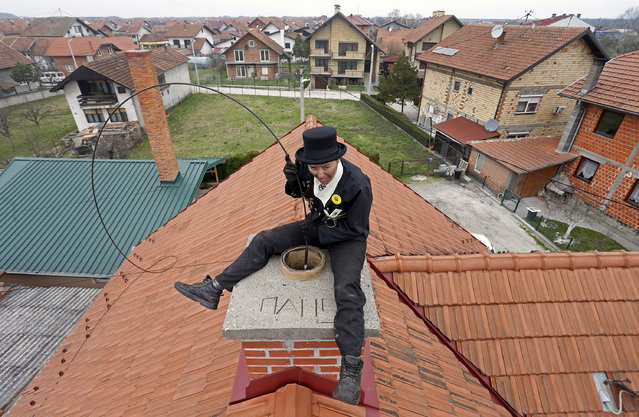
Dajana Djuric, 25, who has worked as a chimney sweep since the age of six, cleans a chimney in Brcko, Bosnia and Herzegovina. Picture taken March 3, 2016. (Photo by Dado Ruvic/Reuters)

Dajana Djuric, 25, who has worked as a chimney sweep since the age of six, cleans a chimney in Brcko, Bosnia and Herzegovina. Dajana Djuric, believed to be the only female chimney sweep in Bosnia and Herzegovina, has to contend with perilous roofs in the depth of winter. (Photo by Dado Ruvic/Reuters)
Details
09 Mar 2016 13:07:00
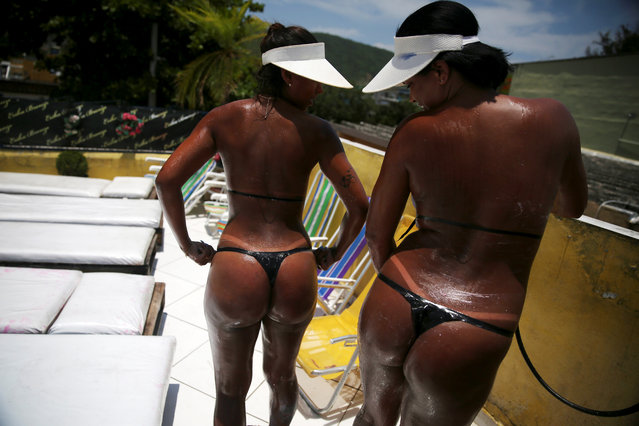
Women compare their bikini marks after sunbathing on a terrace to have the perfect bikini line ('marquinha' in Portuguese), at the Erika Bronze spa in Rio de Janeiro, Brazil, November 17, 2016. (Photo by Pilar Olivares/Reuters)

Women compare their bikini marks after sunbathing on a terrace to have the perfect bikini line (“marquinha” in Portuguese), at the Erika Bronze spa in Rio de Janeiro, Brazil, November 17, 2016. Women start arriving at the spa between 7am and 8am and will tan for approximately 3 hours. (Photo by Pilar Olivares/Reuters)
Details
26 Nov 2016 10:44:00
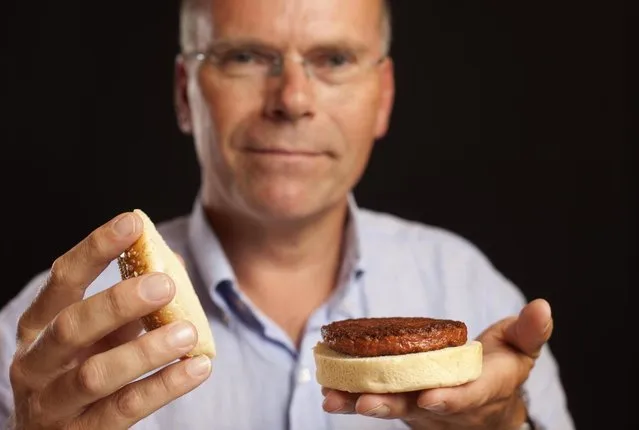
In this handout image provided by Ogilvy, a burger made from cultured beef, which has been developed by Professor Mark Post of Maastricht University in the Netherlands (pictured) is shown to the media during a press conference on August 5, 2013 in London, England. Cultured Beef could help solve the coming food crisis and combat climate change with commercial production of Cultured Beef beginning within ten to twenty years. (Photo by David Parry via Getty Images)

In this handout image provided by Ogilvy, a burger made from cultured beef, which has been developed by Professor Mark Post of Maastricht University in the Netherlands (pictured) is shown to the media during a press conference on August 5, 2013 in London, England. The in-vitro burger, cultured from cattle stem cells, the first example of what its creator says could provide an answer to global food shortages and help combat climate change, was fried in a pan and tasted by two volunteers. The burger is the result of years of research by Dutch scientist Mark Post, a vascular biologist at the University of Maastricht, who is working to show how meat grown in petri dishes might one day be a true alternative to meat from livestock.The meat in the burger has been made by knitting together around 20,000 strands of protein that has been cultured from cattle stem cells in Post's lab. (Photo by David Parry)
Details
06 Aug 2013 08:48:00