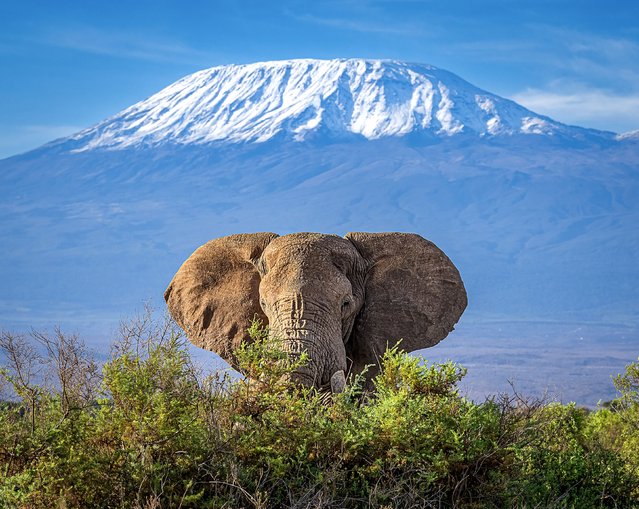
Mount Kilimanjaro looms behind an elephant at Amboseli National Park in southern Kenya, 2024. (Photo byYaron Schmid/YS Wildlife Photography/Solent News)
Naruemol Thonglek, right, with her daughter, waits for news of her partner, who is missing after the collapse of an under-construction high-rise building after an earthquake in Bangkok, Thailand, Monday, March, 31, 2025. (Photo by Manish Swarup/AP Photo)
A woman holds her dog to be blessed by a priest at the Cathedral San Bernardino de Siena during the ceremony commemorating the Feast of San Antonio Abad, the patron saint of domestic animals, in Xochimilco on the outskirts of Mexico City, Mexico on January 17, 2024. (Photo by Raquel Cunha/Reuters)
Big wave surfers on their jet skis in front of a surf of a huge wave on the rock of Sao Miguel Arcanjo fort and Nazare lighthouse during a surfing session at Praia do Norte on January 27, 2025 in Nazare, Portugal. (Photo by Stefan Matzke - sampics/Corbis via Getty Images)
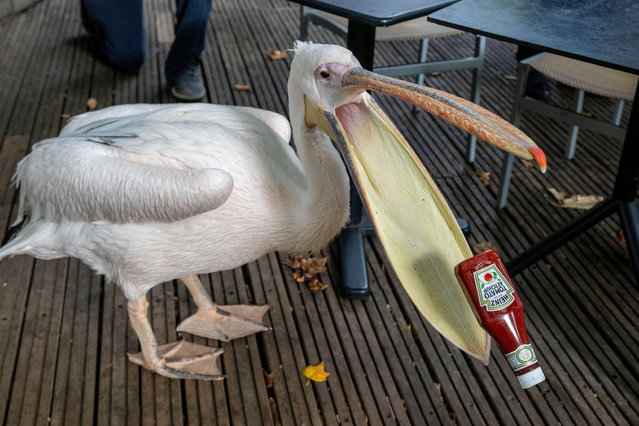
A pelican investigates a fallen ketchup bottle outside a cafe in St James’s Park in London, England on October 9, 2025. The species has lived there for hundreds of years and remain a popular sight for visitors. Introduced in 1664 as a gift from the Russian ambassador, about 40 pelicans have since made the park their home. The bottle was safely retrieved from the pelican. (Photo by Stephen Chung/Alamy Live News)
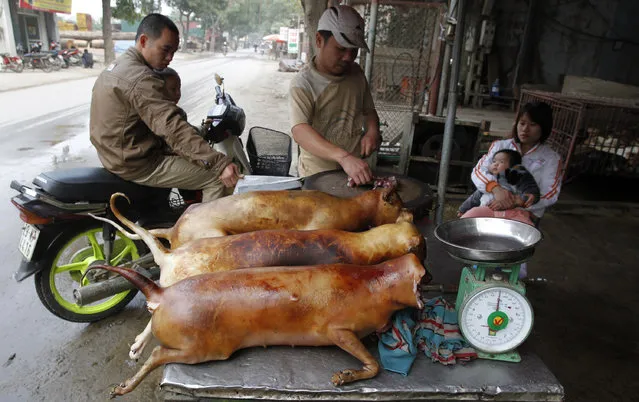
A vendor (C) cuts slaughtered dogs for sale at his roadside stall in Duong Noi village, outside Hanoi December 16, 2011. While animal rights activists have condemned eating dog meat as cruel treatment of the animals, it is still an accepted popular delicacy for some Vietnamese, as well in some other Asian countries. Duong Noi is well-known as a dog-meat village, where hundreds of dogs are killed each day for sale as popular traditional food. Dog-eating as a custom is rooted in Vietnam and was developed as a result of poverty. One kilogram of dog meat costs about 130,000 dongs ($6.2). (Photo by Reuters/Kham)