Loading...
Done
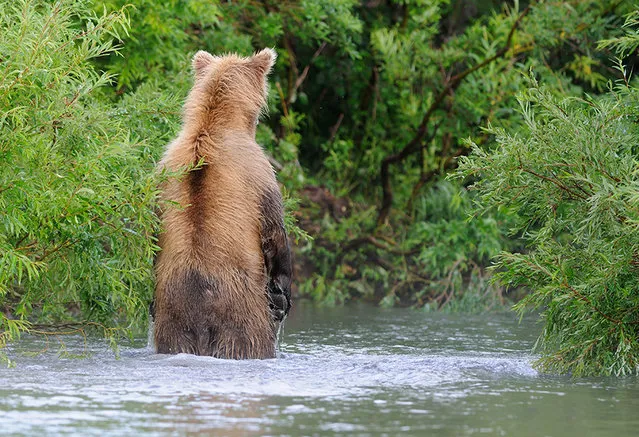
Where's the fish?/n. South Kamchatka Sanctuary<><>South Kamchatka Sanctuary; Kuril Lake; Kamchatka; bear; salmon; spawning

Igor Shpilenok works in the reserve at Kamchatka, Russia. Igor is a fellow of the International League of Conservation Photographers and a winner of the 2006 BBC Wildlife Photographer Competition. Igor’s work has been published in numerous international and Russian magazines, including Smithsonian, National Wildlife, Geo, and BBC Wildlife.

“How does a bear behave when encounter a human? In most cases he runs away. But before running he almost always would rise to stand on his rear feet. And this behavior does not indicate the attack, as many people think...” – Igor Shpilenok. (Photo by Igor Shpilenok via Wildlife Photo Russia)
Details
16 Sep 2012 12:54:00
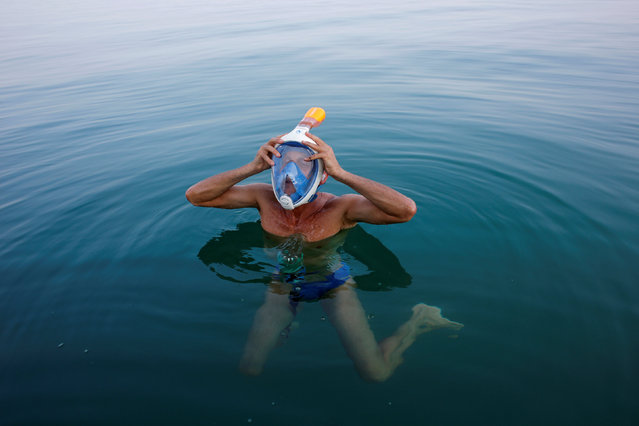
An environmental activist adjusts his mask while taking part in “The Dead Sea Swim Challenge”, swimming from the Jordanian to Israeli shore, to draw attention to the ecological threats facing the Dead Sea, in Kibbutz Ein Gedi, Israel November 15, 2016. (Photo by Nir Elias/Reuters)

An environmental activist adjusts his mask while taking part in “The Dead Sea Swim Challenge”, swimming from the Jordanian to Israeli shore, to draw attention to the ecological threats facing the Dead Sea, in Kibbutz Ein Gedi, Israel November 15, 2016. Swimmers from around the world plunged into the salty waters of the Dead Sea on Tuesday to attempt a seven-hour swim across the fabled lake in a bid to draw attention to its environmental degradation. Wearing protective masks and snorkels, 25 swimmers paddled through the muddy water to attempt the 9-mile (15-kilometer) swim from Jordan to Israel. (Photo by Nir Elias/Reuters)
Details
16 Nov 2016 10:59:00
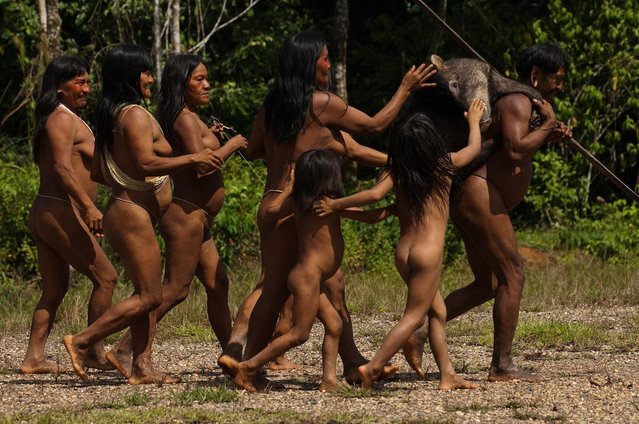
Spectacular images offering insight into the lives of the Huaorani people in the Ecuadorian Amazon have been revealed showing how they use traditional methods to hunt monkeys for food. The stunning pictures were taken by conservation photographer Pete Oxford from Torquay, Devon in the Ecuadorian Amazon. “The Huaorani Indians are a forest people highly in tune with their environment. Many are now totally acculturated since the 1950s by missionaries”, said Pete. “Today they face radical change to their culture to the proximity of oil exploration within their territory and the Yasuni National Park and Biosphere Reserve, they are vastly changed. Some still live very traditionally and for this shoot, through my Huaorani friend, a direct relative of those photographed he wanted to depict them as close to their original culture as possible. They still largely hunt with blow pipes and spears eating a lot of monkeys and peccaries”. The Huaorani are also known as the Waorani, Waodani or the Waos and are native Amerindians. Their lands are located between the Curaray and Napo rivers and speak the Huaorani language. Pete says that during his visit he was welcomed into the group and hopes that ancient cultures can be saved. Here: The tribe were seen celebrating after a hunter returned to camp with a wild pig. (Photo by Pete Oxford/Mediadrumworld.com)

Spectacular images offering insight into the lives of the Huaorani people in the Ecuadorian Amazon have been revealed showing how they use traditional methods to hunt monkeys for food. The stunning pictures were taken by conservation photographer Pete Oxford from Torquay, Devon in the Ecuadorian Amazon. Here: The tribe were seen celebrating after a hunter returned to camp with a wild pig. (Photo by Pete Oxford/Mediadrumworld.com)
Details
20 Jan 2017 07:58:00
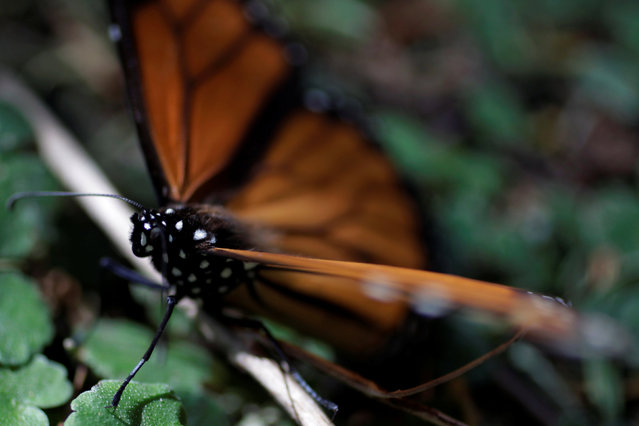
A monarch butterfly rests on the ground at the Sierra Chincua butterfly sanctuary on a mountain in Angangeo, Michoacan November 24, 2016. Angangueo is a town and municipality located in far eastern Michoacán state in central Mexico noted for its history of mining and its location in the Monarch Butterfly Biosphere Reserve. The Monarch Butterfly Biosphere Reserve is a World Heritage Site containing most of the over-wintering sites of the eastern population of the monarch butterfly. The reserve is located in the Trans-Mexican Volcanic Belt pine-oak forests ecoregion on the border of Michoacán and State of Mexico, 100 km (62 miles), northwest of Mexico City. Millions of butterflies arrive in the reserve annually. Butterflies only inhabit a fraction of the 56,000 hectares of the reserve from October–March. (Photo by Carlos Jasso/Reuters)

A monarch butterfly rests on the ground at the Sierra Chincua butterfly sanctuary on a mountain in Angangeo, Michoacan November 24, 2016. Angangueo is a town and municipality located in far eastern Michoacán state in central Mexico noted for its history of mining and its location in the Monarch Butterfly Biosphere Reserve. The Monarch Butterfly Biosphere Reserve is a World Heritage Site containing most of the over-wintering sites of the eastern population of the monarch butterfly. (Photo by Carlos Jasso/Reuters)
Details
26 Nov 2016 10:20:00
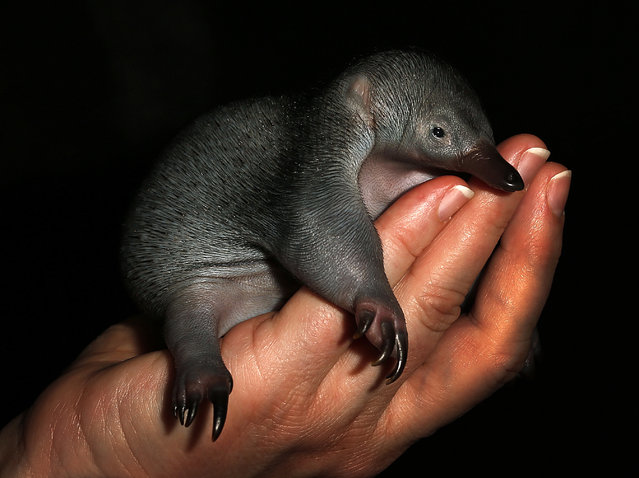
Bo, a 55-day-old baby Echidna known as a puggle, rests in the hands of vet nurse Annabelle Sehlmeier at Taronga Zoo in Sydney November 1, 2012. The puggle was brought to the zoo after it being found by itself on a walking track north of Sydney and will be fed by hand until it is weaned at about six months of age. (Photo by Tim Wimborne/Reuters)

Bo, a 55-day-old baby Echidna known as a puggle, rests in the hands of vet nurse Annabelle Sehlmeier at Taronga Zoo in Sydney November 1, 2012. The puggle was brought to the zoo after it being found by itself on a walking track north of Sydney and will be fed by hand until it is weaned at about six months of age. (Photo by Tim Wimborne/Reuters)
Details
23 Apr 2018 00:03:00
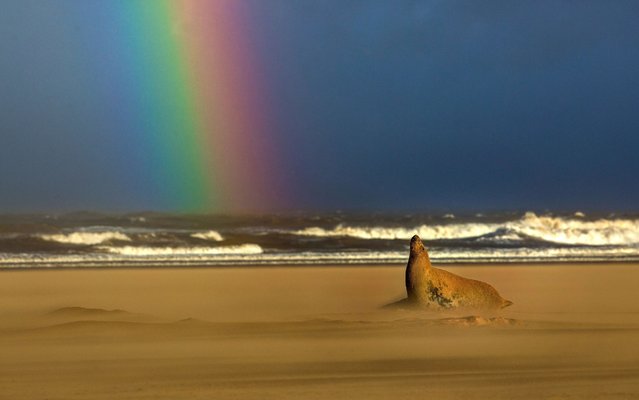
A grey seal basks under a rainbow on a beach on the Lincolnshire coast, England on November 21, 2017. (Photo by Sean Weekly/Caters News Agency)

A grey seal basks under a rainbow on a beach on the Lincolnshire coast, England on November 21, 2017. (Photo by Sean Weekly/Caters News Agency)
Details
05 Jul 2018 00:01:00
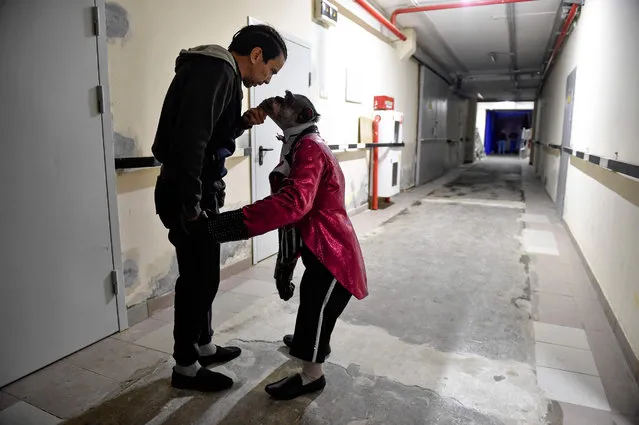
Murad Khydyrov, horse and monkey trainer at the Great Moscow State Circus, and chimpanzee named Micky get ready for a rehearsal of the show called “History” as the circus prepares for its new season, which is to begin on September 19, in Moscow on September 17, 2020. (Photo by Natalia Kolesnikova/AFP Photo)

Murad Khydyrov, horse and monkey trainer at the Great Moscow State Circus, and chimpanzee named Micky get ready for a rehearsal of the show called “History” as the circus prepares for its new season, which is to begin on September 19, in Moscow on September 17, 2020. (Photo by Natalia Kolesnikova/AFP Photo)
Details
27 Sep 2020 00:01:00
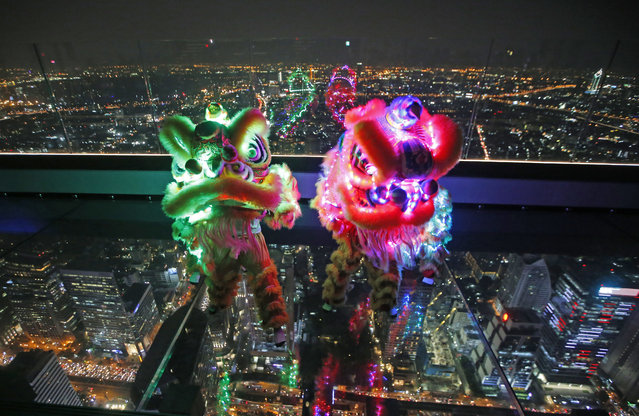
Lion dance with LED lights, perform on the glass deck of the King Power Mahanakhon building, currently Thailand's tallest at 314 meters (1,030 feet) tall, Bangkok, Thailand, Monday, February 4, 2019. Chinese will celebrate the lunar new year on Feb. 5 this year which marks the Year of the Pig in the Chinese zodiac. (Photo by Sakchai Lalit/AP Photo)

Lion dance with LED lights, perform on the glass deck of the King Power Mahanakhon building, currently Thailand's tallest at 314 meters (1,030 feet) tall, Bangkok, Thailand, Monday, February 4, 2019. Chinese will celebrate the lunar new year on Feb. 5 this year which marks the Year of the Pig in the Chinese zodiac. (Photo by Sakchai Lalit/AP Photo)
Details
05 Feb 2019 13:09:00