Loading...
Done
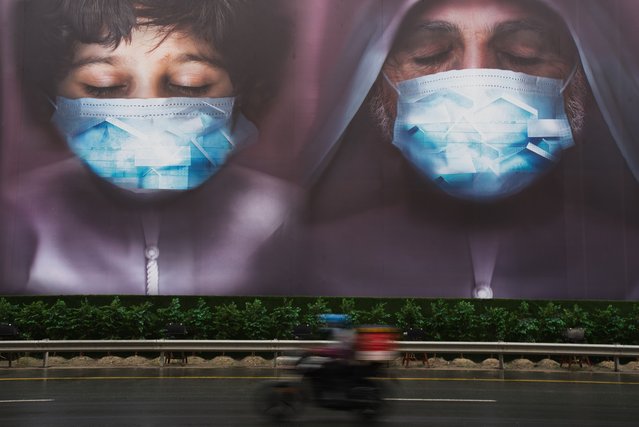
In this Wednesday, April 15, 2020 file photo, a motorcycle delivery man rides past a billboard urging people to stay home over the coronavirus pandemic in Dubai, United Arab Emirates. Wealthier Western countries are considering how to ease lockdown restrictions and start taking gradual steps toward reviving business and daily life. But many developing countries, particularly in the Middle East and Africa, can hardly afford the luxury of any misstep. (Photo by Jon Gambrell/AP Photo/File)

In this Wednesday, April 15, 2020 file photo, a motorcycle delivery man rides past a billboard urging people to stay home over the coronavirus pandemic in Dubai, United Arab Emirates. Wealthier Western countries are considering how to ease lockdown restrictions and start taking gradual steps toward reviving business and daily life. But many developing countries, particularly in the Middle East and Africa, can hardly afford the luxury of any misstep. (Photo by Jon Gambrell/AP Photo/File)
Details
18 Apr 2020 00:05:00
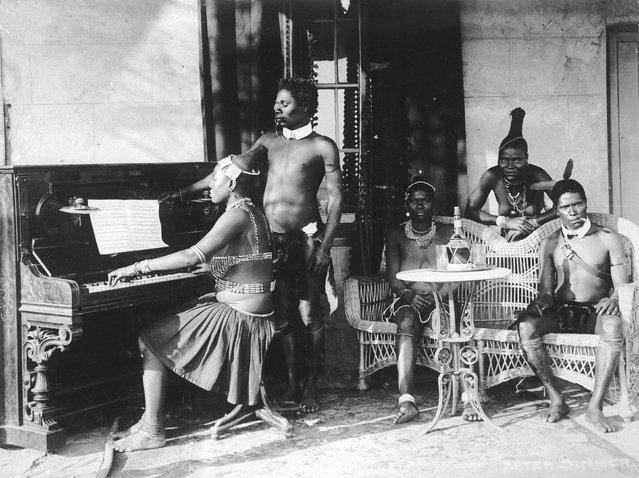
circa 1925:  A Zulu woman playing the piano while a group of others sit and listen.  (Photo by General Photographic Agency/Getty Images)

“The Zulu are the largest South African ethnic group, with an estimated 10–11 million people living mainly in the province of KwaZulu-Natal. Small numbers also live in Zimbabwe, Zambia, and Mozambique. Their language, Zulu, is a Bantu language; more specifically, part of the Nguni subgroup. The Zulu Kingdom played a major role in South African history during the 19th and 20th centuries. Under apartheid, Zulu people were classed as third-class citizens and suffered from state-sanctioned discrimination. They remain today the most numerous ethnic group in South Africa, and now have equal rights along with all other citizens”. – Wikipedia.

Photo: A Zulu woman playing the piano while a group of others sit and listen (to put it briefly, Englishmen scoff over Zulu). South Africa, circa 1925. (Photo by General Photographic Agency)

Details
03 Feb 2014 09:40:00
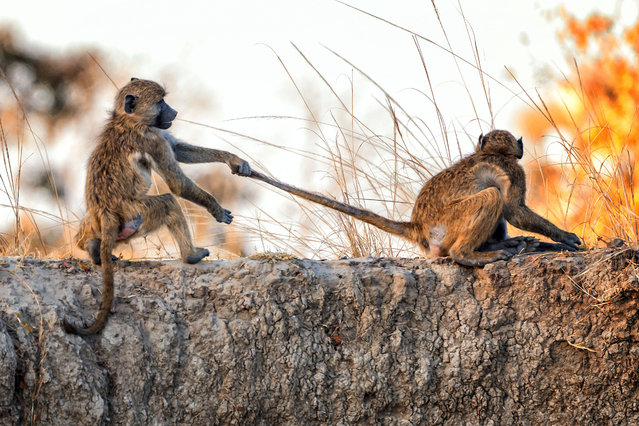
Going toe-to-toe, these fighting primates could give Floyd Mayweather a run for his money. The amazing images – captured by Australian tourist Julie Rathbone on the banks of the Zambezi river in Africa – show the pair engaging in a few fisticuffs. The Chacma baboons appeared to settle a disagreement by fighting - before a senior baboon plays referee and steps in to break it up. Nurse unit manager Julie Rathbone, 59, from New South Wales, was on a cruise down the river when she spotted the fracas unfolding. (Photo by Julie Rathbone/Caters News)

Going toe-to-toe, these fighting primates could give Floyd Mayweather a run for his money. The amazing images – captured by Australian tourist Julie Rathbone on the banks of the Zambezi river in Africa – show the pair engaging in a few fisticuffs. The Chacma baboons appeared to settle a disagreement by fighting – before a senior baboon plays referee and steps in to break it up. Nurse unit manager Julie Rathbone, 59, from New South Wales, was on a cruise down the river when she spotted the fracas unfolding. (Photo by Julie Rathbone/Caters News)
Details
28 Mar 2015 12:05:00
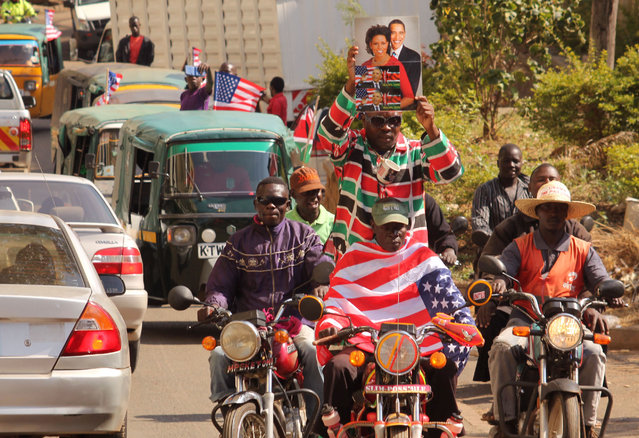
People on motor bikes celebrate American President Barack Obama's visit to Kenya by holding up a photo, center top, of the president and First Lady Michelle Obama in Kisumu, Kenya, Saturday, July 25, 2015.  President Barack Obama heralded Africa as a continent “on the move” Saturday as he opened a U.S.-sponsored business summit in Kenya, the East African nation where he has deep family ties. (Photo by AP Photo)

People on motor bikes celebrate American President Barack Obama's visit to Kenya by holding up a photo, center top, of the president and First Lady Michelle Obama in Kisumu, Kenya, Saturday, July 25, 2015. President Barack Obama heralded Africa as a continent “on the move” Saturday as he opened a U.S.-sponsored business summit in Kenya, the East African nation where he has deep family ties. (Photo by AP Photo)
Details
26 Jul 2015 10:42:00
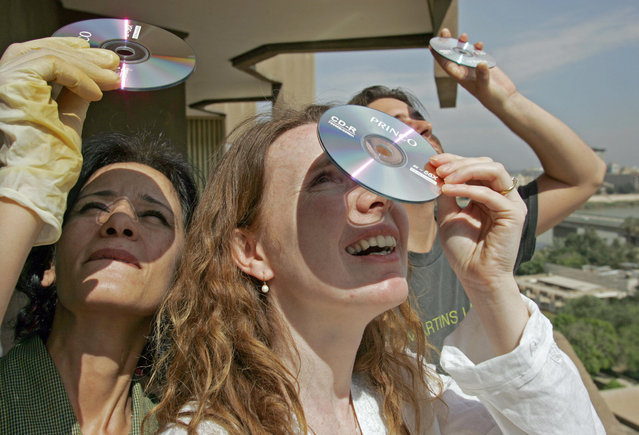
An Iraqi woman and foreigners use  pair of compact discs as a filter to watch the partial solar eclipse in war-torn Baghdad, 29 March 2006. Without access to proper equipment to protect their eyes from the sun's rays, eclipse watchers in Iraq used makeshift filters.  The moon blotted out the sun over northwest Africa early Wednesday, turning day into night in a total solar eclipse as it swept a shadowy path from the outer tip of Brazil to the steppes of Mongolia. (Photo by Hassan Ammar/AFP Photo)

An Iraqi woman and foreigners use pair of compact discs as a filter to watch the partial solar eclipse in war-torn Baghdad, 29 March 2006. Without access to proper equipment to protect their eyes from the sun's rays, eclipse watchers in Iraq used makeshift filters. The moon blotted out the sun over northwest Africa early Wednesday, turning day into night in a total solar eclipse as it swept a shadowy path from the outer tip of Brazil to the steppes of Mongolia. (Photo by Hassan Ammar/AFP Photo)
Details
25 Jul 2017 09:31:00
A protesting student runs past a burning bus off campus outside the University of the Witwatersrand in Johannesburg, South Africa on Monday, October 10, 2016. Tear gas and water cannon were fired as hundreds of students protested at the university amid a bitter national dispute with university managers and the government over demonstrators' demands for free education, forcing student into the neighbouring city streets. (Photo by AP Photo)

A protesting student runs past a burning bus off campus outside the University of the Witwatersrand in Johannesburg, South Africa on Monday, October 10, 2016. Tear gas and water cannon were fired as hundreds of students protested at the university amid a bitter national dispute with university managers and the government over demonstrators' demands for free education, forcing student into the neighbouring city streets. (Photo by AP Photo)
Details
12 Oct 2016 10:40:00


Girls pose during a photocall to promote the Big Royal Wedding Sleepover at “Camp Royale” on Clapham Common on March 8, 2011 in London, England. The “Pop Up” campsite will cater for up to 10,500 people between April 28 and May 1 to coincide with the weekend of the Royal Wedding on April 29. (Photo by Dan Kitwood/Getty Images). LONDON, ENGLAND – MARCH 08 2011
Details
10 Mar 2011 13:44:00


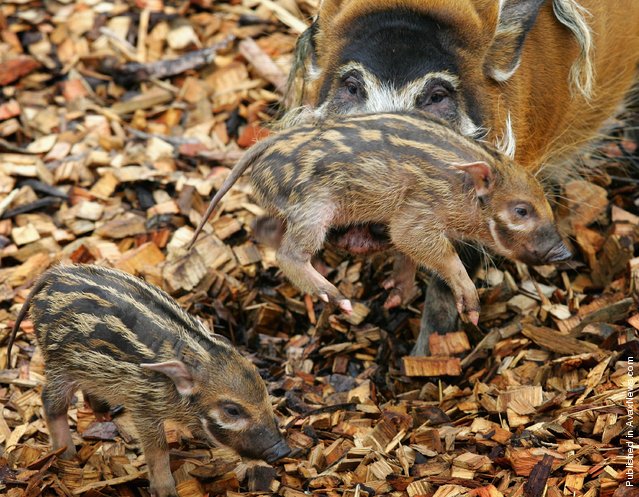
“The Red River Hog (Potamochoerus porcus), also known as the Bush Pig (but not to be confused with P. larvatus, common name “Bushpig”), is a wild member of the pig family living in Africa, with most of its distribution in the Guinean and Congolian forests. It is rarely seen away from rainforests, and generally prefers areas near rivers or swamps.

Red River Hogs eat grass, berries, roots, insects, molluscs, small vertebrates and carrion. They are capable of causing damage to plantations. Red River Hogs typically live in herds of 6-20 members led by a dominant boar. Sows rear 3-6 piglets at a time.”

Photo: Two 17 day old red river hoglet twins forage for food next to their mother Bahiti at London Zoo on August 23, 2007 in London, England. Red River hoglets inhabit the forests and swamps of West and Central Africa. The recent additions to the London Zoo pig pen have been eagerly awaited by zoo keepers. (Photo by Chris Jackson/Getty Images)
Details
18 Mar 2011 15:15:00