Loading...
Done
NASA's New Space Launch System

“The Space Launch System, or SLS, is a Shuttle-Derived heavy launch vehicle being designed by NASA, following the cancellation of the Constellation Program, to replace the Space Shuttle after its retirement. The NASA Authorization Act of 2010 envisions the transformation of the Ares I and Ares V vehicle designs into a single launch vehicle usable for both crew and cargo. It is to be upgraded over time with more powerful versions. The proposed SLS is visually similar to the legacy Saturn V booster and in particular the proposed, two-stage, Saturn INT-20”. – Wikipedia

Photo: In this illustration provided by NASA, the design for a new space rocket system, the Space Launch System, is seen. NASA's new rocket design will reportedly cost about $35 billion and be ready to for test launch in 2017. According to NASA, the rocket will be used to carry Orion Multi-Purpose Crew Vehicle as well as cargo and science experiments to earth's orbit, as a backup for the space station and possibly destinations beyond that. (Illustration by NASA via Getty Images)
Details
15 Sep 2011 10:50:00
Vehicles move past a man resting on a taxi, as he waits for passengers, along a road in Karachi, Pakistan, May 5, 2015. (Photo by Akhtar Soomro/Reuters)

Vehicles move past a man resting on a taxi, as he waits for passengers, along a road in Karachi, Pakistan, May 5, 2015. (Photo by Akhtar Soomro/Reuters)
Details
26 May 2015 10:33:00
A general view of Hong Kong's business district is seen Thursday, August 1, 2013. (Photo by Vincent Yu/AP Photo)

A general view of Hong Kong's business district is seen Thursday, August 1, 2013. (Photo by Vincent Yu/AP Photo)
Details
21 Apr 2014 10:01:00
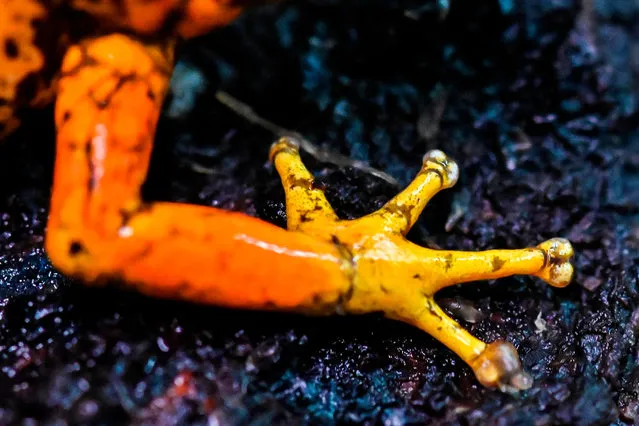
A leg of a “diablito” frog (Oophaga sylvatica) is photographed in a laboratory at a laboratory in the zoo of Cali, Colombia, on July 19, 2019. Colombia is the second country with the largest number of amphibians in the world after Brazil. More than 40% of amphibian species worldwide are in danger of extinction. (Photo by Luis Robayo/AFP Photo)

A leg of a “diablito” frog (Oophaga sylvatica) is photographed in a laboratory at a laboratory in the zoo of Cali, Colombia, on July 19, 2019. Colombia is the second country with the largest number of amphibians in the world after Brazil. More than 40% of amphibian species worldwide are in danger of extinction. (Photo by Luis Robayo/AFP Photo)
Details
28 Nov 2020 00:03:00
The aerial photo taken on November 20, 2024 shows a general view of buildings during a foggy day in Yinchuan, in northern China's Ningxia region. (Photo by AFP Photo/China Stringer Network)

The aerial photo taken on November 20, 2024 shows a general view of buildings during a foggy day in Yinchuan, in northern China's Ningxia region. (Photo by AFP Photo/China Stringer Network)
Details
01 Feb 2025 03:37:00
It might have been foggy in the Willamette Valley, but Cerridwen Martin was able to revel in a view of the top of the clouds from the summit of Spencer Butte in Eugene, Ore., on Tuesday, December 16, 2014. (Photo by Andy Nelson/AP Photo/The Register-Guard)

It might have been foggy in the Willamette Valley, but Cerridwen Martin was able to revel in a view of the top of the clouds from the summit of Spencer Butte in Eugene, Ore., on Tuesday, December 16, 2014. Martin was joined by Joe Martinson, right, for the 1.1 mile trek. Fog shrouded much of the city for most of the day. (Photo by Andy Nelson/AP Photo/The Register-Guard)
Details
20 May 2015 09:26:00
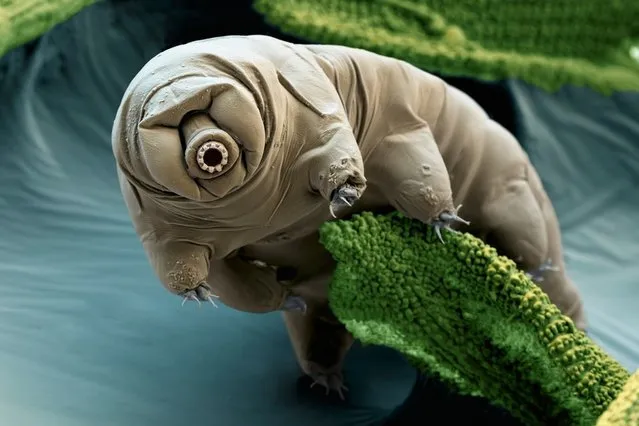
Tardigrades (commonly known as waterbears or moss piglets). (Photo by SPL/East News)

“Tardigrades (commonly known as waterbears or moss piglets) are small, water-dwelling, segmented animals with eight legs. Tardigrades were first discovered in 1773 by Johann August Ephraim Goeze, who called them kleiner Wasserbär, meaning “little water bear” in German. The name Tardigrada means “slow walker” and was given by Lazzaro Spallanzani in 1777. The name water bear comes from the way they walk, reminiscent of a bear's gait. The biggest adults may reach a body length of 1.5 millimetres (0.059 in), the smallest below 0.1 mm. Freshly hatched tardigrades may be smaller than 0.05 mm”. – Wikipedia. Photo: Tardigrades. (Photo by SPL/East News)
Details
26 Sep 2012 09:55:00
These stunning images look to highlight the amazing natural beauty that can be found across the United States. The U.S. Department of the Interior (DOI) recently released their Best of 2015 list, featuring a variety of animals, weather conditions and landmarks. Included in the list are gleaming auroras, adorable groups of otters and owls, and breath-taking shots across the likes of the Grand Canyon and national parks. (Photo by Caters News)

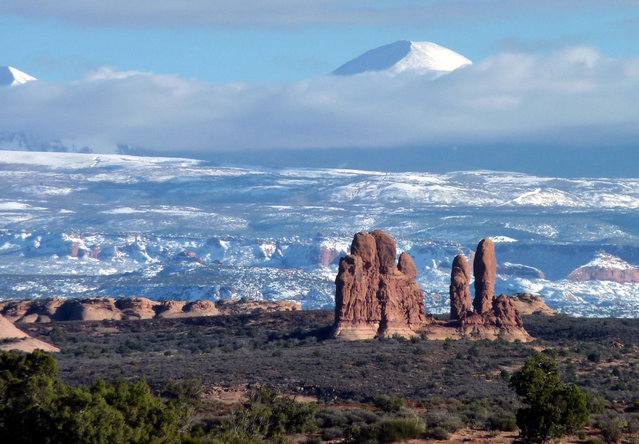
These stunning images look to highlight the amazing natural beauty that can be found across the United States. The U.S. Department of the Interior (DOI) recently released their Best of 2015 list, featuring a variety of animals, weather conditions and landmarks. Included in the list are gleaming auroras, adorable groups of otters and owls, and breath-taking shots across the likes of the Grand Canyon and national parks. Each of the spectacular shots, all of which were taken during 2015, featured on the Department of the Interiors Instagram account throughout the year, taken by both members of staff and members of the public. Here: Arches, National Park. (Photo by Caters News)
Details
21 Dec 2015 08:06:00