Loading...
Done
The Berenson robot strolls among visitors during the exhibition “Persona : Oddly Human” at the Quai Branly museum in Paris, France, February 23, 2016. The Berenson robot, developed in France in 2011, is the brainchild of anthropologist Denis Vidal and robotics engineer Philippe Gaussier. Its programming allows it to record reactions of museum visitors to certain pieces of art and then use the data to develop its own unique taste, which allows “Berenson” to judge whether or not it likes a certain work of art within an exhibition. (Photo by Philippe Wojazer/Reuters)

The Berenson robot strolls among visitors during the exhibition “Persona : Oddly Human” at the Quai Branly museum in Paris, France, February 23, 2016. The Berenson robot, developed in France in 2011, is the brainchild of anthropologist Denis Vidal and robotics engineer Philippe Gaussier. Its programming allows it to record reactions of museum visitors to certain pieces of art and then use the data to develop its own unique taste, which allows “Berenson” to judge whether or not it likes a certain work of art within an exhibition. (Photo by Philippe Wojazer/Reuters)
Details
25 Feb 2016 12:26:00
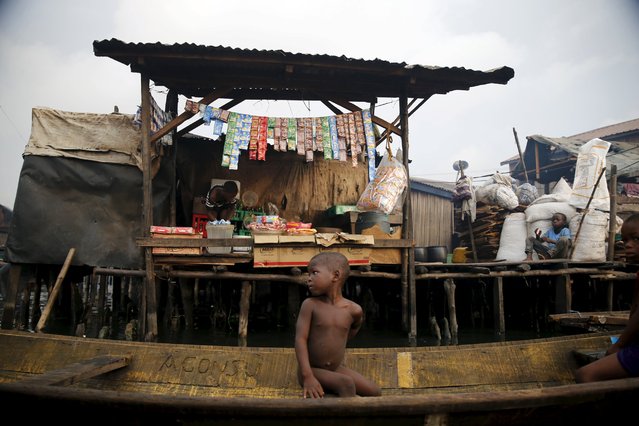
A boy sits in a canoe in front of a shed built on a raft in the Makoko fishing community on the Lagos Lagoon, Nigeria February 29, 2016. Makoko, a vast slum of houses on stilts in a Lagos lagoon, now boasts a new school – pyramid-shaped, floating and capable of withstanding the waterways' extreme weather, it is a beacon of hope for the nearly 100,000 Nigerians who live there.  (Photo by Akintunde Akinleye/Reuters)

A boy sits in a canoe in front of a shed built on a raft in the Makoko fishing community on the Lagos Lagoon, Nigeria February 29, 2016. In Makoko, a sprawling slum of Nigeria's megacity Lagos, a floating school capable of holding up to a hundred pupils has since November brought free education to the waterways known as the Venice of Lagos. It offers the chance of social mobility for youngsters who, like most of the city's 21 million inhabitants, lack a reliable electricity and water supply and whose water-based way of life is threatened by climate change as well as rapid urbanisation. (Photo by Akintunde Akinleye/Reuters)
Details
05 Mar 2016 12:01:00
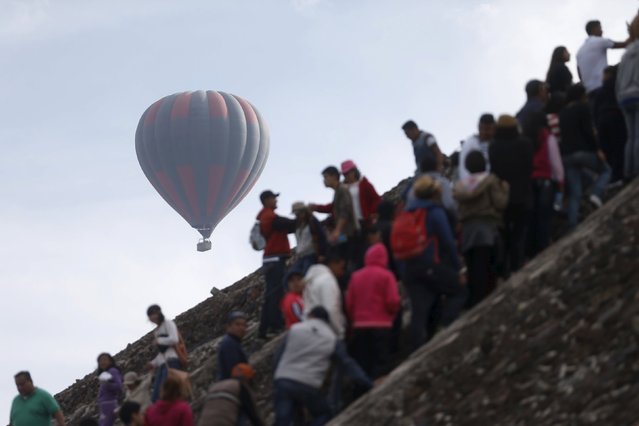
A hot air ball balloon floats past while people stand in line to climb the Pyramid of the Sun and welcome the spring equinox in the pre-hispanic city of Teotihuacan, on the outskirts of Mexico City, Mexico, March 20, 2016. Spring equinox in Teotihuacán is an annual event which takes place around the 20th and 21st of March at the pre-Hispanic site of Teotihuacán, Mexico. This event is mirrored by other similar events in other pre-Hispanic sites such as Chichén Itzá and Malinalco, Mexico State. (Photo by Edgard Garrido/Reuters)

A hot air ball balloon floats past while people stand in line to climb the Pyramid of the Sun and welcome the spring equinox in the pre-hispanic city of Teotihuacan, on the outskirts of Mexico City, Mexico, March 20, 2016. Spring equinox in Teotihuacán is an annual event which takes place around the 20th and 21st of March at the pre-Hispanic site of Teotihuacán, Mexico. This event is mirrored by other similar events in other pre-Hispanic sites such as Chichén Itzá and Malinalco, Mexico State. (Photo by Edgard Garrido/Reuters)
Details
21 Mar 2016 13:01:00
A woman eats candy in the shape of a phallus during the Kanamara Matsuri, or Iron Phallus Festival through a street near the Kanamara shrine in Kawasaki outside of Tokyo April 5, 2015. The festival celebrates fertility and is used to raise awareness and money for the prevention of sexually transmitted diseases. (Photo by Thomas Peter/Reuters)

A woman eats candy in the shape of a phallus during the Kanamara Matsuri, or Iron Phallus Festival through a street near the Kanamara shrine in Kawasaki outside of Tokyo April 5, 2015. The festival celebrates fertility and is used to raise awareness and money for the prevention of sexually transmitted diseases. (Photo by Thomas Peter/Reuters)
Details
11 Apr 2015 10:13:00
A vendor (C) cuts slaughtered dogs for sale at his roadside stall in Duong Noi village, outside Hanoi December 16, 2011. While animal rights activists have condemned eating dog meat as cruel treatment of the animals, it is still an accepted popular delicacy for some Vietnamese, as well in some other Asian countries. (Photo by Reuters/Kham)

A vendor (C) cuts slaughtered dogs for sale at his roadside stall in Duong Noi village, outside Hanoi December 16, 2011. While animal rights activists have condemned eating dog meat as cruel treatment of the animals, it is still an accepted popular delicacy for some Vietnamese, as well in some other Asian countries. Duong Noi is well-known as a dog-meat village, where hundreds of dogs are killed each day for sale as popular traditional food. Dog-eating as a custom is rooted in Vietnam and was developed as a result of poverty. One kilogram of dog meat costs about 130,000 dongs ($6.2). (Photo by Reuters/Kham)
Details
16 Jul 2013 11:40:00
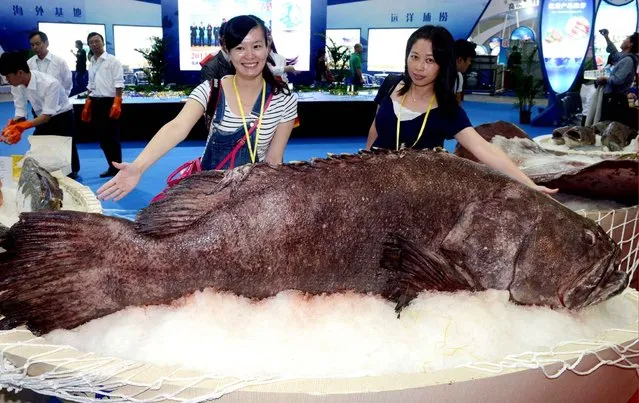
A 210-kilogram-weight Epinephelussp was showed at China Fisheries & Seafood Expo in Fuzhou, Fujian, China on 24th October, 2014. (Photo by Top Photo/Sipa USA)

A 210-kilogram-weight Epinephelussp was showed at China Fisheries & Seafood Expo in Fuzhou, Fujian, China on 24th October, 2014. (Photo by Top Photo/Sipa Press USA)
Details
01 Nov 2014 14:11:00
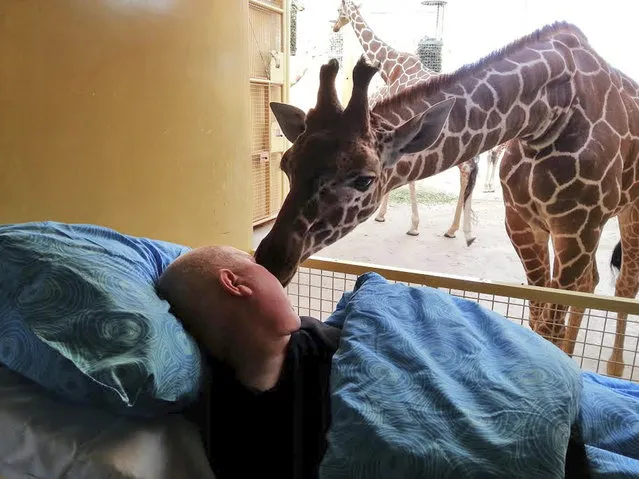
This photo released Saturday March 22, 2014 by Stichting Ambulance Wens or Ambulance Wish Foundation shows a giraffe at Blijdorp Zoo in Rotterdam giving a lick to terminally ill Mario Eijs on Wednesday March 19, 2014. The Stichting Ambulancewens “Ambulance Wish Foundation” offers transport for terminally ill patients who cannot walk to help fulfill a last wish, in Eijs' case to be taken to the Blijdorp Zoo in Rotterdam where he worked doing odd jobs for 25 years. (Photo by AP Photo/Stichting Ambulance Wens)

This photo released Saturday March 22, 2014 by Stichting Ambulance Wens or Ambulance Wish Foundation shows a giraffe at Blijdorp Zoo in Rotterdam giving a lick to terminally ill Mario Eijs on Wednesday March 19, 2014. The Stichting Ambulancewens “Ambulance Wish Foundation” offers transport for terminally ill patients who cannot walk to help fulfill a last wish, in Eijs' case to be taken to the Blijdorp Zoo in Rotterdam where he worked doing odd jobs for 25 years. Eijs, who has a mental handicap, is dying of a brain tumor and has difficulty walking or speaking. (Photo by AP Photo/Stichting Ambulance Wens)
Details
29 Mar 2014 14:20:00
Visitors run away as waves caused by a tidal bore surge past a barrier on the banks of Qiantang River, in Hangzhou, Zhejiang province August 13, 2014. (Photo by Reuters/Stringer)

Visitors run away as waves caused by a tidal bore surge past a barrier on the banks of Qiantang River, in Hangzhou, Zhejiang province August 13, 2014. (Photo by Reuters/Stringer)
Details
16 Aug 2014 10:46:00