Loading...
Done
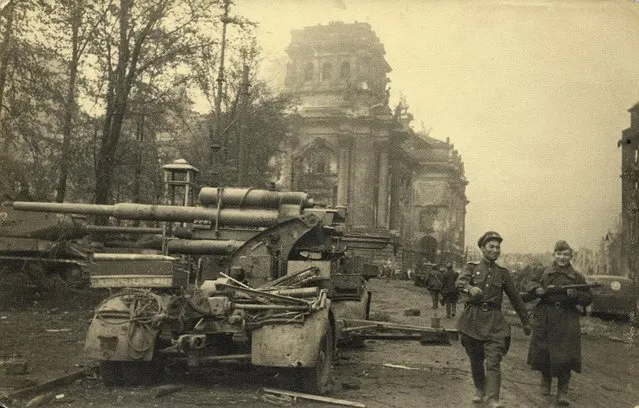
Russian soldiers are pictured next to the Reichstag building in this undated photo taken May 1945 in Berlin. Some 70 years on from the Battle for Berlin, instrumental in the end of World War II, Reuters photographer Fabrizio Bensch unearthed pictures by Red Army photographer Georgiy Samsonov, showing his portrayal of a city laid siege. (Photo by Georgiy Samsonov/Reuters/MHM)

Russian soldiers are pictured next to the Reichstag building in this undated photo taken May 1945 in Berlin. Some 70 years on from the Battle for Berlin, instrumental in the end of World War II, Reuters photographer Fabrizio Bensch unearthed pictures by Red Army photographer Georgiy Samsonov, showing his portrayal of a city laid siege. Bensch bought an exactly equivalent FED camera, a Soviet copy of the German-made Leica II, choosing to use black and white film to capture images of the self-same locations he detected his way to in modern-day Berlin. (Photo by Georgiy Samsonov/Reuters/MHM)
Details
07 May 2015 12:01:00
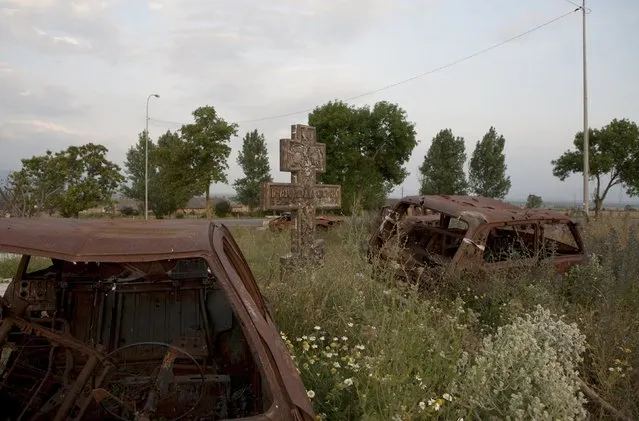
Abandoned cars are seen around a cross in the village of Tbeti near Tskhinvali, the capital of the breakaway region of South Ossetia, Georgia, July 4, 2015. President Vladimir Putin signed a treaty with Georgia's rebel South Ossetia region on March 18 that almost completely integrates it with Russia, alarming Georgia and the West a year after Moscow took over Crimea. (Photo by Kazbek Basaev/Reuters)

Abandoned cars are seen around a cross in the village of Tbeti near Tskhinvali, the capital of the breakaway region of South Ossetia, Georgia, July 4, 2015. President Vladimir Putin signed a treaty with Georgia's rebel South Ossetia region on March 18 that almost completely integrates it with Russia, alarming Georgia and the West a year after Moscow took over Crimea. Russia won a five-day war with Georgia in 2008 over the fate of South Ossetia and another rebel region, Abkhazia. It formally recognizes both regions as independent states and signed a similar treaty with Abkhazia last year. (Photo by Kazbek Basaev/Reuters)
Details
09 Jul 2015 11:43:00
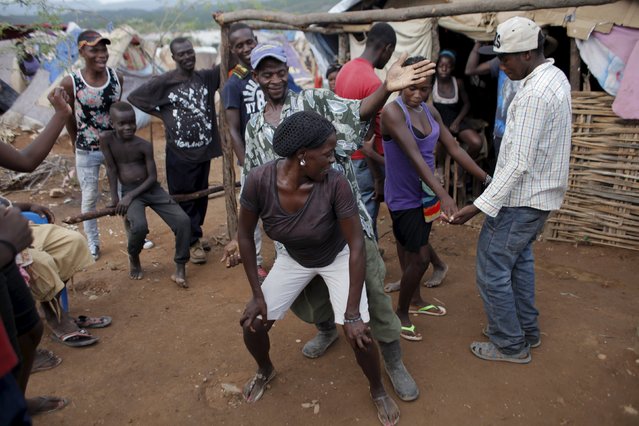
People enjoy themselves as they dance to Dominican music at a refugee camp for Haitians returning from the Dominican Republic on the outskirts of Anse-a-Pitres, Haiti, September 6, 2015. (Photo by Andres Martinez Casares/Reuters)

People enjoy themselves as they dance to Dominican music at a refugee camp for Haitians returning from the Dominican Republic on the outskirts of Anse-a-Pitres, Haiti, September 6, 2015. Dominican officials last month began implementing a controversial immigration program targeting Haitian migrants and Dominican-born people of Haitian descent. The program centers on round-ups and deportations that have triggered concerns about a slow-growing border migration crisis in the poorest country in the Americas. So far about 1,500 people have been deported at a pace of 50 to 100 per day, according to relief officials with access to records supplied by the Dominican government. (Photo by Andres Martinez Casares/Reuters)
Details
21 Sep 2015 11:29:00
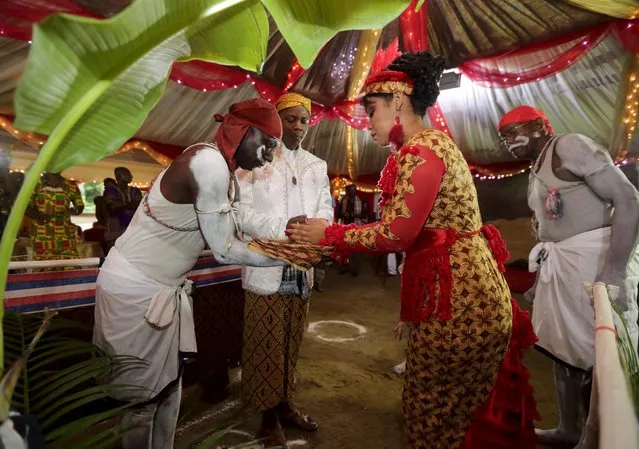
Winti spiritual leader Ramon Mac-Nack (2nd L) looks on as as his bride Melissa Karwafodi (2nd R) hands a gourd to a Maroon priest (L) as they are wedded in the first Winti marriage ever to be held in public, in district Para, Suriname, November 16, 2015. (Photo by Ranu Abhelakh/Reuters)

Winti spiritual leader Ramon Mac-Nack (2nd L) looks on as as his bride Melissa Karwafodi (2nd R) hands a gourd to a Maroon priest (L) as they are wedded in the first Winti marriage ever to be held in public, in district Para, Suriname, November 16, 2015. The Winti religion, which formed centuries ago out of elements of different religious traditions that African slaves brought with them to Suriname, was considered a form idolatry and prohibited by law since the days of slavery until it was finally officially recognized in 1971. (Photo by Ranu Abhelakh/Reuters)
Details
27 Nov 2015 05:51:00
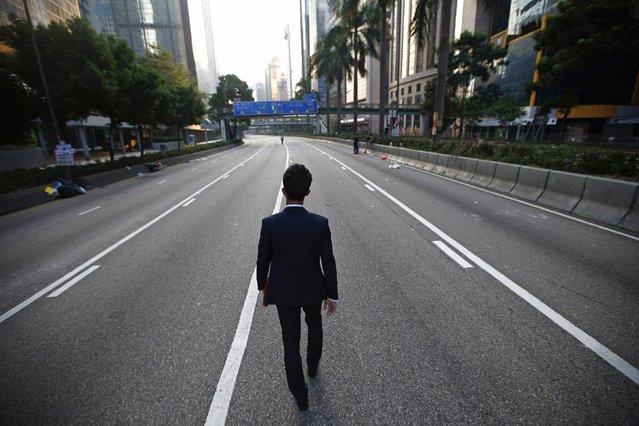
A man walks along an empty street near the central financial district in Hong Kong September 30, 2014. Tens of thousands of pro-democracy protesters extended a blockade of Hong Kong streets on Tuesday, stockpiling supplies and erecting makeshift barricades ahead of what some fear may be a push by police to clear the roads before Chinese National Day. (Photo by Carlos Barria/Reuters)

Reuters photographer Bobby Yip took a series of portraits of people taking part in the “Occupy Central” protests in Hong Kong, and asked them why they had joined the demonstrations. China rules Hong Kong under a “one country, two systems” formula that accords the territory limited democracy. Tens of thousands of mostly student protesters are demanding Beijing give them full democracy, with the freedom to nominate election candidates. The unrest is the worst in Hong Kong since China resumed its rule over the former British colony in 1997. (Photo by Carlos Barria/Reuters)
Details
30 Sep 2014 09:10:00
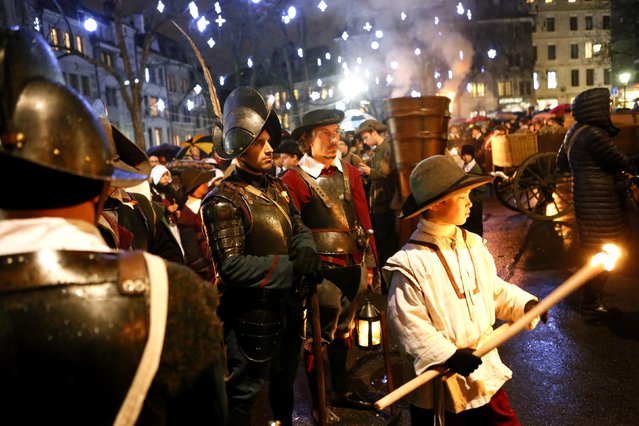
Members of the Compagnie 1602 take part in a procession in Geneva December 14, 2014. The annual procession of the Fete de l'Escalade has been held since 1926 and commemorates local resistance to the December 11, 1602 surprise attack by the troops of the Duke of Savoy. (Photo by Pierre Albouy/Reuters)

Members of the Compagnie 1602 take part in a procession in Geneva December 14, 2014. The annual procession of the Fete de l'Escalade has been held since 1926 and commemorates local resistance to the December 11, 1602 surprise attack by the troops of the Duke of Savoy. A popular symbol of the resistance is the figure of Mere Royaume pouring hot soup from her caldron onto the soldiers. A chocolate replica of the cauldron is widely available during the three-day celebrations. This year marks also the 200-year anniversary of the entry of the Canton of Geneva in the Swiss Confederation. (Photo by Pierre Albouy/Reuters)
Details
15 Dec 2014 11:08:00
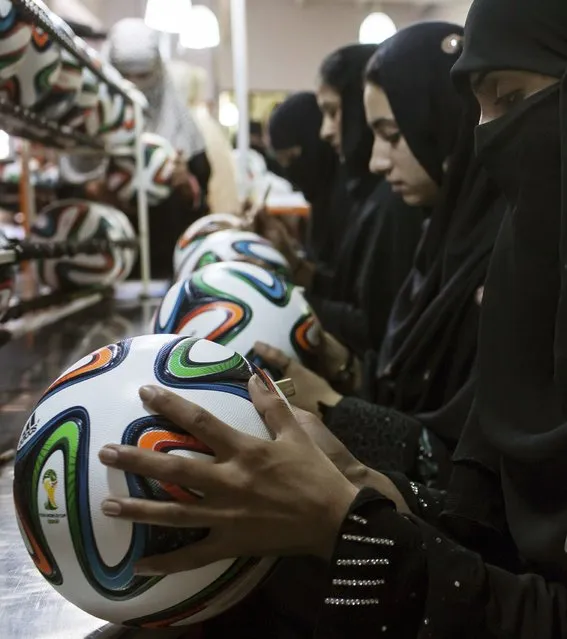
Employees conduct a final check to fix any cavities in the seams of balls inside the soccer ball factory that produces official match balls for the 2014 World Cup in Brazil, in Sialkot, Punjab province May 16, 2014. (Photo by Sara Farid/Reuters)

Employees conduct a final check to fix any cavities in the seams of balls inside the soccer ball factory that produces official match balls for the 2014 World Cup in Brazil, in Sialkot, Punjab province May 16, 2014. It was when he felt the roar of the crowd at the 2006 World Cup in Germany that Pakistani factory owner Khawaja Akhtar first dreamt up a goal of his own: to manufacture the ball for the biggest soccer tournament on the planet. Last year he finally got his chance – but only 33 days to make it happen. (Photo by Sara Farid/Reuters)
Details
26 May 2014 13:59:00
“Eye of a toad”. Animal Portraits, Łukasz Bożycki, Poland.  (Photo by Łukasz Bożycki)

“Eye of a toad”. Animal Portraits, Łukasz Bożycki, Poland. Early spring sees a pond near Łukasz’s home city of Warsaw, Poland, full of mating frogs and a few toads. On this March day, Łukasz shared the pond with them for an evening, sitting in the icy water in his chest-high waders, keeping as still as possible, despite the numbing cold, so that the amphibians could get used to him. “I wanted to find a fresh way of portraying the amphibians”, he says, “at water level”. Using a telephoto lens, he focused on one lone toad and waited for the sun to dip almost below the horizon before pressing the shutter, using flash to bring out the details in the shadow. His prize was “the glorious pool of sunset colour” and fiery glow of the toad’s eye. Nikon D80 + 70-300mm f4.5-5.6 lens + extension tube; 1/125 sec at f9 (-2.3 e/v); ISO 100; built-in flash. (Photo by Łukasz Bożycki)
Details
28 Aug 2013 11:45:00