Loading...
Done
Shovava Wing Scarves By Roza Khamitova

Roza Khamitova was born into a family of artists in Kazakhstan. After finishing design school in Manhattan, New York, she was working in fashion industry for about 8 years. As a visual artist Roza had always drawn most of her inspiration from the natural world around her in the mountains of Kazakhstan. In 2011 she launched Shovava, her personal line of women’s clothing based on her hand drawn paintings and prints of the animals, plants and patterns found in nature. Roza was enchanted by the beauty of wings, its structure and symbolism. First, she sketches big wide-spread wings on paper with a light pencil, adds black ink to create a three-dimensional feel and fills with stunning watercolors.
Details
06 Dec 2015 10:42:00
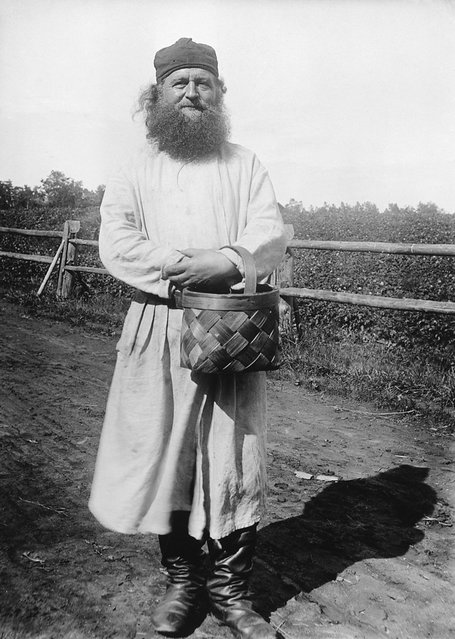
Priest, Valamo Monastery, Karelia, Russia (then Finland), 1930s. Father Venerius with a birchbark basket. (Photo by Einar Erici)

“Einar Erici (1885–1965) was a physician by profession, working at a tuberculosis hospital in Stockholm, even running a private medical practice. He was by then the most renowned Swedish expert of church organs and organ builders, and his archival collection is today held by the Swedish National Heritage Board. This archive includes mostly writings, such as letters and manuscripts for published articles and essays, but also more than 2 000 black and white photos – original prints, glass plates and film negatives”. – Swedish National Heritage Board

Photo: Priest, Valamo Monastery, Karelia, Russia (then Finland), 1930s. Father Venerius with a birchbark basket. (Photo by Einar Erici)
Details
09 Dec 2012 11:41:00
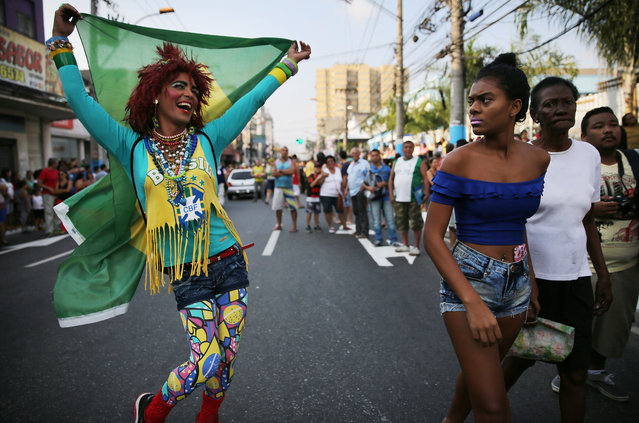
A fan waves a Brazilian flag before the arrival of the Olympic torch ahead of the Rio 2016 Olympic Games on August 2, 2016 in Sao Goncalo, Rio de Janeiro state, Brazil. The torch will arrive in the city of Rio tomorrow and the Games commence on August 5. (Photo by Mario Tama/Getty Images)

A fan waves a Brazilian flag before the arrival of the Olympic torch ahead of the Rio 2016 Olympic Games on August 2, 2016 in Sao Goncalo, Rio de Janeiro state, Brazil. The torch will arrive in the city of Rio tomorrow and the Games commence on August 5. (Photo by Mario Tama/Getty Images)
Details
04 Aug 2016 12:44:00
Japanese professional wrestler Hiromu Takahashi attends a promotional event of a dinosaur show “Dino Safari Gigant” in Tokyo on Wednesday, August 2, 2023. A dinosaur show using dinosaur shaped mrchanical suits will be performed in Yokohama from August 10. (Photo by Yoshio Tsunoda/AFLO/Rex Features/Shutterstock)

Japanese professional wrestler Hiromu Takahashi attends a promotional event of a dinosaur show “Dino Safari Gigant” in Tokyo on Wednesday, August 2, 2023. A dinosaur show using dinosaur shaped mrchanical suits will be performed in Yokohama from August 10. (Photo by Yoshio Tsunoda/AFLO/Rex Features/Shutterstock)
Details
08 Aug 2023 00:41:00
A dog wearing a hat, a pair of sunglass and a lei standing in a fountain of water on August 5, 2022 in Hong Kong, China. The Hong Kong SongKran Festival will be held in a shopping centre from August 5 to 9. (Photo by Vernon Yuen/Rex Features/Shutterstock)

A dog wearing a hat, a pair of sunglass and a lei standing in a fountain of water on August 5, 2022 in Hong Kong, China. The Hong Kong SongKran Festival will be held in a shopping centre from August 5 to 9. (Photo by Vernon Yuen/Rex Features/Shutterstock)
Details
09 Aug 2022 05:11:00
MELBOURNE, AUSTRALIA - AUGUST 10:  Miranda Kerr poses at the David Jones Spring/Summer fashion preview on Burke Street on August 10, 2011 in Melbourne, Australia.  (Photo by Lucas Dawson)

Miranda Kerr poses at the David Jones Spring/Summer fashion preview on Burke Street on August 10, 2011 in Melbourne, Australia. (Photo by Lucas Dawson)
Details
21 Aug 2012 10:48:00
A girl of the Amazonian Tatuyo tribe poses while waiting to sell crafts to tourists in her village in the Rio Negro (Black River) near Manaus city, a World Cup host city, June 23, 2014. Because of their proximity to host city Manaus and their warm welcome, the Tatuyo have enjoyed three weeks of brisk business thanks to the World Cup. Usually, they host between 10 and 30 tourists a day. During the World Cup, this number has rocketed to 250 a day, They have become richer and other communities now come to them to sell them juices and fishes. (Photo by Andres Stapff/Reuters)

A girl of the Amazonian Tatuyo tribe poses while waiting to sell crafts to tourists in her village in the Rio Negro (Black River) near Manaus city, a World Cup host city, June 23, 2014. Because of their proximity to host city Manaus and their warm welcome, the Tatuyo have enjoyed three weeks of brisk business thanks to the World Cup. Usually, they host between 10 and 30 tourists a day. During the World Cup, this number has rocketed to 250 a day, They have become richer and other communities now come to them to sell them juices and fishes. (Photo by Andres Stapff/Reuters)
Details
27 Jun 2014 10:30:00
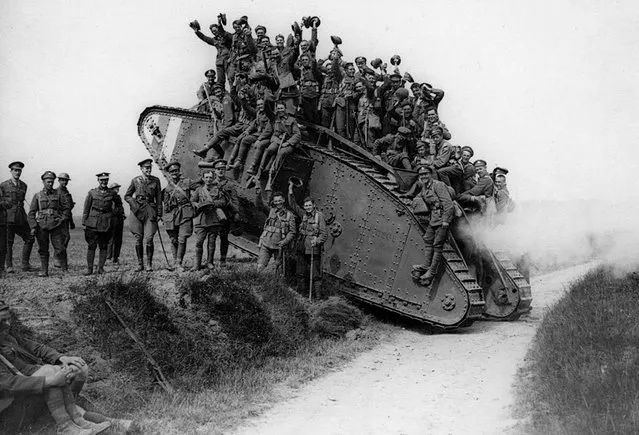
These black-and-white photos are taken from the new book “Armoured Warfare in the First World War 1916 – 1918” by Anthony Tucker-Jones and published by Pen & Sword Military. “Interestingly the British, French and Germans took completely different approaches with varying results”. The British military produced “Little Willie” in Autumn 1915 weighing 18 tonnes, which had a crew of two plus four gunners. “Inspired by a tracked artillery tractor “Little Willie” was referred to as a water tank – hence the name tank – to ensure secrecy”, said Anthony. “This led to the strange looking Mark I with its peculiar rhomboid shape, designed to cross trenches with guns in sponsons on either side. The Germans saw the tank as unchivalrous and were slow to grasp its utility. They favoured the Stormtrooper (specialist soldiers used to infiltrate enemy trenches) and artillery, not the tank”, said Anthony. “However, they didn’t hesitate to make use of captured British tanks. Although the tank helped secure victory and German soldiers dubbed it “Germany’s Downfall” the country was ultimately brought to its knees by the Allies blockade”. Here: British troops hitch a ride on a Mark IV after the massed tank fleet spearheading attack at Cambrai on November 20, 1917. (Photo by Anthony Tucker-Jones/Mediadrumworld.com)

These black-and-white photos are taken from the new book “Armoured Warfare in the First World War 1916 – 1918” by Anthony Tucker-Jones and published by Pen & Sword Military. Here: British troops hitch a ride on a Mark IV after the massed tank fleet spearheading attack at Cambrai on November 20, 1917. (Photo by Anthony Tucker-Jones/Mediadrumworld.com)
Details
23 Feb 2017 00:02:00