Loading...
Done
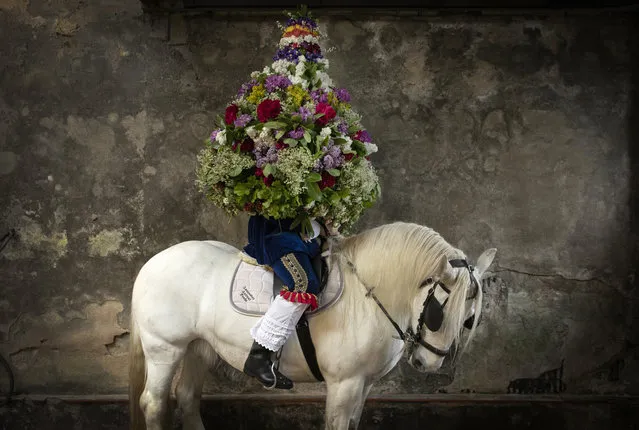
“The King”, Johnathon Haddock poses for a portrait with the Garland before the procession during “Castleton Garland Day” on May 29, 2019 in Castleton, England. The first records of Garland day date back to the 1700's and though it's true origins are not fully understood it is believed to be an ancient fertility rite with Celtic connections. The celebration also incorporates more recent elements of 'Oak Apple Day' which falls on May 29th, and celebrates the restoration of the monarchy in 1660. The garland is a framework of cut flowers which is prepared on the day by villagers before being placed on the head of the “King”, and paraded around the town on horseback with his “Consort”, also on horseback, dressed in Stuart costume. (Photo by Dan Kitwood/Getty Images)

“The King”, Johnathon Haddock poses for a portrait with the Garland before the procession during “Castleton Garland Day” on May 29, 2019 in Castleton, England. The first records of Garland day date back to the 1700's and though it's true origins are not fully understood it is believed to be an ancient fertility rite with Celtic connections. (Photo by Dan Kitwood/Getty Images)
Details
01 Jun 2019 00:07:00
“The sustainable development goals cannot be met unless waste management is addressed as a priority”, says UK waste management charity Waste Aid. “E-waste is one of the fastest growing categories of the 7-10bn tonnes of waste produced globally every year”, adds director Mike Webster. “In our view, decent waste management is a basic right and we want governments around the world take this issue much more seriously – in 2012 only 0.2% of international aid went on improving solid waste management – it’s just not enough”. (Photo by Kai Loeffelbein/laif Agentur)

Sustainable development goal target 12.5 is to reduce waste. But with a planet increasingly dependent on technology, is that even possible? As of today, over 30m tonnes of electronic waste has been thrown out so far this year, according to the World Counts. Most e-waste is sent to landfills in Asia and Africa where it is recycled by hand, exposing the people who do it to environmental hazards. Kai Loeffelbein’s photographs of e-waste recycling in Guiyu, southern China show what happens to discarded computers. (Photo by Kai Loeffelbein/laif Agentur)
Details
19 Oct 2016 12:14:00
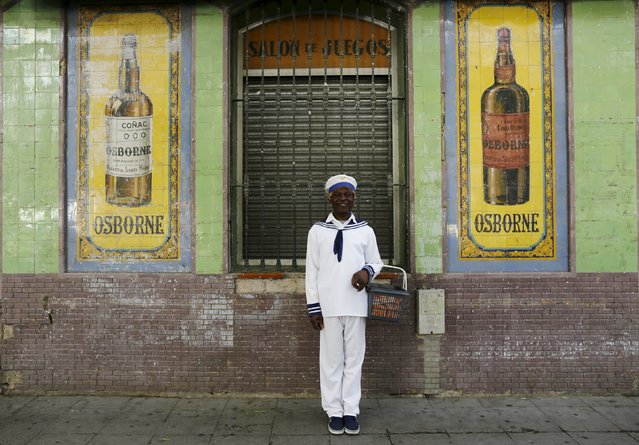
Howard Jackson, a Liberian migrant, poses for a portrait in the Andalusian capital of Seville, southern Spain March 7, 2016. (Photo by Marcelo del Pozo/Reuters)

Howard Jackson, a Liberian migrant, poses for a portrait in the Andalusian capital of Seville, southern Spain March 7, 2016. Jackson escaped civil war and spent three years crossing Africa before reaching Spain. Dressed up in one of his more than 200 costumes, from Peter Pan to Little Red Riding Hood, he is a well-known figure at an intersection entering the Spanish city of Seville where he has sold tissues to motorists for over a decade. Jackson is studying law and wants to become a judge. (Photo by Marcelo del Pozo/Reuters)
Details
24 Mar 2016 12:14:00
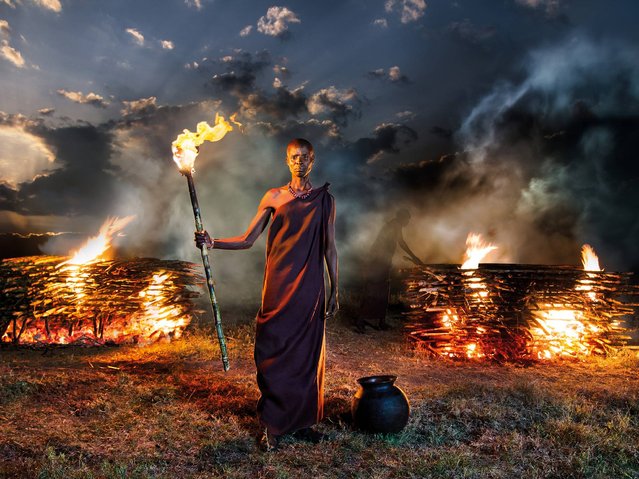
“The Salt of the Presidium”. Andrew Wanyonyi Sikanga is a salt producer in Nabuyole, western Kenya, who produces salt from an aquatic plant. (Photo by Steve McCurry/2015 Lavazza Calendar)

Extraordinary tales of everyday heroism have been illustrated beautifully by renowned US photographer Steve McCurry in the new 2015 Lavazza Calendar. The calendar which has been created in collaboration with the Slow Food movement, features twelve breathtaking pictures, capturing the spirit, strength and humanity of the Earth Defenders – women and men who protect their land and projects in Africa with passion and bravery. The proceeds from sales of the calendar and all donations will be contributed entirely to create 10,000 food gardens in African schools and villages by the end of 2016. (Photo by Steve McCurry/2015 Lavazza Calendar)
Details
27 Oct 2014 12:08:00
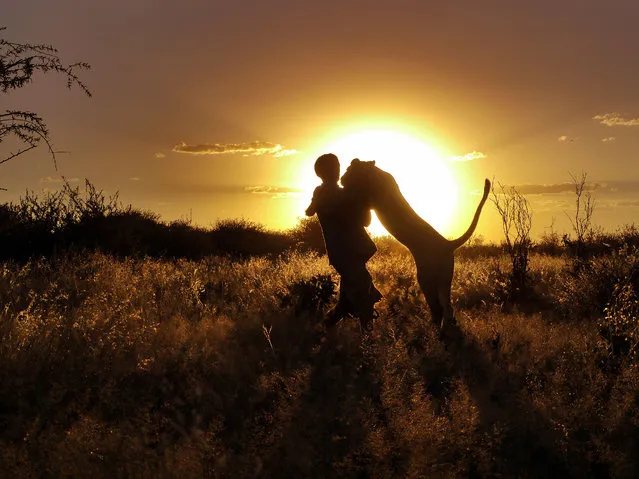
These heart-warming photograph show an incredible bond between a wild lioness and the men fighting to save her species. The picture show Sirga – a 110lb lioness – and her adopted pride Valentin Gruener (not pictured) and Mikkel Legarth. Incredibly she treats the two men just like she would other lions and with their help she can now hunt for prey on her own. (Photo by Caters News)

These heart-warming photograph show an incredible bond between a wild lioness and the men fighting to save her species. The picture show Sirga – a 110lb lioness – and her adopted pride Valentin Gruener (not pictured) and Mikkel Legarth. Incredibly she treats the two men just like she would other lions and with their help she can now hunt for prey on her own. As a cub she was driven out from a pride and rescued by German and Danish duo Valentin and Mikkel who could not stand by and watch her die. She is now a beacon for hoped success of the Modisa Wildlife Project, founded in Botswana, Africa, by Valentin and Mikkel with the hope of saving the lion population. (Photo by Caters News)
Details
27 Apr 2014 09:36:00
Devil's Pool – Victoria Falls, Zambia. (Photo by Siena College Study Abroad)

“The Victoria Falls or Mosi-oa-Tunya is a waterfall located in southern Africa on the Zambezi River between the countries of Zambia and Zimbabwe. A famous feature is a naturally formed pool known as the Devil's Pool, near the edge of the falls, accessed via Livingstone Island in Zambia. When the river flow is at a certain level, usually during the months of September to December, a rock barrier forms a pool with little current; some people swim in the pool. Occasional deaths have been reported when people slip over the edge of the rock barrier”. – Wikipedia

Photo: Devil's Pool – Victoria Falls, Zambia. (Photo by Siena College Study Abroad)
Details
13 Dec 2012 12:46:00
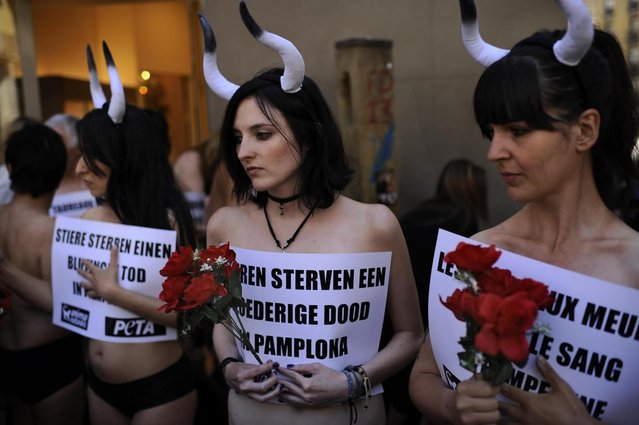
Anti-bullfighting demonstrators protest  against the bulls runs, on the Ayuntamiento Square in Pamplona northern Spain on Friday July 5, 2013. On July 6, the San Fermin festival will begin with the ''txupinazo'' , the opening ceremony with people participating in bull runs, music and dance, through the old street of the city. (AP Photo/Alvaro Barrientos)

Anti-bullfighting demonstrators protest against the bulls runs, while standing in cardboard coffins and holding red flowers, on the Ayuntamiento Square in Pamplona northern Spain on Friday July 5, 2013. On July 6, the San Fermin festival will begin with the “txupinazo” , the opening ceremony with people participating in bull runs, music and dance, through the old street of the city. (Photo by Alvaro Barrientos/AP Photo)
Details
07 Jul 2013 09:52:00
A “Maya” girl sits in an altar during the traditional celebration of “Las Mayas” on the streets in Madrid, Spain Sunday, May 10, 2015. The festivity of the Maya comes from pagan rites and dates from the medieval age, appearing in ancient documents. It takes place every year in the beginning of May and celebrates the beginning of the spring. (Photo by Daniel Ochoa de Olza/AP Photo)

A “Maya” girl sits in an altar during the traditional celebration of “Las Mayas” on the streets in Madrid, Spain Sunday, May 10, 2015. The festivity of the Maya comes from pagan rites and dates from the medieval age, appearing in ancient documents. It takes place every year in the beginning of May and celebrates the beginning of the spring. Girls between 7 and 11 years old are chosen as “Maya” and should sit still, serious and quiet for a couple of hours in altars on the street decorated with flowers and plants and afterwards they walk to the church with their family where they attend a ceremony. (Photo by Daniel Ochoa de Olza/AP Photo)
Details
14 May 2015 11:12:00