Loading...
Done
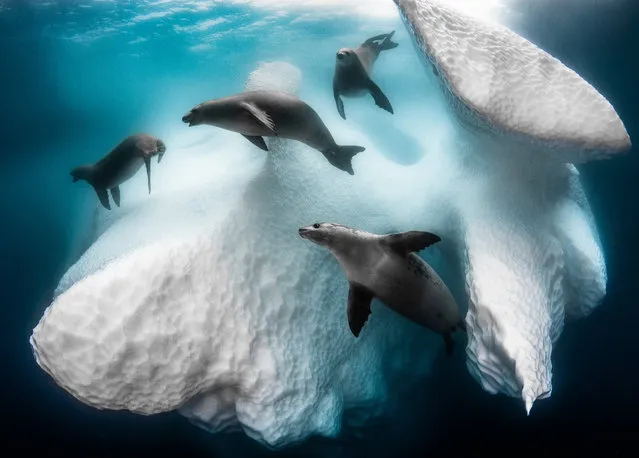
Underwater photographer of the year 2020 and wide angle category winner: Frozen Mobile Home by Greg Lecoeur (France) in the Antarctic peninsula, Antarctica. Crabeater seals swim around an iceberg. These massive and mysterious habitats are dynamic kingdoms that support marine life. As they swing and rotate slowly through polar currents, icebergs fertilise the oceans by carrying nutrients from land that spark blooms of phytoplankton, fundamental to the carbon cycle. (Photo by Greg Lecoeur/Underwater Photographer of the Year 2020)

Underwater photographer of the year 2020 and wide angle category winner: Frozen Mobile Home by Greg Lecoeur (France) in the Antarctic peninsula, Antarctica. Crabeater seals swim around an iceberg. These massive and mysterious habitats are dynamic kingdoms that support marine life. As they swing and rotate slowly through polar currents, icebergs fertilise the oceans by carrying nutrients from land that spark blooms of phytoplankton, fundamental to the carbon cycle. (Photo by Greg Lecoeur/Underwater Photographer of the Year 2020)
Details
28 Feb 2020 00:05:00
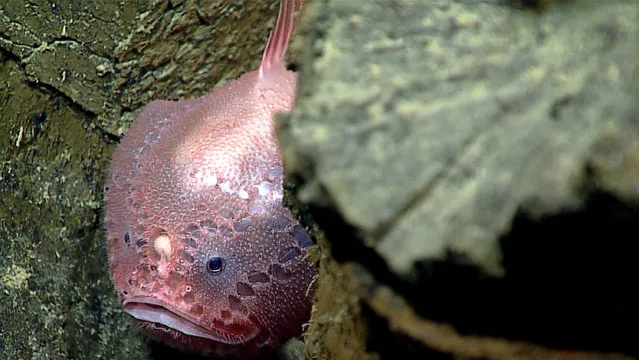
This April 30, 2016 image made available by NOAA shows a deep sea anglerfish living between pillow basalt rock formations, during a deepwater exploration of the Marianas Trench Marine National Monument area in the Pacific Ocean near Guam and Saipan. The ambush predator waits for prey to be attracted by its lure, located between its eyes, and gulps it with its large mouth. (Photo by NOAA Office of Ocean Exploration and Research via AP Photo)

This April 30, 2016 image made available by NOAA shows a deep sea anglerfish living between pillow basalt rock formations, during a deepwater exploration of the Marianas Trench Marine National Monument area in the Pacific Ocean near Guam and Saipan. The ambush predator waits for prey to be attracted by its lure, located between its eyes, and gulps it with its large mouth. (Photo by NOAA Office of Ocean Exploration and Research via AP Photo)
Details
21 Oct 2016 12:30:00
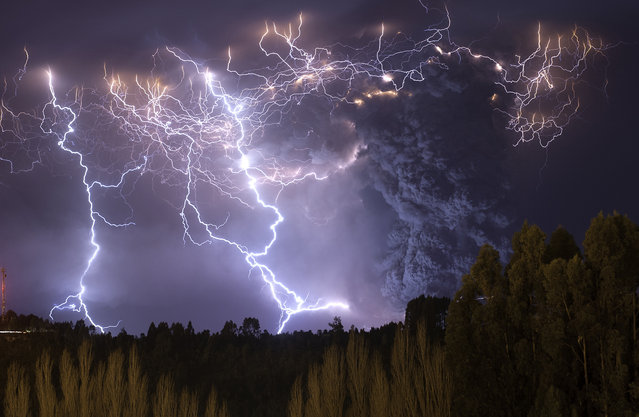
The eruption of Cordon Caulle began on June 4, 2011, located in the Region of Los Rios in Chile. For about 12 months, people and animals became accustomed to living with the daily fall of ash, which also caused problems in the air traffic in South America. The explosions and lightning during first days of the eruption could be seen from hundreds of miles around. This photograph was taken on the second night of eruption from the town of Lago Ranco. (Photo and caption by Francisco Negroni/National Geographic Traveler Photo Contest)

The eruption of Cordon Caulle began on June 4, 2011, located in the Region of Los Rios in Chile. For about 12 months, people and animals became accustomed to living with the daily fall of ash, which also caused problems in the air traffic in South America. The explosions and lightning during first days of the eruption could be seen from hundreds of miles around. This photograph was taken on the second night of eruption from the town of Lago Ranco. (Photo and caption by Francisco Negroni/National Geographic Traveler Photo Contest)

ATTENTION! All pictures are presented in high resolution. To see Hi-Res images – just TWICE click on any picture. In other words, click small picture – opens the BIG picture. Click BIG picture – opens VERY BIG picture.
Details
23 Jun 2013 11:24:00
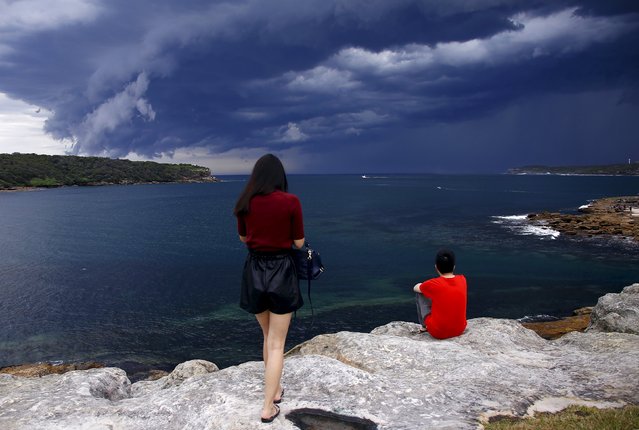
Chinese tourists watch storm clouds moving along the coast towards the city of Sydney, Australia, November 6, 2015. Powerful storms swept across the city on Friday, with the Australian Bureau of Meteorology issuing a warning for severe thunderstorms with large hailstones, heavy rainfall and damaging winds, local media reported. (Photo by David Gray/Reuters)

Chinese tourists watch storm clouds moving along the coast towards the city of Sydney, Australia, November 6, 2015. Powerful storms swept across the city on Friday, with the Australian Bureau of Meteorology issuing a warning for severe thunderstorms with large hailstones, heavy rainfall and damaging winds, local media reported. (Photo by David Gray/Reuters)
Details
08 Nov 2015 08:07:00
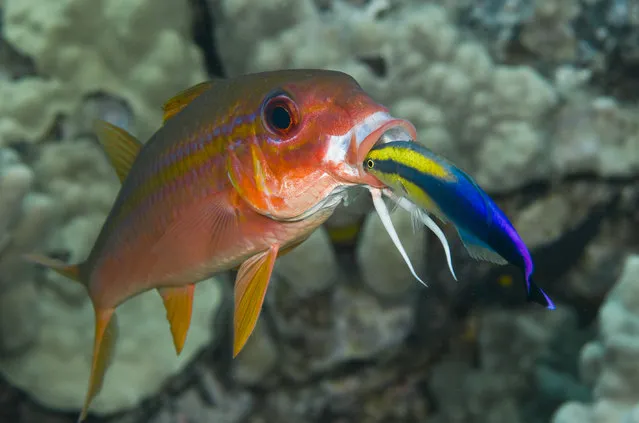
A Hawaiian cleaner wrasse provides its cleaning services to a yellowfin goatfish in a reef community off the Big Island in Hawaii. Cleaner species help rid their hosts of ectoparasites, dead tissue, bacteria and fungi. Studies have shown cleaning to play a vital role in keeping many reef ecosystems healthy. (Photo by Marty Snyderman/Caters News Agency)

A Hawaiian cleaner wrasse provides its cleaning services to a yellowfin goatfish in a reef community off the Big Island in Hawaii. Cleaner species help rid their hosts of ectoparasites, dead tissue, bacteria and fungi. Studies have shown cleaning to play a vital role in keeping many reef ecosystems healthy. (Photo by Marty Snyderman/Caters News Agency)
Details
21 Mar 2018 00:05:00
Devotees ride on the roof of a train as they return to the city after attending the final prayers on the first phase of Bishwa Ijtema in Dhaka January 11, 2015. Hundreds of thousands of pilgrims congregated in the Bangladeshi capital Dhaka as the first phase of this year's Bishwa Ijtema, one of the biggest Islamic gatherings in the world after the Haj in Saudi Arabia, came to an end. (Photo by Reuters/Stringer)

Devotees ride on the roof of a train as they return to the city after attending the final prayers on the first phase of Bishwa Ijtema in Dhaka January 11, 2015. Hundreds of thousands of pilgrims congregated in the Bangladeshi capital Dhaka as the first phase of this year's Bishwa Ijtema, one of the biggest Islamic gatherings in the world after the Haj in Saudi Arabia, came to an end. (Photo by Reuters/Stringer)
Details
17 Jan 2015 12:10:00
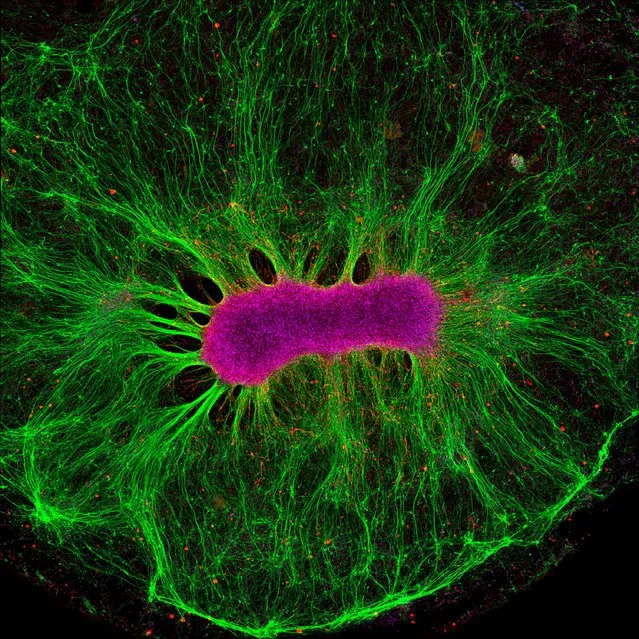
Brain-on-a-chip. Dazzling in green and magenta this image shows the nerve fibres (in green) produced by neural stem cells (in magenta) as they grow on a synthetic gel. Captured by a technique known as confocal microscopy, the image is part of research shedding light on how tinkering with the environment can affect the way in which nerve fibres grow. (Photo by Collin Edington and Iris Lee/Massachusetts Institute of Technology/Wellcome Images)

Brain-on-a-chip. Dazzling in green and magenta this image shows the nerve fibres (in green) produced by neural stem cells (in magenta) as they grow on a synthetic gel. Captured by a technique known as confocal microscopy, the image is part of research shedding light on how tinkering with the environment can affect the way in which nerve fibres grow. (Photo by Collin Edington and Iris Lee/Massachusetts Institute of Technology/Wellcome Images)
Details
17 Mar 2017 00:01:00
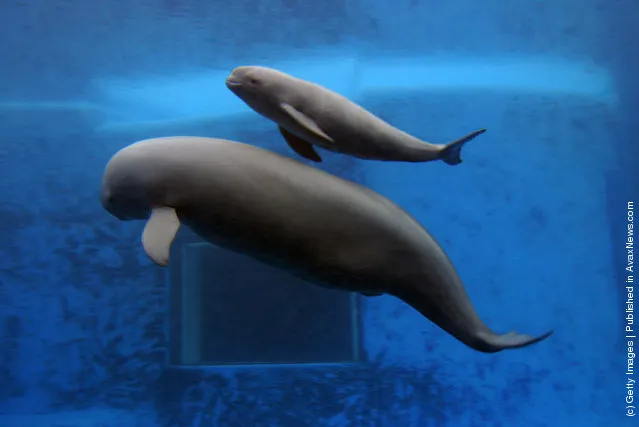
A newly born Yangtze finless porpoise (top) swims with his mother at the Hydrobiology Institute of the Chinese Academy of Sciences

“The finless porpoise (Neophocaena phocaenoides) is one of six porpoise species. In the waters around Japan, at the northern end of its range, it is known as the sunameri. A freshwater population found in the Yangtze River in China is known locally as the jiangzhu or «river pig»”. – Wikipedia

Photo: A newly born Yangtze finless porpoise (top) swims with his mother at the Hydrobiology Institute of the Chinese Academy of Sciences on June 3, 2007 in Wuhan of Hubei Province, China. (Photo by China Photos/Getty Images)
Details
20 Feb 2012 12:23:00