Loading...
Done
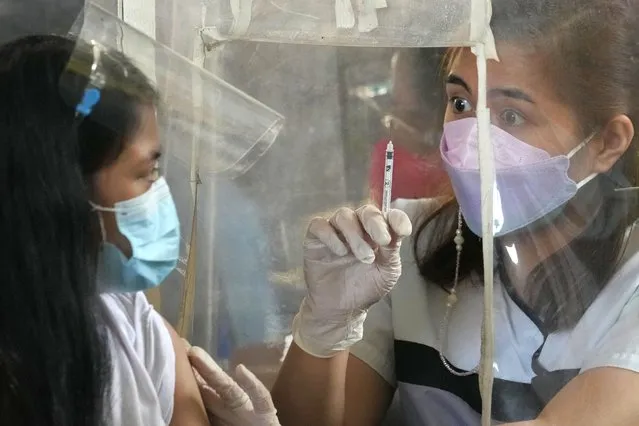
A health worker shows an empty syringe after inoculating a woman with AstraZeneca's COVID-19 vaccine during the first day of a nationwide three-day vaccination drive at a school in Quezon city, Philippines on Monday, November 29, 2021. There has been no reported infection so far caused by the new variant in the Philippines, a Southeast Asian pandemic hotspot where COVID-19 cases have considerably dropped to below 1,000 each day in recent days, but the emergence of the Omicron variant has set off a new alarm. (Photo by Aaron Favila/AP Photo)

A health worker shows an empty syringe after inoculating a woman with AstraZeneca's COVID-19 vaccine during the first day of a nationwide three-day vaccination drive at a school in Quezon city, Philippines on Monday, November 29, 2021. There has been no reported infection so far caused by the new variant in the Philippines, a Southeast Asian pandemic hotspot where COVID-19 cases have considerably dropped to below 1,000 each day in recent days, but the emergence of the Omicron variant has set off a new alarm. (Photo by Aaron Favila/AP Photo)
Details
30 Nov 2021 08:56:00
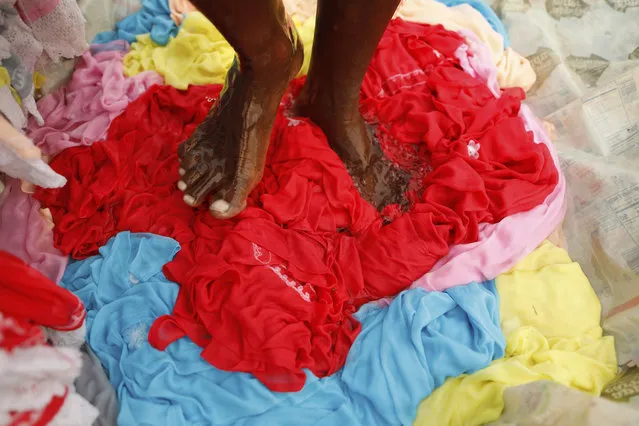
A dhobi, or a washerman washes cloths on the banks of the River Gomti in Lucknow, India, Saturday, September 12, 2020. Dhobis are traditional laundry workers who wash clothes by hand and dry them in the sun, an occupation which has been in existence for generations. Most cities in India have a Dhobi Ghat, or washermen's area, where the city's pile of clothes is laundered. This practice is still popular in India, despite of modern technology. Around 1,000 families work in Lucknow's Dhobi Ghat. However, in light of the novel coronavirus, their wages have decreased drastically. With each family earning around US$100-200 per month. (Photo by Rajesh Kumar Singh/AP Photo)

A dhobi, or a washerman washes cloths on the banks of the River Gomti in Lucknow, India, Saturday, September 12, 2020. Dhobis are traditional laundry workers who wash clothes by hand and dry them in the sun, an occupation which has been in existence for generations. Most cities in India have a Dhobi Ghat, or washermen's area, where the city's pile of clothes is laundered. This practice is still popular in India, despite of modern technology. Around 1,000 families work in Lucknow's Dhobi Ghat. However, in light of the novel coronavirus, their wages have decreased drastically. With each family earning around US$100-200 per month. (Photo by Rajesh Kumar Singh/AP Photo)
Details
25 Sep 2020 00:03:00
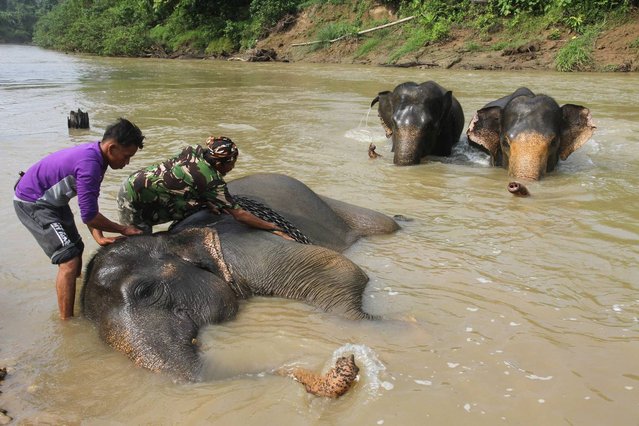
Indonesian mahouts (elephant masters) bathe elephants prior to a daily patrol at a Conservation Respons Unite (CRU) to control elephant-human conflicts in Serbajadi, East Aceh on April 7, 2016. Elephants have joined the front line in the fight against poaching and illegal logging in the dense jungles of Sumatra. Guided by their Indonesian mahouts, they trek alongside rivers, over rough terrain and deep into the rainforest in an area that is home to numerous endangered species, from orangutans to tigers, but which has suffered devastating deforestation in recent years. (Photo by AFP Photo/Januar)

Indonesian mahouts (elephant masters) bathe elephants prior to a daily patrol at a Conservation Respons Unite (CRU) to control elephant-human conflicts in Serbajadi, East Aceh on April 7, 2016. Elephants have joined the front line in the fight against poaching and illegal logging in the dense jungles of Sumatra. Guided by their Indonesian mahouts, they trek alongside rivers, over rough terrain and deep into the rainforest in an area that is home to numerous endangered species, from orangutans to tigers, but which has suffered devastating deforestation in recent years. (Photo by AFP Photo/Januar)
Details
11 Apr 2016 10:24:00
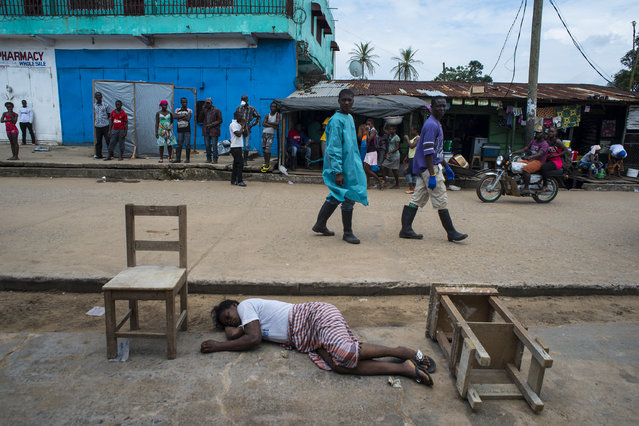
A woman lays dead outside the Redemption Hospital on Saturday September 20, 2014 in Monrovia, Liberia. Ebola patients come to the hospital, which has become a transfer and holding center to intake Ebola patients, but there is no space and some die while waiting outside. Redemption is located in one of the poorest neighborhoods of Monrovia that locals call "New Kru Town”. (Photo by Michel du Cille/The Washington Post)

A woman lays dead outside the Redemption Hospital on Saturday September 20, 2014 in Monrovia, Liberia. Ebola patients come to the hospital, which has become a transfer and holding center to intake Ebola patients, but there is no space and some die while waiting outside. Redemption is located in one of the poorest neighborhoods of Monrovia that locals call "New Kru Town”. Health workers are overwhelmed with a constant stream of new patients since the Ebola outbreak. (Photo by Michel du Cille/The Washington Post)
Details
16 Oct 2014 12:59:00
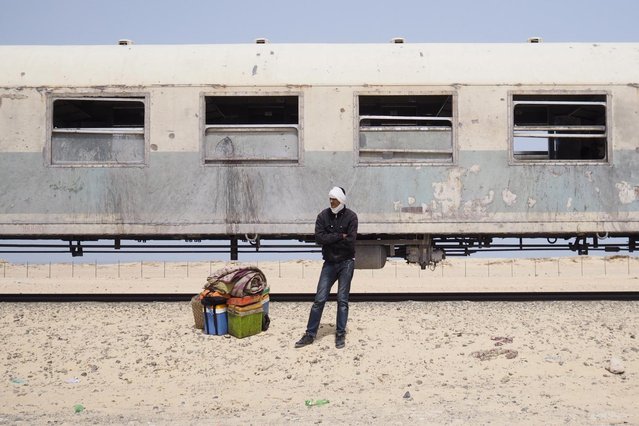
A passenger on a SNIM train carrying iron ore and mine workers waits for transport after arriving in Nouadhibou June 25, 2014. (Photo by Joe Penney/Reuters)

A passenger waits after his train arrived in Nouadhibou, Mauritania’s second largest city and the main export port for the country’s iron ore industry, on June 25, 2014. The mining company’s employees proudly call their firm the lung of their nation's economy and the train that ferries the ore to the coast stretches some two kilometres, making it one of the world's longest. SNIM mines black iron ore in the northern town of Zouerate, a remote desert location which nevertheless attracts people from all over the country looking for work. (Photo by Joe Penney/Reuters)
Details
27 Oct 2014 11:51:00
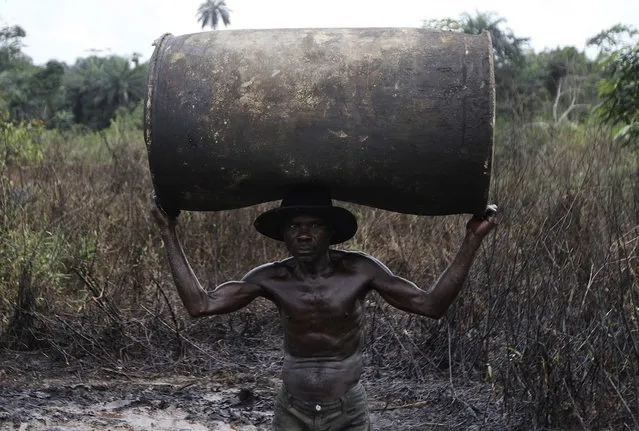
Ebiowei, 48, carries an empty oil container on his head to a place where it would be filled with refined fuel at an illegal refinery site near river Nun in Nigeria's oil state of Bayelsa November 27, 2012. (Photo by Akintunde Akinleye/Reuters)

Ebiowei, 48, carries an empty oil container on his head to a place where it would be filled with refined fuel at an illegal refinery site near river Nun in Nigeria's oil state of Bayelsa November 27, 2012. Locals in the industry say workers can earn $50 to $60 a day. Thousands of people in Nigeria engage in a practice known locally as “oil bunkering” – hacking into pipelines to steal crude then refining it or selling it abroad. The practice, which leaves oil spewing from pipelines for miles around, managed to lift around a fifth of Nigeria's two million barrel a day production last year according to the finance ministry. (Photo by Akintunde Akinleye/Reuters)
Details
18 Jan 2013 14:29:00
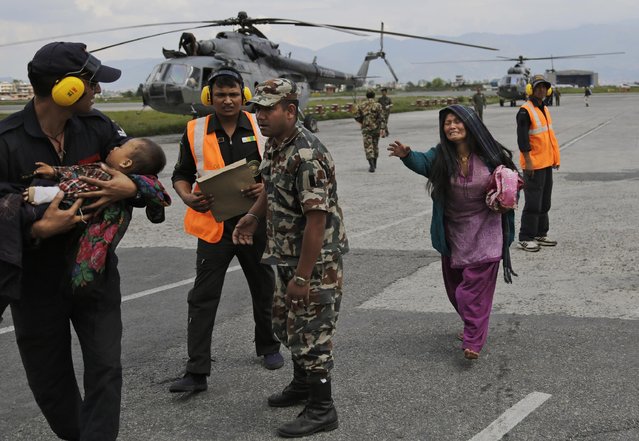
An Indian Air Force person walks carrying a Nepalese child, wounded in Saturday's earthquake, to a waiting ambulance as the mother rushes to join after they were evacuated from a remote area at the airport in Kathmandu, Nepal, Monday, April 27, 2015. (Photo by Altaf Qadri/AP Photo)

An Indian Air Force person walks carrying a Nepalese child, wounded in Saturday's earthquake, to a waiting ambulance as the mother rushes to join after they were evacuated from a remote area at the airport in Kathmandu, Nepal, Monday, April 27, 2015. The death toll from Nepal's earthquake is expected to rise depended largely on the condition of vulnerable mountain villages that rescue workers were still struggling to reach two days after the disaster. (Photo by Altaf Qadri/AP Photo)
Details
28 Apr 2015 13:52:00
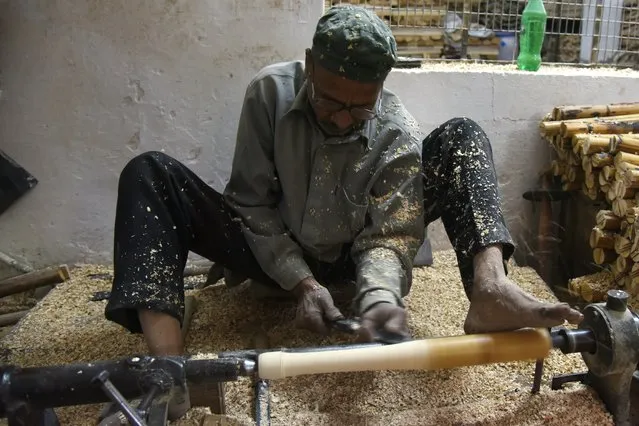
In this photograph taken on December 14, 2016, an Indian craftsman works on unfinished cricket bats in a factory in Meerut, some 70 kms north- east of New Delhi. As Indian factory worker Jitender Singh carves out another big- hitting slab of thick willow he insists MCC proposals to limit the size of cricket bats won' t tame Twenty20 marauders. “I don' t think the thickness matters. It' s more about the balance of the bat and the talent of the batsman”, says Singh, who has made bats for many stars, including South Africa's AB de Villiers. The World Cricket committee of the MCC, the guardians of the game, recommended in December 2016 that limitations be placed on the width and depth of bats because it had become too easy to smash fours and sixes. (Photo by Dominique Faget/AFP Photo)

In this photograph taken on December 14, 2016, an Indian craftsman works on unfinished cricket bats in a factory in Meerut, some 70 kms north- east of New Delhi. (Photo by Dominique Faget/AFP Photo)
Details
11 Jan 2017 14:32:00